Opinions on Further Promoting the Implementation of the 'Shanghai Standards' Marking System
Opinions on Further Promoting the Implementation of the 'Shanghai Standards' Marking System
With a view to further implementing the "Shanghai Standards" marking system, building a high-level Shanghai Standards brand, and accelerating the construction of an international standardization highland, these Opinions are formulated in accordance with the Standardization Law of the People’s Republic of China, the Regulations of Shanghai Municipality on Standardization, and the Provisions of Shanghai Municipality on Promoting the Innovative Development of Standardization in Pudong New Area.
I. Target, Positioning and Main Principles of the 'Shanghai Standards' Marking System
1. Target and positioning. Through further implementation of the 'Shanghai Standards' marking system, a number of Shanghai Standards that are equal to the internationally advanced levels and have a leading and exemplary role will be created to cultivate high-tech innovations of high standards, advance high-level opening up, lead high-quality development, promote more Shanghai Standards to become an important carrier of institutional opening up of standards and a reference system for international rule-making, and help build a modern socialist international metropolis with worldwide influence.
2. Main principles. The implementation of the "Shanghai Standards" marking system shall adhere to the principle of government support, market-based operation, and nongovernmental participation as well as the principle of scientificity, openness, fairness and impartiality.
II. Duties and Working System of the 'Shanghai Standards' Marking System
1. Duties. The Municipal Administration for Market Regulation shall, jointly with relevant departments, be responsible for strengthening the standardization work and improving the standardization level, leading to guide the promotion and comprehensive coordination of the implementation of the "Shanghai Standards" marking system. The district administrations for market regulation shall be responsible for the daily instruction, recommendation, guidance and encouragement of the Shanghai Standards.
The municipal and district administrations for market regulation shall take responsibility for supervising and administrating the implementation of the Shanghai Standards marking system and the use of the marks.
2. Working system. The government shall give full play to the efforts of all parties to jointly promote the implementation of the "Shanghai Standards" marking system, and improve the working system composed of the "Shanghai Standards" Marking Promotion Working Group (hereinafter referred to as the "Promotion Working Group"), the Shanghai Standards Evaluation Committee (hereinafter referred to as the "Evaluation Committee"), and professional technical evaluation institutions, and participated in by various parties in society.
The Promotion Working Group is set up under the municipal standardization work joint meeting to take charge of the guidance and comprehensive coordination of the implementation of the "Shanghai Standards" marking system, deliberate and decide on matters related to the Shanghai Standards, and guide the work of the Evaluation Committee.
The Evaluation Committee is composed of relevant professional quality and standardization institutions, units of the Secretariat of the Standardization Technical Committee, social organizations, scientific research institutions, colleges and universities, and is responsible for the organization and implementation of the "Shanghai Standards" marking system. The office set up by the Evaluation Committee (hereinafter referred to as the "Evaluation Office") shall be undertaken by the municipal public-welfare institution of quality and standardization, and its specific duties shall be prescribed by the articles of association of the Evaluation Committee.
Qualified third-party professional technical evaluation institutions are responsible for professional evaluation of Shanghai Standards, with their specific duties determined by the Evaluation Committee.
Relevant standardization technical committees, social groups, enterprise groups, scientific research institutions, various innovation platforms and other social parties are encouraged to jointly participate in the training and cultivation, recommendation, publicity and promotion, and application and implementation of Shanghai Standards.
III. Evaluation of Shanghai Standards
1. Applicants. An applicant unit voluntarily submits its application for evaluation of Shanghai Standards. Where a local standard applies for evaluation to be upgraded to a Shanghai Standard, the application may be proposed by the standard-proposing unit, or be jointly proposed by the standard-proposing unit and the main drafting unit. Where an organization standard applies for evaluation to be upgraded to a Shanghai Standard, it may be proposed by the standard publicizing unit, or be jointly proposed by the publicizing unit and the main drafting unit. Where an enterprise standard applies for evaluation to be upgraded to a Shanghai Standard, it shall be directly proposed by the enterprise; where a joint standard of enterprises in the name of a standard innovation consortia applies for evaluation to be upgraded to a Shanghai Standard, it shall be jointly proposed by the undertaking unit of the standard innovation consortia and the main drafting unit.
2. Evaluation conditions. The applicant unit shall be legally established in this Municipality, have good business or operation conditions, conform to the national and municipal industrial orientation, laws, rules, regulations and policies, and have a good social credit record.
The standards applied for evaluation and the technology, management or service mode involved in the standards should be advanced and innovative in their respective fields to reach the domestically leading level, or internationally advanced level, or fill international or domestic gaps. They should have wide influence and good implementation effects, which can lead and support the overall improvement of the industry and core competitiveness.
3. Evaluation basis. The evaluation basis of Shanghai Standards includes local standards based on DB31/T 1204 General Requirements for the Evaluation of the Standards Advancement as well as the evaluation rules in related fields. The evaluation rules shall be formulated jointly by the specialized technical evaluation institutions and relevant industries and enterprises, and shall be publicized after deliberation by the Evaluation Committee.
4. Evaluation procedure. The evaluation procedure of Shanghai Standards includes formal review, professional evaluation, social publicity, comprehensive evaluation and other processes. The evaluation result is deliberated and decided by the Evaluation Committee based on the technical opinions of the professional technical evaluation institutions, and the publicity feedback.
IV. Special Marks and Their Use
1. Mark style. The mark "上品" used in the SHANGHAI STANDARDS is composed of the Chinese character 品-shaped Bronze Vessel Scroll Pattern and accompanied by the words "上海标准 Shanghai Standard" or "Shanghai Standard". The mark color is red. Mark users can scale up or down the mark graphics, but may not change the proportionality, pattern, text and color of the graphics (see the figures below).
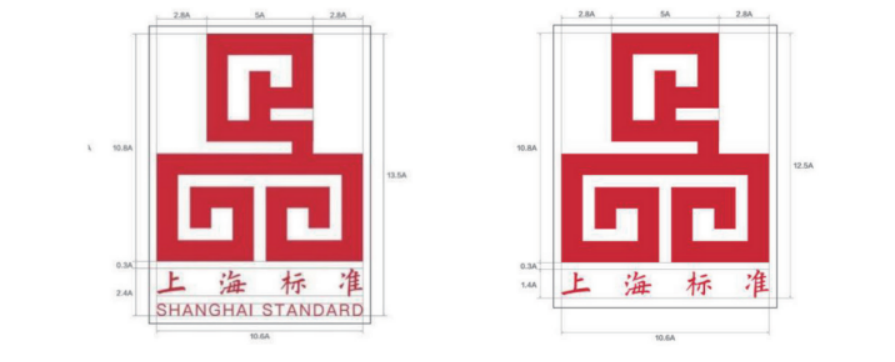
2. Use of the mark. The Evaluation Office authorized by the Municipal Administration for Market Regulation shall manage the use of the copyright and related rights and interests of the "上品" mark used in Shanghai Standards. The Evaluation Committee and the corresponding professional technical evaluation institutions shall jointly issue the Shanghai Standards identification certificate to the applicant unit whose standard project has passed the comprehensive evaluation. The Shanghai Standards special mark can be put at a fixed position of the standard text cover as required. Any product or service that implements the Shanghai Standards is allowed to add the words of Shanghai Standards when the standard number or name is publicized. The Shanghai Standards special mark may be advertised and used in production and business sites, media and public publications, and network carriers. The term of using the mark shall be three years from the date of issuance of the certificate.
3. Information disclosure and publicity. The Evaluation Office shall set up the Shanghai Standards information column and publish the Shanghai Standards catalog with other relevant information in real time. All relevant parties shall jointly promote the application and implementation of Shanghai Standards, publicize Shanghai Standards, create domestically leading and internationally advanced Shanghai Standards brand images, in order to constantly improve the public awareness and market recognition of Shanghai Standards, and give full play to the demonstrating and guiding role of Shanghai Standards.
V. Cultivation, Incubation, Supervision and Administration
1. Cultivation and incubation. The government shall set up Shanghai Standards cultivation pools, and incorporate standards on such pools. The Evaluation Office shall, together with relevant parties, organize professional teams to provide services through centralized training, key incubation and other forms for the standards incorporated on the pools to help upgrade the standards and promote the application and implementation of the standards. The requirements for the cultivation work shall be formulated separately by the Evaluation Office.
2. Follow-up assessment, withdrawal and reassessment. The Evaluation Committee shall establish a standards implementation tracking mechanism and an annual evaluation report system, while the Evaluation Office shall organize professional technical evaluation institutions to track and evaluate the implementation of the Shanghai Standards every year. Based on the follow-up evaluation, the Evaluation Office shall make recommendations for continued validity or reapplication for an evaluation. Where the main indicators or the implementation of the Shanghai Standards have affected the advanced nature of the standard, the Evaluation Committee shall make a decision to cancel the use of the mark and withdraw the certificate.
Where the advanced value of the main indicators of the Shanghai Standards or the implementation of the standards have changed, the original applicant unit shall report to the Evaluation Committee in a timely manner.
Where the term has expired and an application is needed for re-evaluation, the procedure of the re-evaluation shall be simplified. After the evaluation by a professional technical evaluation institution, the result shall be directly submitted to the Evaluation Committee for a comprehensive assessment.
3. Information disclosure supervision. The municipal and district administrations for market regulation shall incorporate the Shanghai Standards into the scope of ongoing and ex post supervision. If any standards information is found not disclosed in accordance with the Standardization Law of the People's Republic of China, the Regulations of Shanghai Municipality on Standardization, and the Provisions of Shanghai Municipality on Promoting the Innovative Development of Standardization in Pudong New Area, the Evaluation Committee and the corresponding professional technical evaluation institutions shall be urged to cancel the use of the mark and withdraw the certificate.
4. Supervision of the Evaluation Committee and the evaluation institutions. The municipal administration for market regulation and other departments shall strengthen supervision and administration of the Evaluation Committee and the professional technical evaluation institutions, urge them to implement the "Shanghai Standards" marking system in strict accordance with the evaluation standards, regulations and management requirements for professional technical evaluation institutions, and ensure that the evaluation process and results are open, fair, objective and scientific.
5. Marking supervision. Any unit or individual that forges, fraudulently uses or transfers the mark, or uses the mark to deceive or mislead the public shall be punished in accordance with relevant laws, rules and regulations.
6. Social supervision. The implementation of the "Shanghai Standards" marking system is subject to the supervision of the whole society, and any unit or individual that finds violations of laws, rules or regulations in the process may report to the municipal and district administrations for market regulation. Any professional technical evaluation institution, evaluation expert or Evaluation Committee member that is found to act illegally during the evaluation and assessment shall be held liable in accordance with law.
These Opinions shall be effective as of December 1, 2023 and remain valid until November 30, 2028.