Showcasing women's perspectives through Chinese and Spanish artists
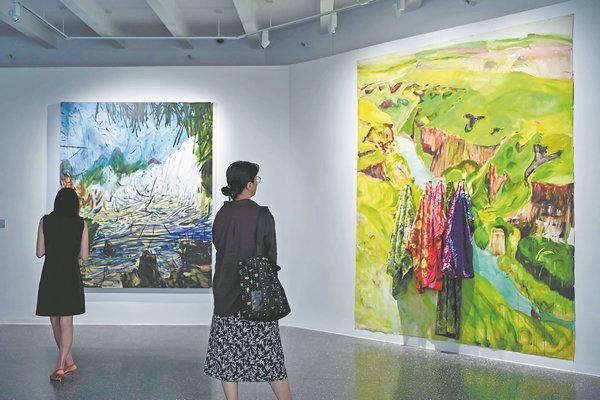
The ongoing exhibition at Jiushi Art Museum, Balada Del Ouroboros, or Ballad of the Ouroboros, marks the final chapter of the Spanish Arts Festival on the Bund in Shanghai.
The exhibition, jointly hosted by Shanghai Jiushi Art Museum and Instituto Cervantes, showcases 44 works by more than 40 female artists from China and Spain, and runs from Sept 6 to Oct 22.
The Ouroboros is a primitive serpent that devours its tail in an endless loop, and has long been a powerful symbol in both Eastern and Western cultures, embodying the mysteries of eternity, transformation, and the interconnectedness of all things, says Rosina Gomez-Baeza, the Spanish cocurator of the exhibition.
In Chinese tradition, the serpent symbolizes wisdom, metamorphosis, and introspection, heralding the power of renewal through release and rebirth. The year 2025 marks the Year of the Snake in China, giving a deeper cultural and temporal resonance to this ancient motif, according to Ma Nan, the exhibition's Chinese cocurator.
Focusing on the works of female artists from China and Spain and highlighting the role of women in contemporary art, the exhibition emphasizes the unique impact of female perspectives in the contemporary cultural landscape, Gomez-Baeza says.
The exhibition is designed in five chapters — Identity Reflection, Spatial Narratives, Versatile Tradition, Logics of Perception, and The Transformation of Matter — and features paintings, installations, videos, and works on other media by contemporary female artists born from the 1940s to the 2000s.
"We hope to present a richer perspective through the works of female artists from different cultural backgrounds and across generations," Ma told China Daily on the opening day of the exhibition.
Spanish artist Sonia Navarro presents STIRPA I, an installation made of dyed esparto and wood in the Versatile Tradition chapter. Esparto is a native plant of the Mediterranean region. The art of weaving with esparto fiber is an ancient craft dating back thousands of years.
In southeastern Spain's Valencia countryside, esparto weaving was one of the few things the older generation of women could make an income from, Navarro says. They made baskets, rugs and shoes with the flexible fiber obtained from the dried leaves. However, the tradition is now dying out. In 2019, the Spanish Ministry of Culture declared esparto tradition as an intangible cultural heritage.
By working with the traditional craft, Navarro hopes to keep its memory alive and protect its heritage.
Chen Shan, a visitor at the opening and a photographer, shares with the Spanish artist that similar grass weaving crafts are found in China. "Someone has to find new uses for traditional crafts. This is the only way to keep the beautiful heritage alive in the modern world," she says.
To celebrate the 20th anniversary of the establishment of the comprehensive, strategic partnership between China and Spain, Jiushi Art Museum kicked off the Spanish Arts Festival on the Bund in June. In addition to the opening of Balada Del Ouroboros, five exhibitions have taken place in four historical buildings on the Bund.
Three other exhibitions are still ongoing, two of which highlight Antoni Gaudi (1852-1926), the legendary Catalan architect.
Splendor to Nature: Gaudi with His Era will run till Oct 8 at Bund 18 Jiushi Art Gallery, and
Splendor Immerses Everything: Sound of Gaudi is ongoing at Jiushi Art Salon on 230 Beijing Road East.
Art Masters: A Virtual Reality Experience, featuring five masterpieces from the collection of the Prado Museum in Madrid, is running at the Shanghai Jiushi International Art Center till Oct 12.