Museum's exhibition is steady as a steed
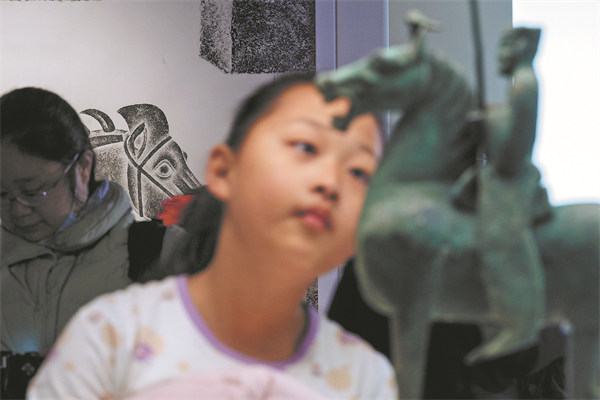
The Shanghai Museum launched the exhibition Galloping into Spring: A Celebration of the Year of the Horse at its People's Square location on Feb 4, featuring 16 horse-themed cultural relics spanning nearly a millennium.
The museum has held annual events featuring the Chinese zodiac for eight years during the Spring Festival holiday. With selected artifacts from its collection, alongside loaned pieces from counterparts across China, these exhibitions are a popular part of many museumgoers' Chinese New Year celebrations.
The horse, a symbolic animal in the Chinese zodiac, has been both a vital companion to humans and a spiritual emblem woven into the fabric of Chinese civilization, Chu Xiaobo, director of the Shanghai Museum, says in the exhibition's preface. "It served in farming and warfare, enabled postal and transport services, and embodied ceremonial grandeur and auspiciousness.
"We hope visitors find inspiration from these steeds in the spring breeze, behold the noble images of horses across the ages, and hear the resounding hoofbeats of history," he says.
The Chinese zodiac-themed exhibitions give the Shanghai Museum the opportunity to select from its collection some of its rarely shown objects, and present them to the public with new interpretations, Chu Xin, head of the museum's exhibition department, said at the exhibition opening. This year, the exhibition also features a young curatorial team and innovative scenography design.
The Six Steeds of Zhao Mausoleum, a series of rubbings from the Tang Dynasty (618-907) that have been stored in the Shanghai Museum's library for decades, are debuting in the exhibition.
The rubbings represent the great achievements of stone art during the Tang Dynasty, Chu Xin says.
The original series consists of six large limestone relief sculptures depicting the war horses of Emperor Taizong (599-649). Each steed, celebrated in poems written by the emperor, bears battle scars, commemorating its service in founding the Tang Dynasty.
While four of the reliefs are now kept at the Beilin (Stele Forest) Museum in Xi'an, Shaanxi province, two were smuggled and sold to the United States in the early 1900s and are exhibited at the Penn Museum at the University of Pennsylvania.
The rubbings vividly present the reliefs' details and serve as precious historical records, preserving the imagery of these national treasures.
Borrowed from the Xianyang Museum of Shaanxi province is the white jade sculpture Celestial Immortal Riding a Galloping Horse, dating to the Western Han Dynasty (206 BC-AD 24). A masterwork of Han Dynasty circular carving (yuandiao), this exquisite piece depicts a winged immortal astride a celestial steed. It represents the pinnacle of Han jade craftsmanship and embodies contemporary beliefs in transcendence and the pursuit of immortality, Chu Xin explains.
Among the exhibits, the Figurine of a Drum-playing Horseman from the Tang Dynasty marks recent archaeological finds in China. A loaned piece from the Gansu Institute of Cultural Relics and Archaeology, it was unearthed from a tomb of the Tuyuhun people in a village of Gansu province in 2019.
It depicts a rider in a wide-sleeved robe seated on a horse and beating a drum. Tuyuhun served as a crucial buffer zone along the Silk Road between the Tang Dynasty and the powers beyond.
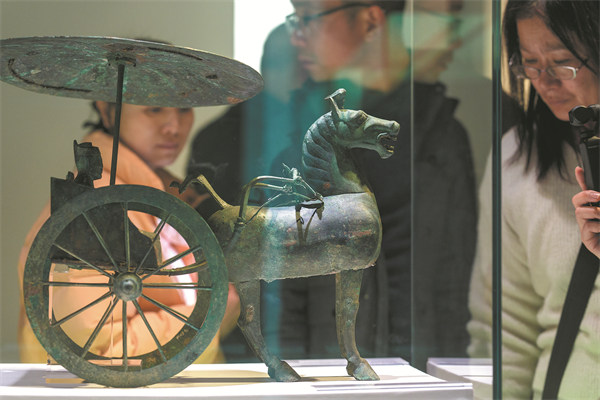
Also on display is a bronze chariot from the Leitai Tomb of the Han Dynasty in Wuwei — the same site that yielded the famed bronze sculpture, A Galloping Horse Treading on a Flying Swallow, which is a widely recognized Chinese icon.
Two bronze knights on horseback, one holding a spear and the other a ji, a weapon similar to the halberd, are from a series on loan from the Gansu Provincial Museum, inviting visitors to experience the imposing spectacle of Han chariot processions.
The Shanghai Museum selected two modern Chinese paintings from its collection: Xu Beihong's Drinking Horse and Zhang Daqian's After Cao Ba's Yu Hua Cong.
"We hope visitors will find a moment of peace and leisure, and a feel of the spring breeze in these paintings," Chu Xin says.
Tang Hanchen, a 12-year-old boy from Guangzhou, Guangdong province, was among the first visitors to the exhibition on opening day. Born in the year of the horse, the boy has a special fondness for the animal and told China Daily that the bronze knight holding a spear was his favorite piece.
When asked what quality of the horse he admires most, Hanchen gave a quick and firm reply: "Perseverance."
The exhibition runs until March 17.