Mark Greeven: Shanghai's innovation potential hinges on collaboration
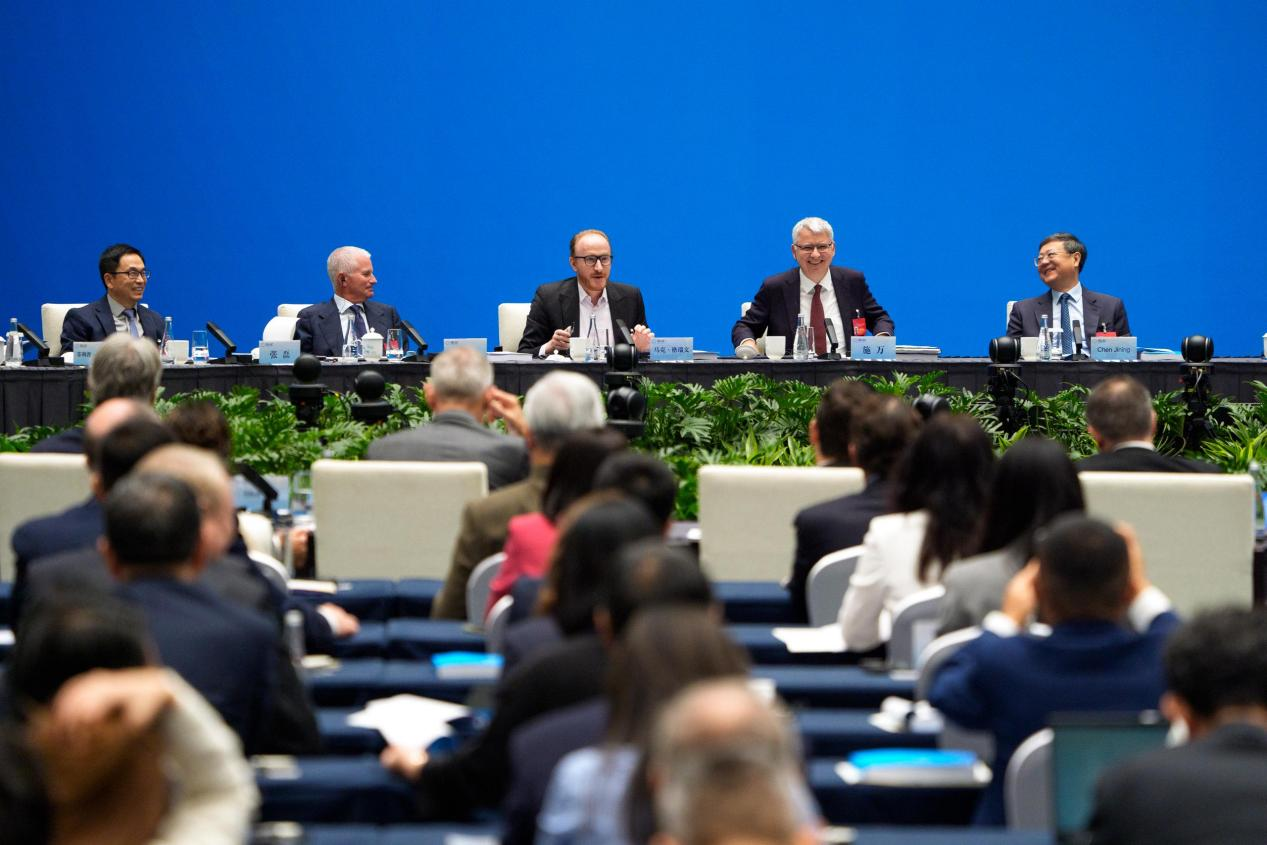
Shanghai has the potential to become a global innovation hub by fostering collaboration and orchestrating resources within its ecosystem, rather than solely focusing on rankings and inputs, according to Mark Greeven, professor of the International Institute for Management Development, speaking at the 37th annual meeting of the International Business Leaders' Advisory Council for the Mayor of Shanghai on Oct 12.
Greeven emphasized the need to move beyond viewing innovation as a collection of isolated components and instead approach it as a collaborative ecosystem. "Perhaps we need to think about not the pieces, but the system," he said, drawing inspiration from the Dutch city of Eindhoven, which successfully revitalized its economy by fostering collaboration between business, knowledge institutions, and government.
He believes Shanghai is already playing a vital role in hosting innovation and R&D, both for domestic and global enterprises.
"Shanghai is particularly well positioned to play a role in driving innovation into and from China," Greeven noted, highlighting the city's potential in areas such as biotech, advanced manufacturing, AI, and robotics.
Greeven identified four main friction points hindering Shanghai's innovation potential, one of which is data flow. "Without data, no ecosystem; without data, no AI," he explained, emphasizing the need for a trusted environment for data collaboration both within and outside of China. He suggested expanding the Lin-gang data pilot as a possible step forward.
He also stressed the importance of inclusivity, urging multinational corporations to actively participate in co-creating Shanghai's innovation environment.
"An ecosystem only works if everybody participates, and everybody means everybody," Greeven said, urging multinationals to actively co-create the environment needed for Shanghai to become a global innovation center.
Intellectual property protection remains another critical factor. While Greeven acknowledged China's progress in developing a solid IP environment, he pointed out the need for more predictability in the rules.
"China indeed provides a very, very solid IP environment today, but sometimes it's not about the actual formal protection on the books. Sometimes it's about the predictability of the rules of the game to stay stable," he said.
Greeven also addressed the challenge of scaling up innovations from pilot projects to successful businesses. He suggested leveraging the integration of the Yangtze River Delta to create platforms for Shanghai's experimental projects to expand and achieve broader impact.
He offered two key suggestions for multinational corporations: actively co-create innovation in China and learn from Chinese innovators.
"There is no place in the world where collaboration, closeness, and proximity to the customer are as crucial as in China," Greeven said, referencing a study conducted with MIT.
Addressing geopolitical complexities, Greeven cautioned against isolating regional ecosystems. Instead, he advocated for embedding locally while finding smart ways to connect regional ecosystems through talent corridors and a focus on global standard setting.
"Ecosystems thrive on interdependence," Greeven concluded, emphasizing the importance of orchestrating complementarity among different stakeholders. "There is an important role for multinationals to play, but I think there is a very, perhaps even more important role for the local government to play to orchestrate the complementarity, not the conflicts between the different players of an ecosystem."