Lula tries Shanghai-made robot in simulated remote surgery
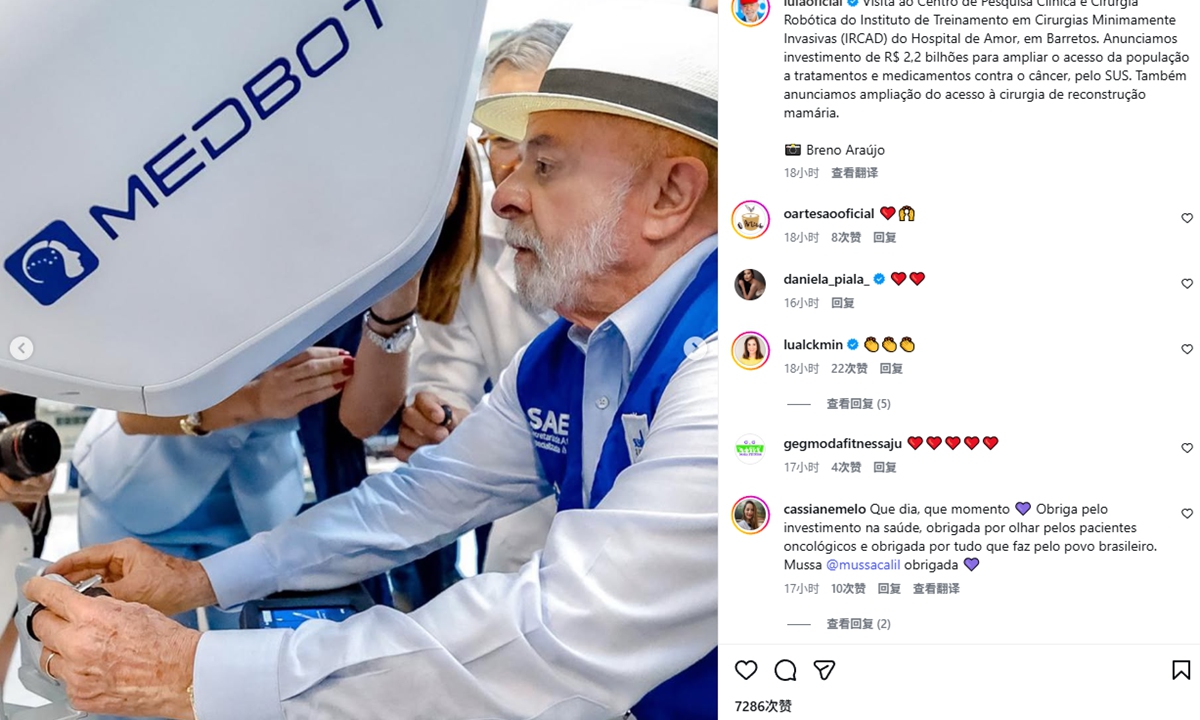
"It is incredible to see up close how innovation can expand access, save lives, and further strengthen Brazil's Unified Health System," said Brazilian President Luiz Inacio Lula da Silva recently on social media after conducting a simulated remote surgery using a China-developed surgical robot.
The devise praised by Lula was the Toumai surgical robot developed by Shanghai MicroPort MedBot. During a visit to the Barretos Cancer Hospital on May 15, Lula remotely operated a robotic arm located around 1,400 kilometers away in Salvador.
According to the Global Times, the Toumai remote surgical system has secured regulatory approval 13 countries including China and Brazil. In October 2025, Hospital Nove de Julho in Brazil completed the first commercial remote robotic surgery on a human patient in Latin America.
In February, Toumai officially entered Brazil's Unified Health System. The University of Sao Paulo (USP) Medical School carried out the first remote robotic surgeries, covering multiple specialties including urology, head and neck surgery, thoracic surgery, gynecology, and general surgery.
Brazil's Unified Health System plans to deploy the Toumai remote surgical system on a large scale, with the first clinical procedures expected to take place in July.
Eloisa Bonfa, dean of the USP Medical School, described the achievement as a landmark step for Brazil's public healthcare sector.
She said the project not only introduced world-class surgical technology to Brazil, but also established a safe, scalable and evidence-based medical service model capable of expanding access to advanced healthcare resources.
Equipped with a high-definition imaging system offering 10x optical magnification and naked-eye 3D visualization, the Toumai robot provides surgeons with enhanced precision during complex procedures. Its robotic arms feature seven degrees of freedom and can filter out surgeons' natural hand tremors, significantly improving surgical stability and accuracy.
Today, commercial orders for this Shanghai-made surgical robot span nearly 60 countries, while its remote surgery applications have reached more than 20 countries across Asia, Europe, Africa, and Latin America.
Source: Shanghai Pudong New Area Government