Hongkou upgrades talent support policies

Shanghai's Hongkou district has unveiled the latest list of domestic and overseas graduates eligible for housing rent subsidies.
Notably, the "employer" field was absent from the 48 applicants' personal information, underscoring the district's determination to attract talent regardless of their employment background.
Shanghai has established a rapid talent attraction mechanism, bringing in nearly 150,000 domestic and overseas professionals in 2025.
The driving force behind Shanghai's urban development has shifted from the "accumulation of physical capital" to "human development", said Lin Lan, a researcher at the Institute of Urban and Demographic Studies at the Shanghai Academy of Social Sciences.
Housing subsidies have become a foundation for attracting talent to settle in the city. The subsidy program covers three categories: outstanding domestic and overseas graduates, outstanding domestic and overseas interns, and recognized high-level professionals.
A key feature is that applicants may apply for rent subsidies if they lease housing within designated properties, regardless of whether they have secured employment or whether their job is located in Hongkou district.
One example is Xu Yiran, a PhD graduate from Fudan University. After submiting her graduation certificate via the Suishenban app, she received a six-month rent reduction for her talent apartment.
Upon uploading proof of employment, she qualified for an additional one-year rent concession for STEM PhDs, bringing her total rental subsidy period to one and a half years.
This year, the policy package has been further upgraded. Outstanding domestic and overseas interns and recognized high-level professionals participating in internships or practical activities in Hongkou may receive up to three months of rent-free accommodation.
Meanwhile, outstanding domestic and overseas PhDs in designated fields can enjoy subsidies under the policy for up to one and a half years.
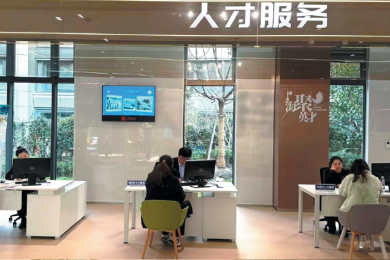
Lin also suggested that "subsidy-based" talent support policies could be further transformed into "entitlement-based" ones — such as improving convenience of visa and residency applications, cross-border research collaboration, and everyday services, while facilitating access to social security, housing provident funds, and other public services for professionals moving across provinces.
Hongkou has also shown strength in attracting talent to key industries. For example, Shanghai Fuhong New Energy, a company specializing in green power investment, grew from five to over 60 employees within one year, with about one-third renting talent apartments.
The district's talent support policies are closely aligned with industrial development, offering targeted services and dedicated programs for young professionals.
Shanghai's advantage lies not only in its concentration of universities and research institutes, but also in its comprehensive industrial system, efficient urban management, and strong capacity to turn innovation into real-world applications.
The city is set to introduce scenario lists and compliance lists in cutting-edge fields like green and low-carbon technologies and synthetic biology, providing a full cycle pathway from research data access and product iteration to commercial validation, strengthening its ability to retain talent through opportunity and development.
Sources: Wenhui Daily, Shanghai International Talent website