Shanghai sets 2030 targets for international shipping center
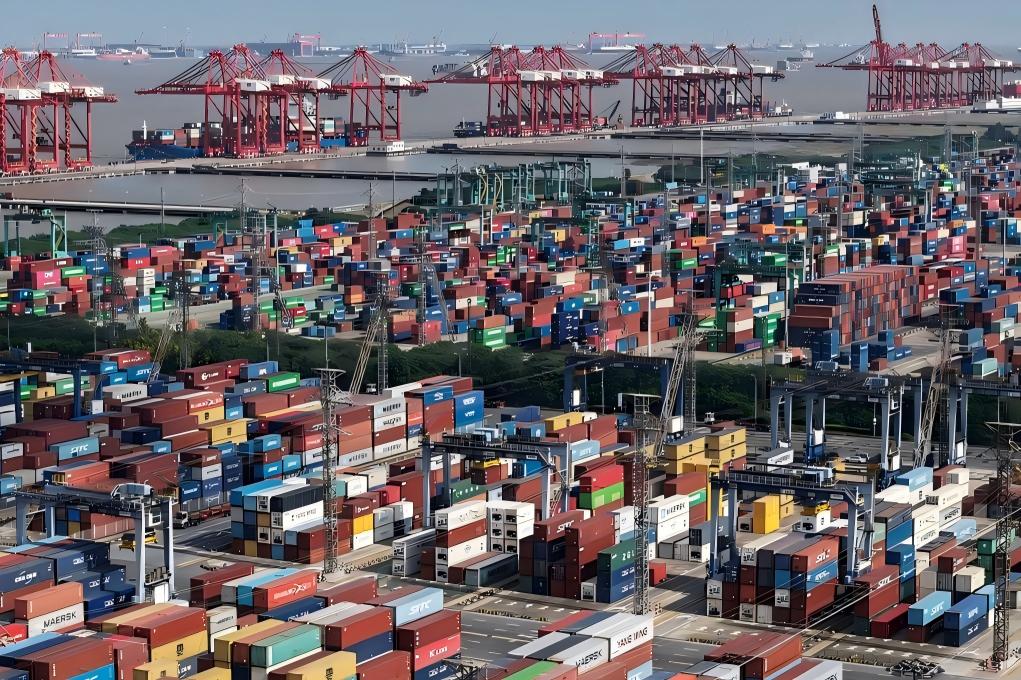
Shanghai has unveiled a five-year plan to strengthen its role as an international shipping center, setting new targets for port and airport capacity, global connectivity, high-end shipping services, and digital and green development through 2030.
2030 targets at a glance
By 2030:
Shanghai Port aims to handle over 58 million twenty-foot equivalent units, or TEUs, annually while strengthening its leading role within the Yangtze River Delta port cluster.
Shanghai's airports are expected to handle 150 million passenger trips and around 4.7 million metric tons of cargo and mail annually.
The share of water-to-water container transshipment is expected to reach 55 percent.
Sea-rail intermodal transport volume is expected to reach around 2 million TEUs.
Automated container handling volume at Shanghai Port is expected to reach 15 million TEUs.
Shanghai's airports are expected to support fully paperless travel throughout the passenger journey.
Bonded liquefied natural gas bunkering volume will reach 1 million cubic meters.
Annual cruise ship calls are expected to total 420.
Stronger sea and air connections
Shanghai will continue major port projects at the Xiaoyangshan North Operation Area and the Luojing Port Area while reserving deep-water shoreline resources for future development.
With a designed annual capacity of 11.6 million TEUs, the Xiaoyangshan North Operation Area is being developed in phases. Its first western section is expected to be ready for trial operations by the end of 2026. The Xiaoyangshan North project will become Shanghai Port's third automated container terminal.
Shanghai East Railway Station is scheduled to open in 2027. The second phase of the Shanghai-Suzhou-Nantong Railway and Metro Line 21 will be completed alongside the new station to improve air-rail connectivity.
The fourth-phase expansion of Shanghai Pudong International Airport is expected to be completed and ready for operation by the end of 2028, increasing the airport's annual passenger capacity to 130 million.
Smarter and greener shipping
Shanghai will expand the scope and scale of digital applications in shipping and trade, with a focus on developing a distributed and collaborative multimodal transport data chain for the Yangtze River Economic Belt.
The city will upgrade its smart ports and airports and systematically develop smart inland waterways. Shanghai will also focus on promoting the wider use of new-energy and clean-energy vessels.
Shanghai plans to develop a center for the certification, bunkering, and trading of green fuels for international shipping. It will also promote the low-carbon and intelligent transformation of the marine equipment industry.
In the cruise sector, Shanghai will work toward becoming an Asia-Pacific cruise economy center by developing an Asia-Pacific cruise tourism hub port, attracting regional headquarters of multinational cruise companies, and establishing a base for the construction, maintenance, and refitting of large cruise ships.
Stronger high-end shipping services
Shanghai will accelerate the development of a shipping insurance ecosystem and encourage insurers to introduce specialized products for new vessel types and intermodal transport.
Finance leasing services for aircraft and vessels will be expanded. The city will also promote the use of ad hoc arbitration in key areas such as shipping insurance, and strengthen the international service capabilities of local arbitration institutions.
Shanghai will improve clearance procedures at ports of entry, judicial safeguards, talent development, industry guidance, and international exchanges to create a more stable, transparent, and sound environment for shipping-related businesses.
Building on strong foundations
Shanghai made significant progress in developing its international shipping center during the 14th Five-Year Plan period (2021-25).
In 2025, Shanghai Port handled more than 55.06 million TEUs, ranking first worldwide for the 16th consecutive year. The city's two airports handled 135 million passenger trips, ranking Shanghai third among global cities. They also handled 4.537 million metric tons of cargo and mail, ranking Shanghai second.
Shanghai Port also became capable of providing ship-to-ship bunkering services for bonded LNG and green methanol. China's first domestically built large cruise ship, Adora Magic City, entered commercial service during the period.
According to the 2026 Xinhua-Baltic International Shipping Centre Development Index Report, released on July 10, Shanghai rose to second place worldwide, overtaking London for the first time.
Source: Shanghai Municipal People's Government