WorldSkills opening ceremony: A stage built on skills
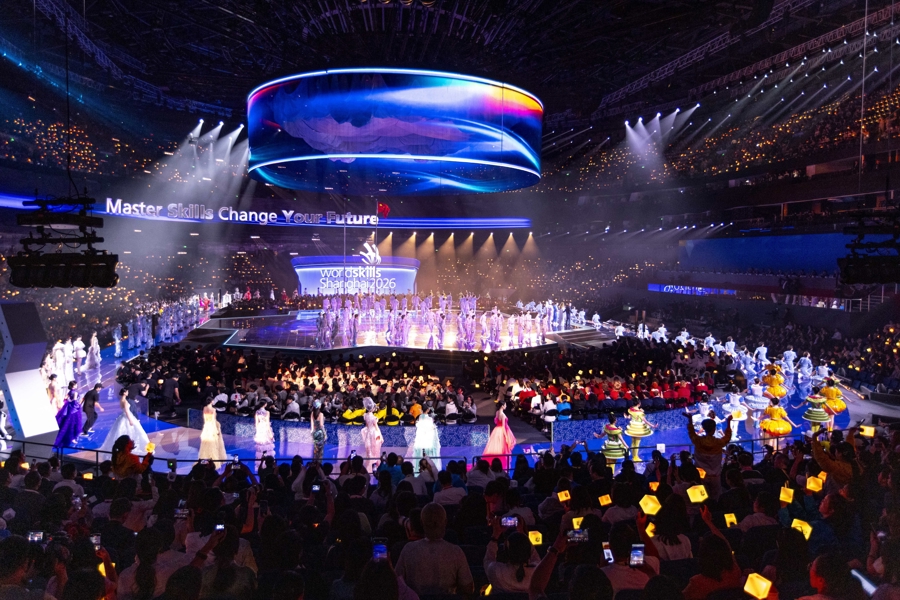
The 48th WorldSkills Competition opened at 8 pm on Sept 22 at the Shanghai World Expo Cultural Center.
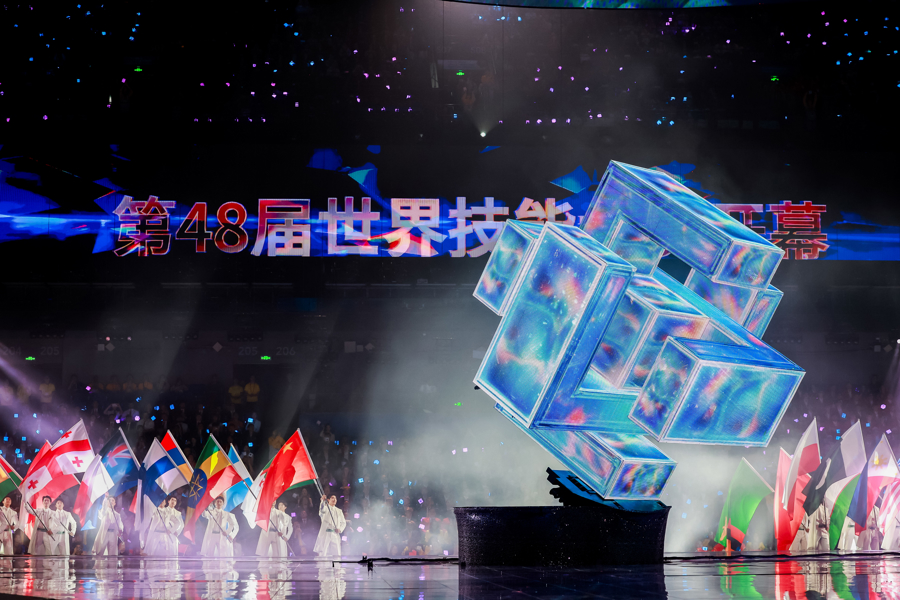
At one of the ceremony's key moments, a 200-metric-ton mortise-and-tenon installation rose above the stage. Its parts moved into position and locked together. Light spread across the structure, which then formed the competition's emblem.
The installation came together in 1 minute and 15 seconds. Reaching that point took more than a year of design, manufacturing, testing, and adjustments.
That contrast ran throughout the opening ceremony. The audience saw changing images, moving structures, and dancing robots. Behind the scenes were electricians, riggers, sewing specialists, programmers, engineers, stage designers, and performers.
The ceremony did not simply showcase skills. Skills made the ceremony possible.
The skills behind each stage effect
The mortise-and-tenon joint, a traditional Chinese woodworking technique, provided the main visual motif.
An early version of the installation required nearly five minutes to assemble. Repeated adjustments substantially reduced the assembly time. Its surface was covered with a holographic screen about 0.2 millimeters thick, finished with laser engraving, combining the traditional structure with modern light effects.
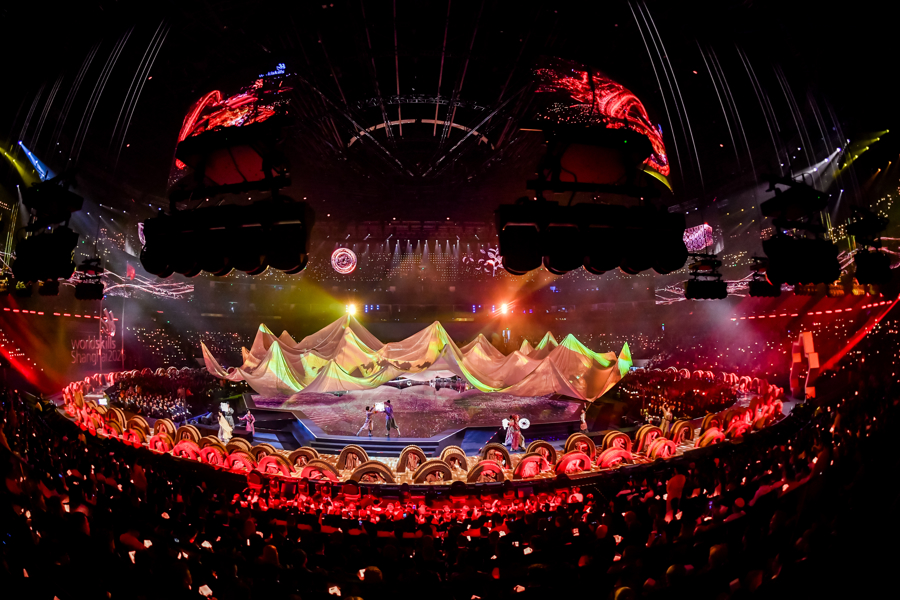
A computer-controlled canopy about 39 meters long hung above the stage. Nearly 200 suspension points allowed it to change shape throughout the performance, taking the forms of eaves, a mountain range, and a flowing skirt, while flashing with welding sparks.
In a scene featuring textile pioneer Huang Daopo, the canopy became an expanse of "silk" covering about 1,000 square meters, evoking the ancient Silk Road.
Before installation, teams from Shanghai Jiao Tong University and Beijing Institute of Technology used an AI simulation system to test the canopy's shapes and loads and coordinate camera work, lighting, performers' positions, and stage machinery. According to the developers, this approach made coordination two to three times more efficient and reduced the need for repeated on-site rehearsals.
Another stage element combined projection technology with sewing skills.
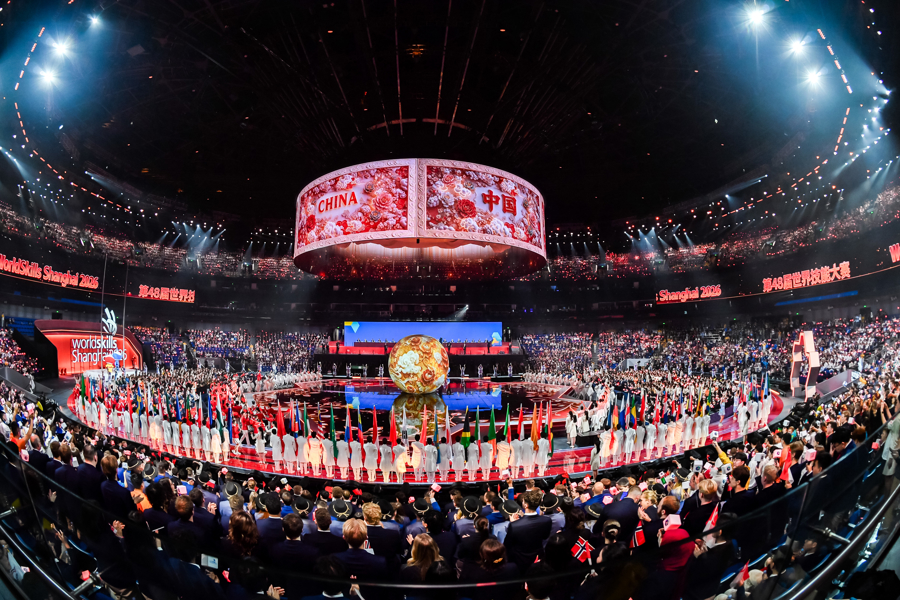
At center stage, a 5.5-meter-diameter inflatable sphere displayed various floral motifs as the delegations entered. After eight rounds of testing, the sphere could inflate in 30 seconds and remain stable for more than an hour. It also supported 360-degree projection.
Another critical detail came down to sewing: the fabric panels had to be stitched together with precision so the seams would not disrupt the projected images.
The sphere looked futuristic, yet its smooth surface still relied on skilled hands.
Skills stories from five continents
Competitors sat around the central performance area, becoming part of the ceremony rather than watching from distant stands.
Five past WorldSkills competitors from five continents told their stories onstage.
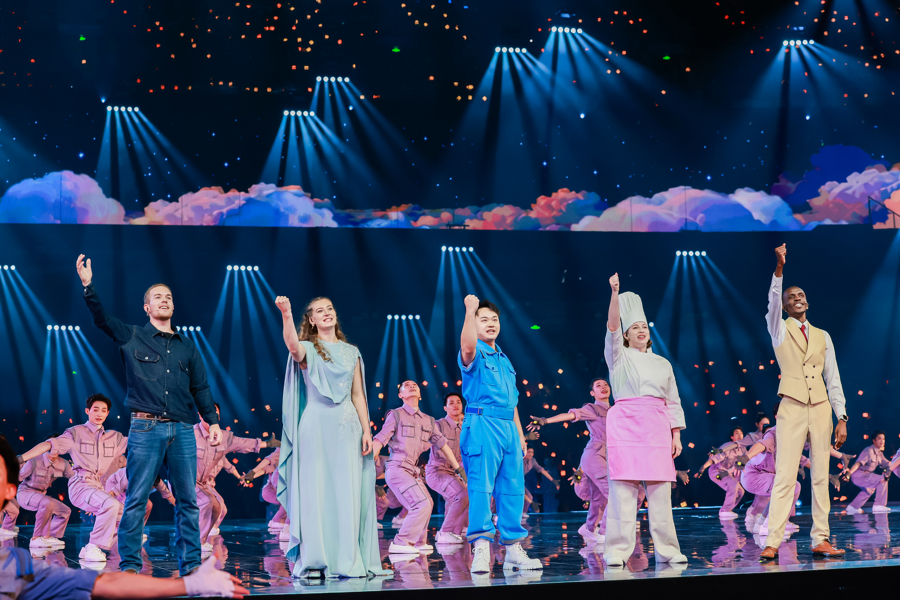
Abraham Mundengo of Zambia used his skills in Information Network Cabling to make a difference in his community. Cloe Lemarechal of France, who has dyslexia, found her place in fashion design.
Canadian welder Ben Rainforth rediscovered a childhood passion sparked by a welding torch from his grandfather. Australian baker Rachel Crawford, who grew up in a family with a strong love of food, wanted to bake to show care for others.
The fifth speaker was Tang Fan from China.
Tang grew up in the mountains, watching planes cross the night sky and dreaming of touching one. He later became an aircraft maintenance technician and won gold in Aircraft Maintenance at WorldSkills Lyon 2024 — China's first gold medal in the skill.
As Tang finished his story, a paper plane left his hand and followed a precisely planned path across the arena. Its flight led to an image of a C919 aircraft on the screen.
For a moment, a childhood wish and the skill he later mastered shared the same stage.
When dancers and robots share the stage
The final chapter placed young dancers alongside full-size humanoid robots. The robots walked and shifted formation among the performers. One robot completed a short finger dance, while others waltzed with their human partners.
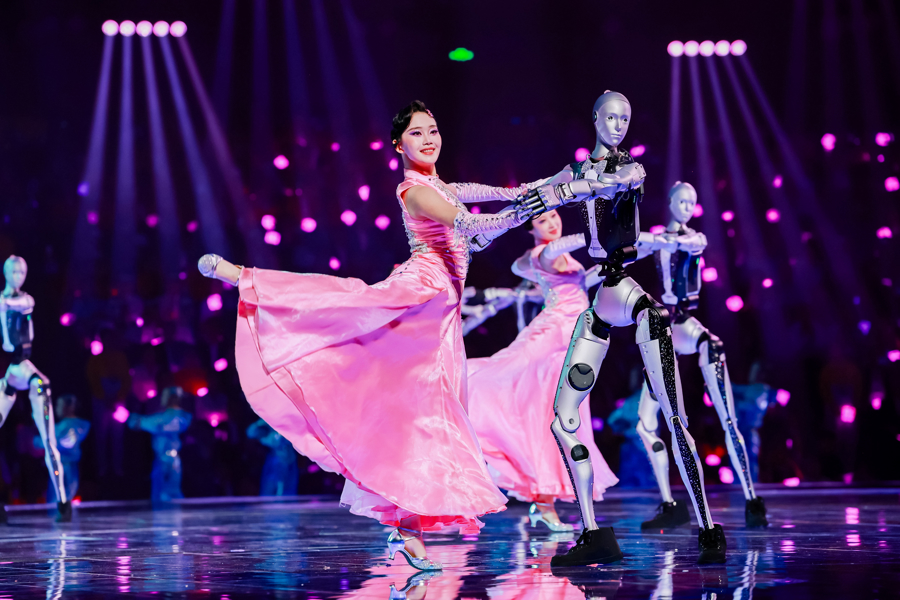
The smooth interaction took time to achieve.
During early rehearsals, the dancers wore protective gear and were hesitant to get close to the robots. Repeated practice gradually helped them become comfortable working at close range.
Every robotic gesture also began with human work. The team repeatedly tested and calibrated the motion data, while programmers relayed the directors' requirements to engineers.
Only then could a robot extend its hand and a dancer confidently take it.
Source: Shanghai Observer