Shanghai encourages students returned from overseas studies to work and start businesses in Shanghai (Issue 131)
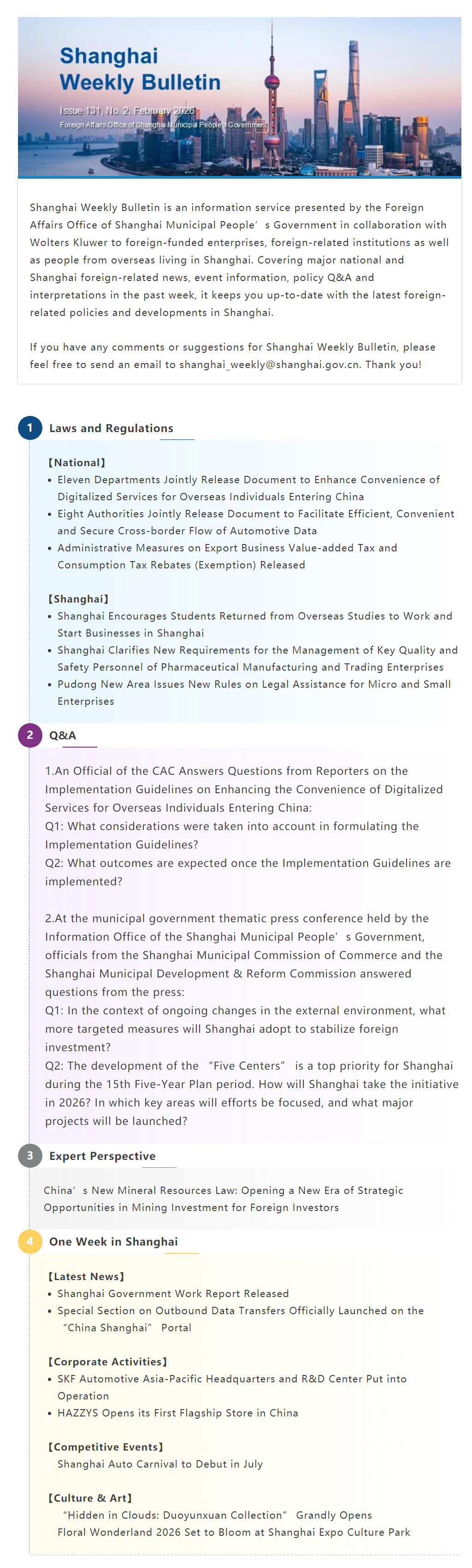
Laws and Regulations
National
1. Eleven Departments Jointly Release Document to Enhance Convenience of Digitalized Services for Overseas Individuals Entering China
[Keywords: Overseas individuals, Entry, Digitalized services]
Recently, the Cyberspace Administration of China (CAC) and ten other authorities jointly issued the revised Implementation Guidelines on Enhancing the Convenience of Digitalized Services for Overseas Individuals Entering China. The document clearly sets out 14 measures in five areas: strengthening digitalized basic services, improving digitalized payment services, optimizing digitalized tourism services, enriching digitalized public services, and strengthening network and data security assurance.
Source: CAC
2. Eight Authorities Jointly Release Document to Facilitate Efficient, Convenient and Secure Cross-border Flow of Automotive Data
[Keywords: Automotive data, Outbound transfers]
Recently, the Ministry of Industry and Information Technology (MIIT) and seven other authorities jointly issued the Security Guidelines for Automotive Data Outbound Transfer (2026 Edition). The document specifies the management approach and applicable conditions for outbound transfers of automotive data, introduces nine exemption scenarios, and refines the rules for determining important data in business scenarios such as R&D and design, manufacturing, driving automation, software upgrading, and connected operations.
Source: MIIT WeChat Official Account
3. Administrative Measures on Export Business Value-added Tax and Consumption Tax Rebates (Exemption) Released
[Keywords: Export tax rebates (exemption)]
Recently, the State Taxation Administration (STA) released the Administrative Measures on Export Business Value-added Tax and Consumption Tax Rebates (Exemption). The document consolidates and integrates the export tax rebates (exemption) administration regulations issued at different times into a unified set of administrative measures. It also clarifies matters such as export tax rebates (exemption) filing, declaration, processing, and service administration, further standardizes the administration of export tax rebates, and facilitates taxpayers’ comprehensive understanding, accurate application, and efficient and compliant observance. The document took effect on January 1, 2026.
Source: STA
Shanghai
1. Shanghai Encourages Students Returned from Overseas Studies to Work and Start Businesses in Shanghai
[Keywords: Students returned from overseas studies]
Recently, the Shanghai Municipal People’s Government issued the Several Provisions on Encouraging Students Returned from Overseas Studies to Work and Start Businesses in Shanghai. For eligible high-level students returned from overseas studies, their overseas professional work experience, academic and research achievements, and contributions to sci-tech innovation may be used as the basis for evaluation for senior professional and technical titles and will not be subject to the requirement on their length of service in China. The document took effect on February 1, 2026, and will remain valid until January 31, 2031.
Source: Shanghai Municipal People's Government
2. Shanghai Clarifies New Requirements for the Management of Key Quality and Safety Personnel of Pharmaceutical Manufacturing and Trading Enterprises
[Keywords: Pharmaceutical manufacturing and trading, Key personnel]
Recently, the Shanghai Municipal Medical Products Administration (SMPA) issued the Administrative Measures on Key Personnel for Quality and Safety Assurance of Pharmaceutical Manufacturing and Trading Enterprises in Shanghai. The document revises contents including the qualification requirements for key personnel of commissioned manufacturing enterprises. It will take effect on March 1, 2026, and remain valid until February 28, 2031.
Source: SMPA
3. Pudong New Area Issues New Rules on Legal Assistance for Micro and Small Enterprises
[Keywords: Micro and small enterprises, Legal assistance]
The Several Provisions on Legal Assistance for Micro and Small Enterprises in Pudong New Area was released recently. The document specifies that Pudong New Area will expand and extend the public legal service system and provide legal services, including legal consultation and representation, free of charge to eligible micro and small enterprises. The document took effect on February 1, 2026, and will remain valid until January 31, 2031.
Source: People's Government of Pudong New Area
Q&A
1. An Official of the CAC Answers Questions from Reporters on the Implementation Guidelines on Enhancing the Convenience of Digitalized Services for Overseas Individuals Entering China:
Q1
What considerations were taken into account in formulating the Implementation Guidelines?
A1
The Implementation Guidelines adheres to a system-based approach, a problem-oriented mindset, and scenario-based design. It aims to properly balance the relationships between development and security, domestic and international dimensions, and vitality and order, and proactively and steadily advance institutional and practical innovation in order to foster a sound digital environment.
First, it aims to properly balance development and security. While enhancing the convenience of digitalized services for overseas individuals entering China, expanding institutional opening-up, and leveraging opening-up to drive reform and development, the Implementation Guidelines also strengthens cybersecurity protection capabilities, improves data security and personal information protection, effectively safeguards personal information and rights, and coordinates the advancement of high-quality development and high-level security.
Second, it aims to properly balance domestic and international dimensions. Based on domestic needs, the Implementation Guidelines expands autonomous opening-up, upholds equal treatment for Chinese and foreign individuals without special or differential treatment, and, while promoting the active alignment of China’s digitalized services with internationally accepted models, helps global friends better integrate into China’s digitalized services ecosystem, thereby enhancing overseas individuals’ experience and sense of gain when using digitalized services upon entry.
Third, it aims to properly balance vitality and order. On the one hand, the Implementation Guidelines focuses on making digitalized services for overseas individuals entering China more convenient, in order to attract more overseas individuals to visit China for tourism, consumption, and investment and to boost the vitality of economic and social development. On the other hand, it emphasizes the strengthening of mutual recognition of standards, urges digitalized service platforms to provide products and services in accordance with the law and regulations, and optimizes digitalized service experiences within the framework of China’s laws and regulations, thereby advancing the enhancement of convenience in an orderly manner.
Q2
What outcomes are expected once the Implementation Guidelines are implemented?
A2
The implementation of the Implementation Guidelines will further leverage the leading role of informatization in economic and social development. By expanding autonomous opening-up in the field of digitalized services, it will continuously unleash China’s economic vitality, deepen high-standard opening-up, enhance China’s international image, and provide strong support for high-quality economic and social development.
First, it will unlock new potential for inbound consumption. Improving digitalized payment and tourism services will help further unleash the consumption potential of overseas individuals entering China, promote the prosperity and development of service industries such as tourism and accommodation, stimulate the vitality of the digital economy industry, and enhance its role in attracting foreign investment, boosting domestic demand, and promoting growth, thereby injecting new momentum into high-quality economic and social development.
Second, it will create a “golden name card” for opening-up. By helping global friends better integrate into China’s digitalized service system, the Implementation Guidelines will further enhance the convenience of cross-border people-to-people exchanges, facilitate the deepening of international collaboration, and contribute to higher-standard, broader-scope, and deeper-level opening-up.
Third, it will strengthen soft power in terms of international influence. By showcasing China’s achievements in informatization through the application of network and information technologies and enabling global friends to understand China through first-hand experiences of digitalized services, the Implementation Guidelines will help enhance China’s competitiveness, attractiveness, and influence in global talent flows and international economic and trade cooperation.
Source: CAC
2. At the municipal government thematic press conference held by the Information Office of the Shanghai Municipal People's Government, officials from the Shanghai Municipal Commission of Commerce and the Shanghai Municipal Development & Reform Commission answered questions from the press:
Q1
In the context of ongoing changes in the external environment, what more targeted measures will Shanghai adopt to stabilize foreign investment?
A1
By the end of last year, a total of 1,076 regional headquarters of MNCs and 636 R&D centers of multinational corporations had been recognized. In 2025, more than 6,300 new foreign-invested enterprises were established, representing a year-on-year increase of 6.8%, while the value of contracted foreign investment grew by 19.8%. This fully demonstrates that Shanghai remains one of the preferred destinations for foreign investment and one of the preferred locations for multinational corporations to arrange their global industrial and supply chains. Going forward, we will further advance high-standard opening-up, support the transformation and upgrading of foreign-invested enterprises, continue to build a world-class business environment, and enhance the sense of gain of foreign-invested enterprises through more precise and high-quality services.
Q2
The development of the “Five Centers” is a top priority for Shanghai during the 15th Five-Year Plan period. How will Shanghai take the initiative in 2026? In which key areas will efforts be focused, and what major projects will be launched?
A2
This year, we will strive for greater breakthroughs in enhancing the city’s overall capacity and core competitiveness. Efforts will be made to accelerate the development of a modern industrial system with advanced manufacturing as the backbone, expedite the implementation of a number of major industrial projects, and speed up the development of a global allocation center for renminbi-denominated assets and a risk management center. We will attract enterprises to establish global supply chain management centers in Shanghai, accelerate the development of a hub for bulk commodity resource allocation, and focus on enhancing high-end shipping services such as ship management, marine insurance, and maritime arbitration. Priority will be given to strengthening the source functions of the sci-tech innovation center and supporting national laboratories in better performing their role as the “central platform and chief coordinator” of innovation chains.
Source: Shanghai Release
Expert Perspective
China's New Mineral Resources Law: Opening a New Era of Strategic Opportunities in Mining Investment for Foreign Investors
By Yang Guisheng, Zhu Qi, Wang Yonghui, and Shi Ranran [Beijing Dentons Law Offices]
[Continued from the previous issue]
III. Reform of the Protection of Mining Rights Holders' Interests
1. State Expropriation and Requisition: Balancing Public Interests and Private Rights
Before the expiration of the term of a mining right, the original authority granting the mining right may, for reasons of public interest, lawfully revoke the mining right, but must provide “fair and reasonable” compensatory payment. This provision establishes a mechanism for balancing public interests and individual rights, which both safeguards the implementation of major national construction projects and public interests, and maintains proper order in the mining rights market. It reduces policy uncertainty for investors, provides mining rights holders with stable expectations regarding their rights, and strengthens investors’ confidence in long-term investment.
2. Management of Overlying Mineral Resources: From Compensation for Direct Losses to Fair and Reasonable Compensation
Under the old Mineral Resources Law, in cases of overlying mineral resources, the scope of compensation in practice was usually limited to direct investment losses. The New Mineral Resources Law, however, elevates the standard of compensation to a “fair and reasonable” level, with the possibility of compensation being made based on the market price of mining rights. This reform fully takes into account the property attributes of mining rights, follows the laws of the market economy, and reflects comprehensive protection of the rights and interests of mining rights holders.
3. Competitive Transfer: Allowing the Market to Allocate Resources
Mining rights shall, in principle, be transferred through competitive means such as bidding, auction, and listing, except where laws, administrative regulations, or provisions of the State Council permit the establishment of mining rights through agreements or other means. This system is of great significance for improving the efficiency of mineral resource development and utilization. It not only increases the transparency and fairness of mining rights allocation and stimulates market vitality, but also attracts more external capital into the mining sector, thereby promoting capital flows and competition in the mining industry.
4. Strengthening International Collaboration in the Mining Sector
Article 15 of the New Mineral Resources Law provides that “the State adheres to the principles of equality, mutual benefit and win-win cooperation, and actively promotes international collaboration in the field of mineral resources.” This is a newly added provision located in the General Provisions of the New Mineral Resources Law. The Energy Law, which was adopted on the same day as the New Mineral Resources Law, also emphasizes in its General Provisions the promotion of international collaboration in the field of energy. For the first time at the legislative level, international collaboration in the fields of mineral resources and energy is encouraged and strengthened.
The underlying logic behind the new law’s emphasis on international collaboration in mineral resources remains the pronounced contradiction between rigid domestic demand for mineral resources and insufficient supply. By strengthening international collaboration in the mineral resources sector, drawing on the experience of major mining powers, and enhancing China’s capacity for global resource allocation, the new law seeks to alleviate domestic supply–demand imbalances, improve security of supply for critical minerals, and safeguard mineral resources security.
[To be continued]
One Week in Shanghai
Latest News
1. Shanghai Government Work Report Released
[Keywords: Government work report]
The Shanghai Municipal Government Work Report was recently released. In 2025, the city’s GDP reached RMB 5.67 trillion, representing a year-on-year growth of 5.4%. For 2026, the city has set an annual GDP growth target of around 5 %.
Source: Shanghai Release
2. Special Section on Outbound Data Transfers Officially Launched on the "China Shanghai" Portal
[Keywords: Outbound data transfers]
Recently, the Cyberspace Administration of the CPC Shanghai Municipal Committee launched a dedicated section on outbound data transfers on the “China Shanghai” portal (www.shanghai.gov.cn) to provide enterprises with one-stop, full-process services for outbound data transfer activities. The section offers Shanghai-based enterprises with outbound data transfer needs four key services: integrated access to policy documents, precise policy interpretations, convenient consultation services, and direct access to filing systems.
Source: Cyberspace Administration Shanghai
Corporate Activities
1. SKF Automotive Asia-Pacific Headquarters and R&D Center Put into Operation
[Keyword: SKF]
On February 4, 2026, SKF's Automotive Asia-Pacific Headquarters and R&D Center were put into operation. The new project integrates three major functions, namely, the Asia-Pacific headquarters, sales company, and R&D center, and forms a complete value chain covering R&D, sales, manufacturing, and support services.
Source: Shanghai Jiading
2. HAZZYS Opens its First Flagship Store in China
[Keyword: HAZZYS]
Recently, fashion brand HAZZYS officially opened its first flagship store in China at a prime location in Shanghai Xintiandi, at the intersection of Huangpi South Road and Taicang Road. The new space, designed by internationally renowned architectural firm Casper Mueller Kneer, perfectly blends classic British rowing club culture with modern architectural aesthetics to create an immersive brand experience space for fashion enthusiasts.
Source: Shanghai Huangpu
Competitive Events
1. Shanghai Auto Carnival to Debut in July
[Keywords: Shanghai Auto Carnival]
From July 2, 2026 to July 5, 2026, the Shanghai Auto Carnival (SAC) will make its debut at the National Exhibition and Convention Center (Shanghai). The event will be held concurrently with the Green and Smart Auto Shanghai 2026 (GSA 2026), with a combined exhibition area of over 100,000 square meters.
Source: International Services Shanghai
Culture & Art
1. "Hidden in Clouds: Duoyunxuan Collection" Grandly Opens
[Keywords: Duoyunxuan]
Recently, the “Hidden in Clouds: Duoyunxuan Collection” grandly opened at China Art Museum, Shanghai. The exhibition features Tang dynasty calligraphy, Song dynasty painting albums, Ming and Qing dynasty calligraphy and painting, Tianhuang stone figurine sculptures. The collection also includes rare ancient books, rubbings and manuscripts, seals and inscribed works in metal and stone, as well as masterpieces by modern and contemporary masters such as Ren Bonian, Wu Changshuo, Xu Beihong, Zhang Daqian, Guo Moruo, and Master Hongyi, along with several representative works of the national intangible cultural heritage technique of woodblock watermark printing. A total of 105 pieces (sets) are on display. The exhibition will run through March 18, 2026.
Source: China Art Museum, Shanghai
2. Floral Wonderland 2026 Set to Bloom at Shanghai Expo Culture Park
[Keywords: Floral Wonderland]

The Shanghai Expo Culture Park will host the "Floral Wonderland 2026" exhibition from February 14, 2026, to May 20, 2026. Centered on century-old rare flowering trees, the exhibition will showcase typical spring flowers such as weeping plum, weeping cherry, wisteria, azalea, iris, and rose, and will incorporate contemporary art sculptures. Through 16 themed garden scenes, three art clusters, and two specialty markets, it invites visitors into an immersive artistic landscape that is visually engaging, emotionally resonant, and intellectually inspiring.
Source: International Services Shanghai