Shanghai formulates global sci-tech partnership plan (Issue 140)
Laws and Regulations
National
1. The State Council Releases the Opinions on Promoting Expansion and Quality Improvement of the Service Sector
[Keywords: Service sector]
Recently, the State Council released the Opinions on Promoting Expansion and Quality Improvement of the Service Sector. The document specifies 20 measures across four aspects. It sets the goal that by 2030, significant progress shall be made in the high-quality development of the service sector, with the total scale reaching the RMB 100 trillion milestone. The initiative aims to cultivate more “China Service” brands, significantly enhance the global competitiveness and influence of the service sector, and continuously improve the sense of gain of the people.
Source: Website of the Chinese Government
2. The General Office of the State Council Forwards the Several Measures of the General Administration of Customs on Promoting Expansion and Quality Improvement of Comprehensive Bonded Zones
[Keywords: Comprehensive bonded zone]
Recently, the General Office of the State Council forwarded the Several Measures of the General Administration of Customs on Promoting Expansion and Quality Improvement of Comprehensive Bonded Zones. The document puts forward specific measures in four aspects, namely, bolstering the development of new business forms and models, ensuring the resilience and security of industrial and supply chains, promoting the integrated development of domestic and foreign trade, and improving the efficiency of intelligent supervision and collaborative governance.
Source: Website of the Chinese Government
3. Ten Authorities Issues the Provisions on Promoting and Regulating the Application of Electronic Documentation
[Keywords: Electronic documentation]
Recently, the Cyberspace Administration of China and nine other authorities jointly issued the Provisions on Promoting and Regulating the Application of Electronic Documentation. The document encourages institutions and enterprises in fields such as trade in goods, logistics and finance to recognize and use electronic documentation, in order to enhance digitalization in operations and drive quality and efficiency improvement across industries. The document will take effect on September 1, 2026.
Source: CAC China
Shanghai
1. Shanghai Formulates the Global Sci-tech Partnership Program
[Keywords: Global sci-tech partners]
Recently, the General Office of the Shanghai Municipal People’s Government issued the Shanghai Global Sci-Tech Partnership Program. The document proposes the implementation of six major actions: international joint research, talent exchange and visits, introduction and cultivation of international scientific organizations, open science initiatives, internationalization of industrial innovation, and optimization of the innovation ecosystem.
Source: Shanghai Municipal People's Government
2. Shanghai Issues Document to Accelerate the Development of the National Digital Economy Innovation and Development Pilot Zone
[Keywords: National digital economy, Innovation and development pilot zone]
Recently, the General Office of the Shanghai Municipal People’s Government issued the Implementation Plan for the National Digital Economy Innovation and Development Pilot Zone (Shanghai). The document proposes that by 2028, the value of data as a key factor of production will be fully activated, institutional development will effectively lead innovation, the integration of the real economy and the digital economy shall be further deepened, and the development of the pilot zone shall achieve significant results.
Source: Shanghai Municipal People's Government
3. Shanghai to Leverage Industrial Internet Platforms to Empower Industrial Growth
[Keywords: Internet platform, Industrial development]
Recently, the Shanghai Municipal Commission of Economy and Information Technology and six other authorities issued the Action Plan for Shanghai to Promote Industrial Internet Platforms to Empower Industrial Development (2026-2028). The document aims to focus on the development needs of industrial chains such as new energy vehicles, electronic information, integrated circuits, embodied intelligence and advanced materials, gives full play to the connective power of industrial internet platforms, and strives to build Shanghai into a hub for platform innovations, characterized by “data-driven intelligence, deep empowerment, ecosystem synergy, and open connectivity”.
Source: Shanghai Municipal Commission of Economy and Information Technology
4. Establishing "One-Stop" Maritime Dispute Resolution Center to Support the Development of Shanghai as an International Shipping Center
[Keywords: International shipping, Maritime dispute resolution]
On April 21, the Shanghai Maritime Safety Administration and three other authorities jointly issued the Implementation Plan for Establishing One-Stop Maritime Dispute Resolution Center to Support the Development of Shanghai as an International Shipping Center. The document puts forward 16 measures across three dimensions, namely, regulatory framework, operational mechanism and quality and efficiency enhancement, with the ultimate goal of realizing “one-stop” acceptance, comprehensive mediation and “full-chain” resolution of maritime disputes.
Source: Shanghai Maritime Release
Q&A
At the press conference held by the Information Office of Shanghai Municipal People’s Government on Shanghai’s progress in building a powerhouse in intellectual property rights and accelerating the development of new-quality productive forces, an official from the Shanghai Municipal Science and Technology Commission answered questions from journalists.
Q
The theme of this press conference highlights “cultivating new-quality productive forces”, and there is significant external interest in the development of Shanghai as an international sci-tech innovation center. What are the commission’s priority areas in 2026 regarding the reinforcement of the city’s role as a source of sci-tech innovation?
A
The core of cultivating new-quality productive forces lies in sci-tech innovation. In 2025, Shanghai successfully achieved the targets set in the 14th Five Year Plan for the development of the international sci-tech innovation center. The ratio of total R&D expenditure to GDP in the city increased from 4.1% in 2020 to around 4.5%, the function of sci-tech innovation as a source was significantly enhanced, and strong momentum was injected into the development of new-quality productive forces.
In the past year,the capacity for original innovation grew rapidly. Shanghai scientists contributed over 30% of the national total number of papers published in the world’s top three academic journals. Significant breakthroughs were achieved in basic research, core and frontier technologies in key fields, and a series of milestones were obtained in areas such as deep-sea microorganisms, desktop muon sources, next-generation memory chips, and cell and gene therapy. The innovation capacity of industries such as integrated circuits, biomedicine and AI continued to strengthen.
The ecosystem for sci-tech innovation continued to flourish. Both the number and the amount of investment and financing cases in the three major industries ranked among the top nationwide. The transaction value of technology contracts of universities and research institutes increased by 70% year-on-year. Furthermore, the development of high-quality incubators achieved remarkable results, and more sci-tech achievements quickly moved from “bookshelves” to “market shelves”. On average, more than 320 sci-tech enterprises were newly added in the city every day, and the number of companies listed on the STAR Market reached 95, with the total market value ranking first in the country. The number of overseas returnees coming to Shanghai for work and entrepreneurship ranked first nationwide.
Institutional reforms gained significant ground.The development of pilot zones for basic research continued to deepen, systemic reform of the management of sci-tech programs was accelerated, and robust mechanisms for cultivating future industries were established. Furthermore,,we pioneered tiered cultivation models for leading tech enterprises, unleashing the vitality of various innovation entities.
The year 2026 is the first year of the 15th Five Year Plan. We will spare no effort to advance the development of the Shanghai (Yangtze River Delta) International Sci-Tech Innovation Center.
Firstly, anchoring national strategies, we will strengthen the source function. We will vigorously promote high-risk and high-value basic research, enhance the systematic layout of basic research, accelerate breakthroughs in key core technologies in key fields, and speed up the cultivation of frontier and disruptive technologies and future industries. Secondly, we will foster the innovation ecosystem and enhance system effectiveness. We will strengthen the principal position of enterprises in innovation and promote the efficient commercialization of sci-tech achievements. We will reform and improve the management system of sci-tech parks and promote the high-quality development of Zhangjiang National Innovation Demonstration Zone. Furthermore, we will bolster the sci-tech service sector and deepen open cooperation in sci-tech innovation. Thirdly, we will deepen reform and unleash innovation momentum. We will continue to deepen reform of fiscal investment in science and technology, improve the sci-tech finance system, and promote integrated reform of education, sci-tech and talent development systems.
Source: Shanghai Release
Expert Perspective
New Foreign Trade Law Series Interpretation (II): Compliance with and Safeguarding of Multilateral Trade Rules and Improvement of the Foreign Trade Contingency Mechanism
By Li Zhenghao, Su Chang, Yuan Xiaokun (King & Wood Mallesons)
[Continued from the previous issue]
Summary
Article 55 of the new Foreign Trade Law establishes the “trade adjustment assistance” system in legal form for the first time. This allows relevant government authorities to establish assistance mechanisms in compliance with WTO rules in order to respond to trade risks and changes in the trade environment and to stabilize industrial and supply chains.
Trade adjustment assistance aims to help enterprises that encounter operational difficulties due to external trade shocks resume operations through means such as technical support, efficiency improvement and market development, which is different from traditional trade remedies such as anti-dumping that mainly rely on additional tariffs.
This system has been relatively mature in the United States, Europe and the Republic of Korea, and China has also carried out pilots for nearly ten years in areas such as the Shanghai Pilot Free Trade Zone. The new law elevates local practices to legal authorization. At the same time, it emphasizes that assistance shall comply with WTO disciplines on non-discrimination, subsidies and transparency so as to avoid disguised illegal subsidies.
Details
I. Establishing a Trade Adjustment Assistance System to Provide Lawful and Compliant Support for Enterprise Adjustment
The new Foreign Trade Law expressly provides for the system of “trade adjustment assistance”. Article 55 stipulates: “In order to respond to trade risks and the impact of changes in the trade environment, relevant people's governments may, as needed, establish trade adjustment assistance systems in compliance with World Trade Organization rules and other requirements, and actively carry out trade adjustment assistance work to stabilize industrial and supply chains.”
1. Brief Analysis of the Trade Adjustment Assistance System
Trade adjustment assistance refers to a system under which the government provides assistance to enterprises that have fallen into operational difficulties due to shocks in the external trade environment, helping them restore normal production and operation. Trade adjustment assistance and traditional trade remedy measures (such as anti-dumping, countervailing and safeguard measures) share certain similarities, as both are designed, in the context of trade liberalization, to provide certain remedies to domestic enterprises and industries in response to external trade shocks. However, compared with traditional trade remedy measures, trade adjustment assistance pays more attention to the impact on specific business activities of enterprises at the micro level. In addition, unlike traditional defensive remedies that mainly adopt the imposition of additional tariffs, trade adjustment assistance aims to actively help enterprises expand markets and improve production efficiency and to restore normal production and operation through diversified technical assistance and other measures. WTO panels have pointed out that a country's trade adjustment assistance is not designed to “seek correction” of actions of other WTO members that violate multilateral rules, but rather to address the damage caused by such actions to its domestic enterprises and workers. The trade adjustment assistance system has developed into a relatively mature trade remedy system in jurisdictions such as the United States, the European Union and the Republic of Korea.
2. Trade Adjustment Assistance System in China: Building an Institutional Arrangement in Line with WTO Rules
China has been conducting local pilots on the trade adjustment assistance system for nearly ten years. In 2015, the Guidelines of the State Council on Accelerating the Implementation of the Free Trade Zone Strategy (Guo Fa [2015] No. 69) proposed “studying the establishment of a trade adjustment assistance mechanism” and “providing assistance to industries, enterprises and individuals impacted by tariff concessions”. Subsequently, the China (Shanghai) Pilot Free Trade Zone took the lead in launching a pilot in 2017 and issued the Trial Measures of the China (Shanghai) Pilot Free Trade Zone on Trade Adjustment Assistance. In 2021, the Outline of the 14th Five-Year Plan for National Economic and Social Development and Long-Range Objectives Through the Year 2035 of the People's Republic of China included in the plan the requirement to “improve the industry injury early-warning system and enrich policy tools such as trade adjustment assistance and trade remedies to properly address economic and trade frictions”. In recent years, many regions across the country have explored and introduced their own trade adjustment assistance measures. As shown in the table below, these local systems share certain common characteristics:
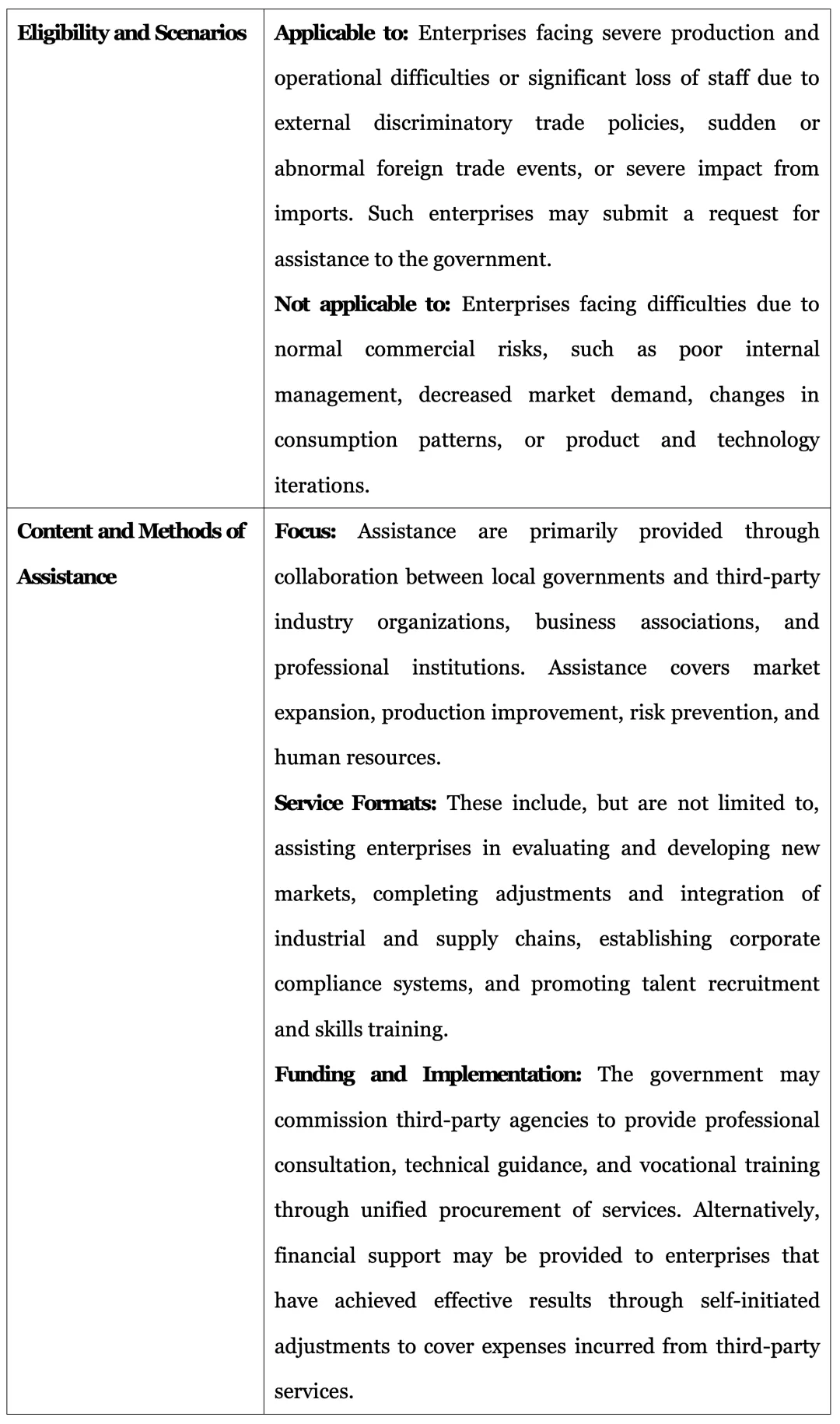
Article 55 of the new Foreign Trade Law elevates previous local practices of trade adjustment assistance to legal authorization, making clear that the purpose of such assistance is to respond to trade risks and the impact of changes in the trade environment and to stabilize industrial and supply chains.
It is worth noting that, from the perspective of safeguarding multilateral trade rules, the new Foreign Trade Law explicitly requires that relevant trade adjustment assistance must “comply with World Trade Organization rules and other requirements”. This requirement helps further enhance the consistency between government assistance work and relevant international rules. In general, trade adjustment assistance provided by governments to enterprises may involve multilateral disciplines in areas such as non-discrimination, subsidies and transparency. Such assistance is usually available to all enterprises that have fallen into operational difficulties due to external trade shocks, is mainly based on technical assistance with financial support as a supplement, and has a certain degree of generality. Therefore, it should not possess the specificity required to constitute actionable subsidies, does not directly affect the domestic industries of other members, and is consistent with the practices of many WTO members. At the same time, such assistance is generally not contingent upon product export or the use of domestic substitute products, and thus should not fall within the prohibited subsidies under the WTO Agreement on Subsidies and Countervailing Measures, namely, export subsidies and import-substitution subsidies. Nevertheless, when providing such assistance, relevant people’s governments shall still pay attention to compliance with relevant international rules, shall not use this system to provide disguised illegal subsidies to specific industries or enterprises, and shall not impose any discriminatory conditions on applicant enterprises. Regulations, policies and notices related to the provision of assistance shall also meet transparency requirements.
Insights
The new Foreign Trade Law provides a new institutional opportunity for further improving China's trade adjustment assistance work, and trade adjustment assistance also provides an institutional safety net for the healthy development of foreign trade enterprises under new circumstances. Enterprises may actively familiarize themselves with local trade adjustment assistance policies. Where enterprises encounter operational difficulties due to external trade shocks or discriminatory policies, they may apply for assistance to relevant authorities and adopt reasonable adjustment measures based on their actual circumstances.
[To be continued]
One Week in Shanghai
Latest News
1. Shanghai Releases Economic Performance Data for Q1 2026
[Keywords: National economy]
On April 22, the economic performance data for Shanghai in the first quarter of 2026 was officially released. According to the unified regional calculation of gross domestic product (GDP), the city’s regional GDP in the first quarter reached RMB 1,352.691 billion, representing a year-on-year growth of 5.9% when calculated at constant prices. By industry, the added value of the primary industry was RMB 2.133 billion, an increase of 3.4%; the added value of the secondary industry was RMB 250.932 billion, up by 5.2%; and the added value of the tertiary industry was RMB 1,099.626 billion, marking a growth of 6.0%.
Source: International Services Shanghai
2. World Industrial Design Association Established in Shanghai
[Keywords: World Industrial Design Association]
Recently, the inaugural conference of the World Industrial Design Association (WIDA) was held in Shanghai. The first group of founding members comprises 168 organizations and individuals from 23 countries and regions around the world. The organization has also established connections with more than 60 countries, covering a wide range of disciplines and industrial fields such as design thinking, design science, AI, aerospace and high-end equipment.
Source: Shanghai Science and Technology
3. SHFE Introduces Overseas Traders into Nickel Futures and Options; TSR 20 Options and International Copper Options Listed on the Same Day
[Keywords: Nickel futures and options, TSR 20 options, International copper options]
On April 22 (starting from the continuous trading session on the night of April 21), the Shanghai Futures Exchange (SHFE) officially introduced overseas traders to participate in nickel futures and options trading, simultaneously opening these markets to Qualified Foreign Investors (QFI). On the same day, the Shanghai International Energy Exchange (INE), a subsidiary of SHFE, listed Technically Specified Rubber (TSR) 20 options and international copper options. These markets have also introduced overseas traders and are open to QFI.
Source: Shanghai Futures Exchange Release
Corporate Activities
1. PepsiCo Omnichannel Smart Logistics Center Breaks Ground in Shanghai
[Keywords: PepsiCo]
On April 21, the “Huizhong Supply Chain – PepsiCo Foods Omnichannel Smart Logistics Center”, with a total investment of RMB 80 million, officially broke ground in Shihudang Town, Songjiang District, Shanghai. After the project is put into operation, it will significantly improve the response speed of distribution channels and the accuracy of demand forecasting in the entire area. The on-time and in-full (OTIF) delivery rate of PepsiCo Foods orders is expected to increase by about 10 percentage points compared with the current level, and the fulfillment efficiency across all channels is expected to improve by about 50%.
Source: Shanghai Foreign Investment Association
2. Audi and SAIC Deepen Cooperation with Establishment of Audi Innovation and Technology Center in Shanghai
[Keywords: Audi]
Recently, Audi and SAIC Motor Corporation Limited officially signed a strategic cooperation agreement to further deepen their cooperation. According to the agreement, the two parties plan to establish a new Audi Innovation and Technology Center in Shanghai. Led by Audi AG, the center will focus on R&D of intelligent electrification technologies as well as the whole-vehicle development across the entire value chain of intelligent connected vehicles (ICVs).
Source: International Services Shanghai
3. Ivoclar Relocates to China for the First Time, Settling in Minhang
[Keywords: Ivoclar]
Recently, Ivoclar Group and Xinzhuang Industry Park officially signed a project cooperation agreement, announcing a Phase I investment of 10 million US dollars to build an automated production line for dental medical devices. The newly launched manufacturing project plans to establish automated production lines for dental medical devices. It is designed to localize the production of dental filling materials and adhesives.
Source: Minhang Today
Competitive Events
Shanghai Longines Global Champions Tour 2026 to Gallop Off during the May Day Holiday
[Keywords: Shanghai Longines Global Champions Tour]
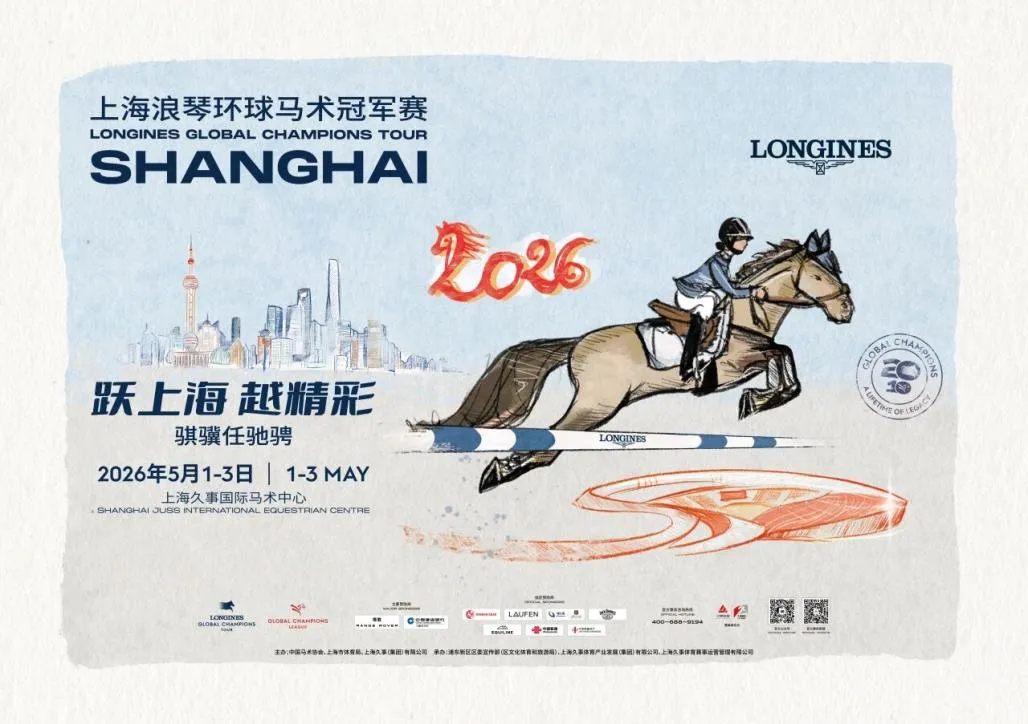
From May 1 to 3, the Shanghai Longines Global Champions Tour 2026 will be grandly held at the Shanghai Juss International Equestrian Centre. The event’s schedule has been further optimized. A new 1.60-meter GCL (Global Champions League) individual event will be introduced on the opening day as one of the major qualifiers for the Longines Grand Prix. It will continue to offer both daytime and evening sessions to meet diverse needs of spectators.
Source: Shanghai Longines Global Champions Tour
Culture & Arts
1. Enjoy May Day in Shanghai with Five Thrilling Music Festivals
[Keywords:May Day, Music festival]
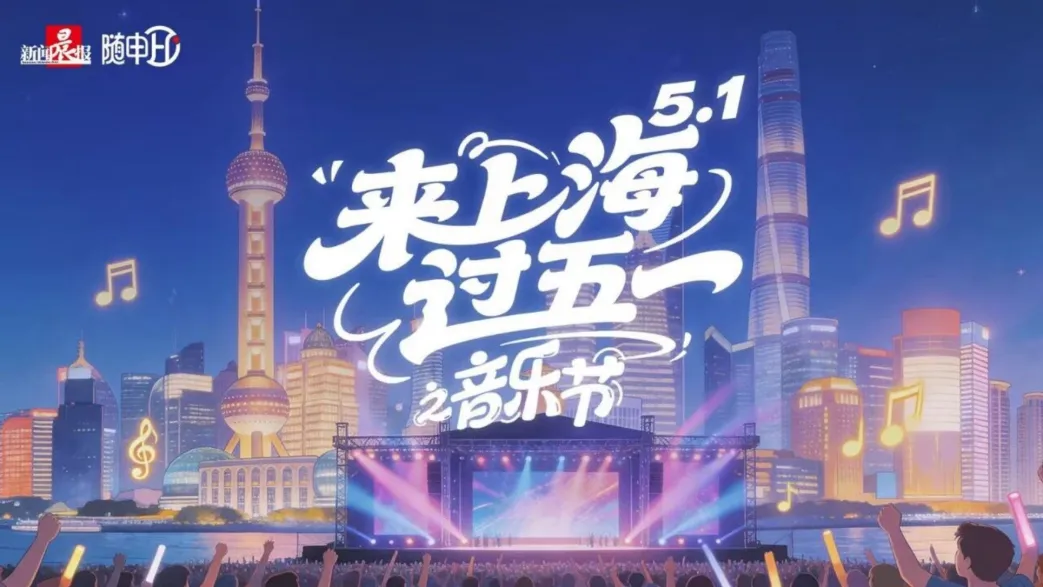
During the May Day holiday, Shanghai will host five music festivals featuring a diverse range of styles, from hip-hop and pop to rock and electronic dance music (EDM). A series of exciting tie-in events and exclusive offers will also be available, adding more fun to the holiday celebrations.
Source: Shanghai Release
2. 2026 Shanghai Jing’an Modern Drama Valley Opens
[Keywords: Shanghai Jing’an Modern Drama Valley]
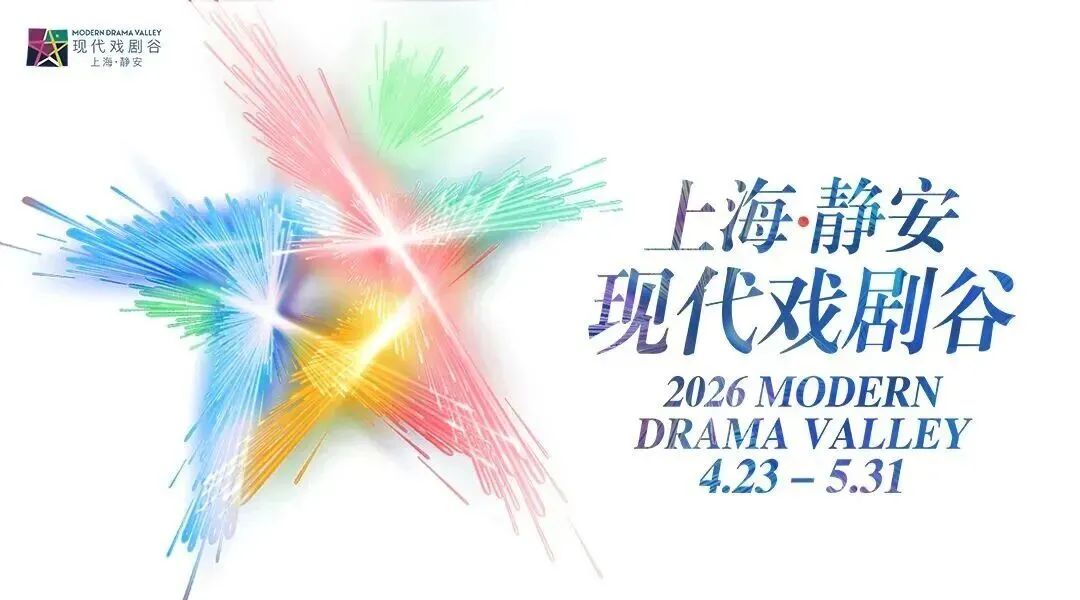
On April 23, the 2026 Shanghai Jing’an Modern Drama Valley opened. Centered on three major sections, namely, “Famous Plays Showcase”, “Drama in the Air” and “One Drama Awards”", the event has also created, for the first time, a “Drama Market”. By integrating resources across the entire area, it presents 21 works and 84 performances, as well as nearly 40 public-benefit performances.
Source: Jing’an Culture and Tourism