Ten key breakthrough tasks for optimizing Shanghai's business environment in 2026 released (Issue 141)
Laws and Regulations
National
1. MOFCOM Releases Master Plan for National Trade in Service Innovation and Development Demonstration Zones
[Keywords: Trade in services, Innovative development demonstration zones]
Recently, MOFCOM released the Master Plan for the Development of National Trade in Service Innovation and Development Demonstration Zones. The document specifies that Beijing, Shanghai and 14 other cities as well as Hainan Province will take the lead in the development of such demonstration zones. Moreover, it sets out five main tasks, namely, exploring integrated innovation across industrial and supply chains, cultivating competitive advantages of business entities, promoting the efficient supply of production factors, leading high-standard opening-up, and establishing domestic and international promotion systems.
Source:MOFCOM
2. Measures for the Administration of Online Marketing of Financial Products Released
[Keywords: Financial products, Online marketing]
Recently, the People's Bank of China and seven other authorities released the Measures for the Administration of Online Marketing of Financial Products. The document requires financial institutions to be responsible for the legality and compliance of online marketing content, to establish a review mechanism led by their headquarters for overall management, approval and filing, and compliance review, and to implement relevant requirements on the protection of the rights and interests of financial consumers and investors. The document will take effect on September 30, 2026.
Source: CAC
3. State Taxation Administration Releases the Positive and Negative Lists for the Compliance-Based Issuance of Invoices by Taxpayers
[Keywords: Issuance of invoices, Positive and negative lists]
Recently, the State Taxation Administration released the Positive and Negative Lists for the Compliance-Based Issuance of Invoices by Taxpayers. The document contains 44 items across four categories, including 16 items on the positive checklist and 28 items on the negative checklist. Taxpayers may refer to the checklist for self-assessment to determine whether key matters such as the invoice issuing and receiving entities, production and business activities, invoice information elements, and time limits for issuance comply with relevant requirements.
Source: State Taxation Administration
4. China Implements Zero-Tariff Treatment for 20 African Countries with Diplomatic Relations from May 1, 2026
[Keywords: Africa, Countries with diplomatic relations, Zero-tariff treatment]
Recently, the Customs Tariff Commission of the State Council issued the Announcement on Implementing Zero-Tariff Measures for African Countries with Diplomatic Relations. The document provides that, from May 1, 2026 to April 30, 2028, zero-tariff treatment will be implemented for 20 African countries that have established diplomatic relations with China and are not among the least developed countries. China has thus become the first major economy in the world to unilaterally provide full-coverage zero-tariff treatment to all African countries with diplomatic relations and all least developed countries with diplomatic relations.
Source: Ministry of Finance
Shanghai
1. Ten Key Breakthrough Tasks for Optimizing Shanghai Business Environment in 2026 Released
[Keywords: Business environment]
On May 6, the Shanghai Municipal Development & Reform Commission issued the Circular on the Key Promotion of the “Ten Key Breakthrough Tasks for Optimizing Shanghai Business Environment in 2026”. The document sets out ten major breakthrough tasks, including improving full process services for pro-business policies, optimizing administrative inspections involving enterprises, improving financing services for small and medium-sized enterprises, regulating bidding, tendering and government procurement, and improving online business environment, with the goal of achieving notable progress within the year.
Source: International Services Shanghai
2. Shanghai Releases Administrative Measures for the Negative List and the Negative List for Cross-Border Data Transfers in Pilot Free Trade Zones and Comprehensive Pilot Areas for Expanding Opening-Up in the Services Sector
[Keywords:Cross-border data transfer, Negative list]
Recently, the Shanghai Municipal Internet Information Office and Shanghai Data Bureau issued the Administrative Measures for the Negative List and the Negative List for Cross-Border Data Transfers in the Pilot Free Trade Zone and the Comprehensive Pilot Areas for Expanding Opening-Up in the Services Sector (Shanghai). The document specifies that data processors registered in Shanghai that operate in the industries and sectors listed in the negative list may provide data outside the scope of the negative list to overseas recipients without being required to apply for cross-border data transfer security assessment, enter into standard contracts for the outbound transfer of personal information, or obtain personal information protection certification.
Source: Cyberspace Administration Shanghai
3. Shanghai Maritime Safety Administration Releases Implementation Opinions to Safeguard High-Quality Development of the Shipping Industry in the Pilot Free Trade Zone
[Keywords: Pilot free trade zone, Shipping industry]
Recently, the Shanghai Maritime Safety Administration released the Implementation Opinions on Supporting High-Standard Opening-Up and Promoting High-Quality Development of Shipping-Related Industries in the China (Shanghai) Pilot Free Trade Zone. The document systematically sets out 16 specific measures around four core tasks, namely, enhancing the capacity of the shipping services industry, promoting cost reduction and quality and efficiency improvement in waterway transport and logistics, fostering the development of new-quality productive forces in the shipping sector, and strengthening the supply of maritime policies.
Source: Shanghai MSA (Maritime Safety Administration)
4. Public Comments Invited on the Provisions of Shanghai Municipality on Improving Online Business Environment (Draft)
[Keywords:Business, Online environment]
Recently, the Shanghai Municipal Internet Information Office invited public comments on the Provisions of Shanghai Municipality on Improving Online Business Environment (Draft). The document aims to improve online business environment, foster a sound online ecosystem, and protect the lawful rights and interests of enterprises and other business entities. The deadline for feedback is May 30.
Source: Cyberspace Administration Shanghai
Q&A
An official of the Shanghai Municipal Development and Reform Commission answered media questions at a press conference held by the Information Office of Shanghai Municipal People’s Government on the city’s efforts to advance the “Top Key Breakthrough Tasks” for optimizing the business environment in 2026.
Q
Foreign invested enterprises and foreign nationals are paying close attention to Shanghai’s efforts to build a world class business environment. What measures have been introduced to promote the development of an international business environment and optimize policies and the law enforcement environment for foreign-invested enterprises? Are there any relevant supporting policies for foreign nationals to start businesses in Shanghai?
A
Internationalization is an inherent part of Shanghai’s identity and a defining characteristic of the city. At present, Shanghai is home to nearly 80,000 foreign-invested enterprises, many of which have been deeply rooted in the city for two to three decades. Through their growth and development, these enterprises have become vivid examples of companies growing and prospering together with Shanghai and China. Shanghai’s continued efforts to improve the business environment are aimed at fostering a fair, stable, transparent and predictable development environment, while supporting the growth and expansion of enterprises of all sizes, including foreign-invested enterprises, on an equal basis. In line with this year’s work, Shanghai is continuing to improve the development environment for foreign-invested enterprises mainly through the following three aspects:
First, Shanghai will vigorously implement key breakthrough tasks.For example, Shanghai will enhance the transparency of applications for and implementation of pro-business policies,reduce on-site inspections for enterprises with low risks and good credit records, and strengthen comprehensive intellectual property protection mechanisms through better coordination between administrative and criminal enforcement.These are among the issues of greatest concern to foreign-invested enterprises and are areas where they are most directly affected. Through focused efforts on these tasks, Shanghai will continuously improve the sense of satisfaction and experience of foreign-invested enterprises.
Second, Shanghai will continuously improve the investment environment for foreign-invested enterprises.In recent years, Shanghai has introduced a series of measures to relax market access for foreign investment and ensure the implementation of foreign investment projects. The ripple effects of major foreign investment projects such as the Tesla Shanghai Gigafactory and its energy storage plant as well as the LEGOLAND Resort have continued to emerge. Building on these efforts, at the beginning of this year,Shanghai took the lead in releasing a local policy document encouraging domestic reinvestment by foreign-invested enterprises.Many foreign-invested enterprises have already added new production lines, upgraded technologies, and established new research and development centers through domestic reinvestment.
Third, Shanghai will continuously enhance the convenience of work and daily life for foreign nationals.Shanghai will rely on the Shanghai International Services Portal to provide multilingual information and policy releases, and will expand the lifestyle service functions of the “Easy Go” platform to help foreign nationals work and live in Shanghai with greater ease and comfort. At the same time, with respect to investment and entrepreneurship by foreign natural persons, Shanghai welcomes talents from home and abroad to start businesses in the city, and encourages local authorities to provide one-stop entrepreneurship support services.Several districts, including Pudong New Area, have introduced policies to support the development of one person companies (OPCs). Among them, the Hongqiao International Central Business District, in collaboration with Minhang District, is developing an international OPC community that will provide overseas talent with professional services such as cross-border payment support, tax compliance consulting, and guidance on visa and residence facilitation for international talents.At present, four of the 32 projects settled in the community are founded by foreign entrepreneurs from different countries. Shanghai warmly welcomes entrepreneurs, investors and professionals from around the world to join us in this dynamic and opportunity-rich city to write a new chapter of development.
Source: Shanghai Release
Expert Perspective
New Foreign Trade Law Series Interpretation (III): Enhancing the Level of Openness in Foreign Trade and Encouraging the Development of New Forms of Trade
By Li Zhenghao, Su Chang, Yuan Xiaokun [King & Wood Mallesons]
[Continued from the previous issue]
Summary
This article analyzes the establishment of the negative list system for cross-border trade in services under the newly revised Foreign Trade Law, and points out that China is further enhancing the institutional opening-up of trade in services. The new law defines four modes of international trade in services, namely, cross-border supply, consumption abroad, commercial presence, and movement of natural persons, and adopts differentiated regulatory approaches for each mode. This institutional design is aligned with international rules such as the General Agreement on Trade in Services (GATS) and the Comprehensive and Progressive Agreement for Trans-Pacific Partnership (CPTPP). Meanwhile, the new law formally extends to the whole country the negative list for cross-border trade in services that was previously piloted in free trade zones. While further expanding opening-up, the system also takes into account regulatory requirements related to national security, financial prudence, and cultural administration. Overall, the codification of the negative list system not only reflects China’s continued commitment to high-standard opening-up, but also provides more stable and transparent institutional expectations for enterprises and individuals engaged in cross-border trade in services.
Details
I.Establishing the Negative List for Trade in Services and Significantly Enhancing the Level of External Opening-Up
At present, China’s trade in services has become the second largest in the world. The newly revised Foreign Trade Law aims to further enhance the institutional opening-up of cross-border trade in services and inject new momentum into the high-quality development of trade in services. Specifically, Article 27 of the new Foreign Trade Law encourages the conduct of international trade in services through various modes such as cross-border supply, consumption abroad, commercial presence, and movement of natural persons. The first three paragraphs of Article 31 of the new law specify that a negative list management system shall be implemented for cross-border trade in services conducted through cross-border supply, consumption abroad, and movement of natural persons, while international trade in services conducted through the commercial presence mode shall be governed by the Foreign Investment Law of the People’s Republic of China and other laws and regulations. In addition, the fourth paragraph reserves an interface for the implementation of specific treaties and agreements that provide for more preferential policies on trade in services.
1. Analysis of international modes of trade in services
The new Foreign Trade Law lists four commonly used modes of international trade in services, namely cross-border supply, consumption abroad, commercial presence and presence of natural persons. These four modes are basically consistent with the definition of “trade in services” in Article 1.2 of GATS and have the following characteristics:
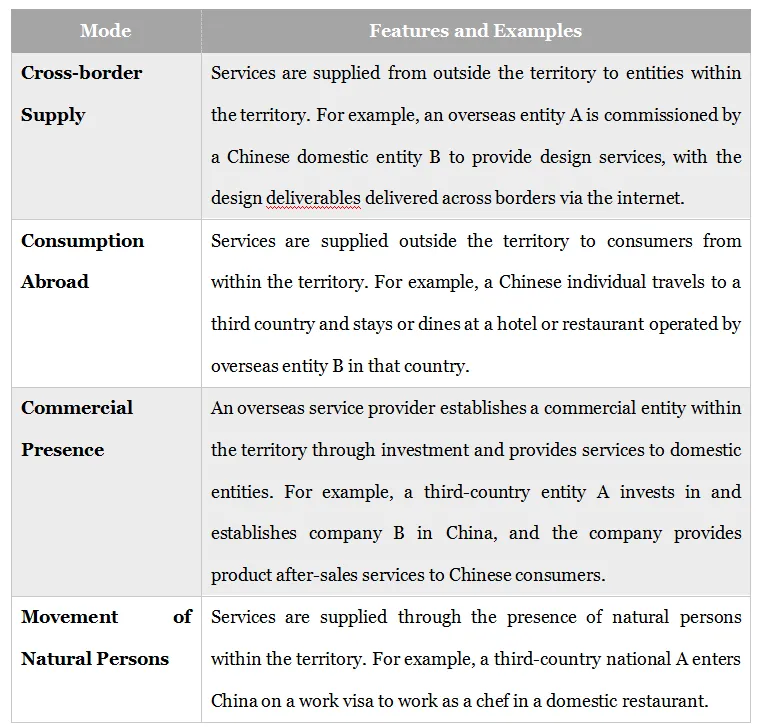
At the same time, Article 31 of the new Foreign Trade Law also reflects China’s differentiated regulatory positioning for various modes of trade in services. For example, paragraph 3 of Article 31 provides that international trade in services conducted through the commercial presence mode shall be governed by the relevant provisions of the Foreign Investment Law. For international trade in services conducted through cross-border supply, consumption abroad and presence of natural persons, paragraph 1 of Article 31 uniformly categorizes them as “cross-border” trade in services and introduces corresponding regulatory measures. Although GATS does not adopt such classification of modes of trade in services, similar classification can be found in CPTPP, which represents a higher level of openness. Chapter 10 of CPTPP sets out disciplines on cross-border trade in services. According to Article 10.1 of CPTPP, cross-border trade in services under this chapter includes trade in services through cross-border supply, consumption abroad and presence of natural persons, but excludes the provision of services through investments within the territory of a member.
2. Negative list for cross-border trade in services: from pilot free trade zones to a nationwide system
For international trade in services conducted through the mode of commercial presence, the Foreign Investment Law, which came into effect in 2020, has established a unified negative list management system for foreign investment. This negative list specifies sectors in which foreign investment is prohibited or restricted, while granting national treatment to foreign investment outside the list. For cross-border trade in services conducted through cross-border supply, consumption abroad and presence of natural persons, the newly revised Foreign Trade Law formally establishes, at the legal level, a negative list management system.
Taking the current national version of negative list as an example, the list uniformly specifies special regulatory measures that apply to overseas service providers in specific areas and specific service categories, covering areas such as national treatment, market access, local presence, cross-border trade in financial services. The list contains a total of 71 items. Compared with the negative list applicable in pilot free trade zones, it imposes additional restrictions only in a limited number of sectors. For service sectors not included on the list, regulation is carried out based on the principle of equal treatment for domestic and foreign services and service providers.
At the same time, while enhancing opening-up, the above negative list also fully takes into account major security risks. For example, the list sets out detailed special management measures for cross-border trade in services in areas such as information technology, finance and culture. It also makes clear that measures not included on the list, including those related to national security, public order, financial prudential regulation, social services, biological resources, research and development in the humanities and social sciences, new forms of cultural business, cultural relic protection, aviation traffic rights, immigration and employment, as well as exercise of governmental functions, shall continue to be governed by existing regulations.
Implications:
The new Foreign Trade Law formally incorporates the negative list regime for cross border trade in services, a practice that has already been expanded nationwide from China’s pilot free trade zones. This is another solid step forward in the country’s efforts to advance institutional opening up. Based on the current negative list, it is foreseeable that, as China continues to advance high-standard opening-up, the various special regulatory measures set out in the list will be further streamlined. At the same time, the negative list provides more stable expectations for entities engaged in cross-border trade in services. For service sectors not included on the list, enterprises and individuals may actively carry out relevant business activities. For sectors on the list that are subject to restrictive requirements, enterprises and individuals may also engage in relevant business activities on the basis of a thorough understanding of the regulatory requirements.
One Week in Shanghai
Latest News
1. Third Batch of Shanghai Innovative Enterprise Headquarters Awarded
[Keywords: Innovative enterprise headquarters]
Recently, the awarding ceremony for the third batch of Shanghai innovative enterprise headquarters was held. Gong Zheng, Mayor of Shanghai attended the ceremony and awarded plaques to 44 innovative enterprise headquarters. The awarded enterprises cover key areas of strategic emerging industries such as integrated circuits, biopharmaceuticals, artificial intelligence and the digital economy.
Source: Shanghai Municipal Development & Reform Commission
2. Shanghai Receives 16.9016 Million Tourist Trips During May Day Holiday
[Keywords: May Day, Tourists]
During this year's May Day holiday, Shanghai received a total of 16.9016 million tourist trips, representing a year-on-year increase of 2.43%. The hotel room occupancy rate in the city reached 72.80%. The total tourism-related spending in Shanghai during the May Day holiday, including food, accommodation, transportation, sightseeing, shopping and entertainment, was estimated at 21.51 billion yuan.
Source: International Services Shanghai
Corporate Activities
1. AtlasCopco Industrial Technique Customer Experience Center Commences Operation in Shanghai Songjiang
[Keywords:AtlasCopco]
Recently, the AtlasCopco Industrial Technique Customer Experience Center commenced operation in Shanghai Songjiang. The center comprises three major exhibition areas, which systematically showcase the full-chain value from the Smart Assembly concept and cutting-edge integrated hardware and software solutions to real cross-industry application cases.
Source: Shanghai Songjiang
2. Lindt Opens its First Store in China on Huaihai Middle Road
[Keywords: Lindt]
Lindt recently began trial operations for its first store in China on the first floor of Longfeng·PRSCO on Huaihai Middle Road. The store offers a wide range of classic chocolate products, along with special chocolate gift boxes featuring Shanghai-themed elements.
Source: Shanghai Huangpu
Competitive Events
2026 IRONMAN 70.3 Shanghai Chongming Set to Return
[Keywords: IRONMAN 70.3]
The 2026 IRONMAN 70.3 Shanghai Chongming will take place on May 17 in the Guangming Tianyuan Scenic Area. The event is expected to attract nearly 1,500 athletes from 66 countries and regions, reaching a new record high in both participation scale and international representation.
Source: Shanghai Chongming
Culture & Arts
"Giorgio Morandi: Solo" to Open at Museum of Art Pudong on June 17
[Keywords:Giorgio Morandi]

Starting from June 17, the Museum of Art Pudong will present the exhibition "Giorgio Morandi: Solo" in collaboration with the Morandi Museum in Bologna, Italy. As the largest Morandi exhibition in this century, it will showcase more than 200 exhibits, including over 140 original works by Morandi, representing the most comprehensive and systematic presentation in this century.
Source: Museum of Art Pudong MAP