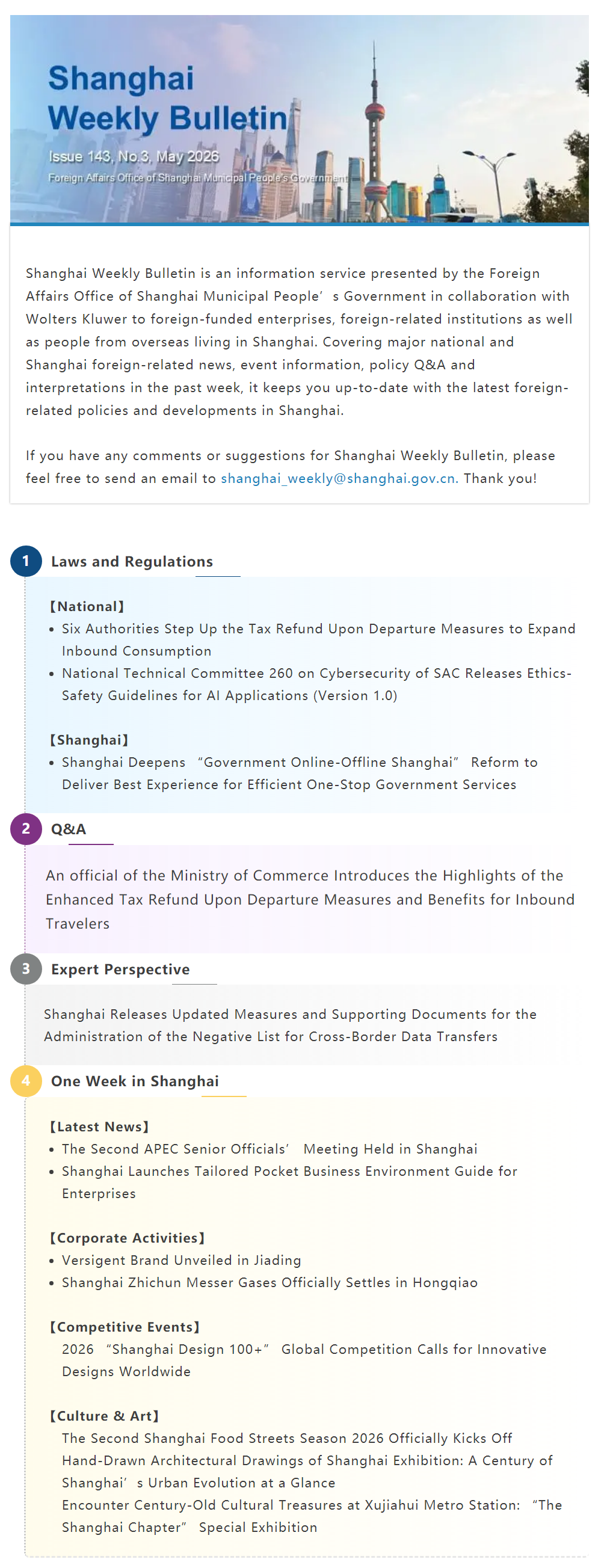
Shanghai deepens reform to deliver best experience for efficient one-stop government services (Issue 143)
Laws and Regulations
National
1. Six Authorities Step Up the Tax Refund Upon Departure Measures to Expand Inbound Consumption
[Keywords: Tax refund on departure, Inbound consumption]
Recently, the Ministry of Commerce (MOFCOM) and five other departments released the Notice on Stepping Up Efforts to Optimize Tax Refund Upon Departure Measures and Expand Inbound Consumption. The document proposes eight measures such as expanding coverage of tax refund stores, implementing random inspections for small-amount claims, and optimizing the “refund upon purchase” service. These measures aim to further optimize the “tax refund upon departure” measures and facilitate and expand inbound consumption.
Source: MOFCOM
2. National Technical Committee 260 on Cybersecurity of SAC Releases Ethics-Safety Guidelines for AI Applications (Version 1.0)
[Keywords: AI technology, Application ethics]
Recently, the National Technical Committee 260 on Cybersecurity of SAC (tc260) released the Ethics-Safety Guidelines for Artificial Intelligence Applications (Version 1.0). Focusing on the development, provision, and use of AI applications the document sets out key principles including promoting human wellbeing, respecting the right to life, ensuring fairness and justice, maintaining reasonable risk control, enhancing openness and transparency, protecting privacy and security, and ensuring that AI systems remain controllable and trustworthy.
Source: tc260
Shanghai
Shanghai Deepens "Government Online-Offline Shanghai" Reform to Deliver Best Experience for Efficient One-Stop Government Services
[Keywords: Government Online-Offline Shanghai]
Recently, the General Office of Shanghai Municipal People’s Government issued the Action Plan of Shanghai for Deepening the “Government Online-Offline Shanghai” Reform to Deliver Best Experience for Efficient One-Stop Government Services. The document introduces 26 measures across six areas. To further enhance the internationalization of government services, the document proposes a continued focus on the needs of foreign nationals by improving the service capabilities and professionalism of the International Services Shanghai portal. Measures include establishing dedicated service sections and launching a range of more convenient and personalized services.
Source: International Services Shanghai
Q&A
At a press conference held by the State Council Information Office (SCIO) on measures to further optimize the tax refund upon departure policies and expand inbound consumption, an official from the MOFCOM answered questions from the media.
Q
Compared with last year’s Version 1.0 tax refund upon departure optimization policy, what are the highlights of the newly introduced measures? What tangible conveniences will they bring to inbound travelers?
A
The newly-introduced Version 2.0 tax refund upon departure policy represents an upgraded package of measures building on last year’s policy framework. Focusing on achieving “more stores, less waiting time, paperless processing, and standardized services”, the new measures are designed to further facilitate the tax refund upon departure procedures for travelers, improve the inbound consumption environment, and strengthen the “Shop in China” brand.
"More stores" means expanding the network of departure tax refund stores. In response to the currently limited coverage, the Version 2.0 policy encourages more qualified merchants to register as tax refund stores and optimize their spatial layout. Efforts will be made to fully leverage the leading role of international consumption center cities and pilot cities for internationalized consumption environment development. By supporting local authorities in selecting key commercial districts, tourist attractions, marketplaces, and ports with high volumes of overseas visitors, we aim to achieve near-full coverage of tax refund stores in major locations. In addition, to facilitate shopping and tax refund services for exhibitors and business visitors attending major exhibitions in China, including the China International Import Expo, the China Import and Export Fair, and the China International Consumer Products Expo, support will be provided for the establishment of dedicated tax refund upon departure service areas at exhibition venues, creating integrated tax refund service platforms for major trade fairs.
"Less waiting time" means reducing customs verification times at departure ports. Since the launch of the Version 1.0 policy last year, the volume of the tax refund upon departure transactions has increased significantly, with the number of applications in the first quarter of 2026 rising nearly fivefold year on year. To improve processing efficiency, the Version 2.0 policy draws on international practices by introducing a random inspection mechanism for application forms involving a tax-refundable sales amount below RMB 10,000. Only travelers selected through random checks will be required to undergo physical customs inspection of the goods, which is expected to substantially reduce queueing times at departure ports.
“Paperless processing” aims to enhance the digitalization of tax refund services. Our research revealed that some travelers failed to claim refunds because they had lost their paper application forms or sales invoices. To address this issue, the Version 2.0 policy introduces paperless tax refund processing. After customs authorities or authorized service agencies enter the traveler’s identity information, the system will automatically retrieve the application forms and invoice information, eliminating the requirement to present paper documents. Travelers who prefer traditional paper-based processing may still continue to use that method. It should also be noted that both the paperless processing measure and the random inspection mechanism for small value refunds will officially take effect on July 1 this year.
“Standardized services” focuses on optimizing the “refund upon purchase” service. During the nationwide expansion of the pilot program, issues have emerged such as the lack of mutual recognition across different regions and inconsistent departure deadlines among localities. In response, the MOFCOM, together with relevant departments, is actively coordinating with authorized service agencies to promote cross regional mutual recognition of the “refund upon purchase” service, enabling travelers to complete tax refund procedures at ports of departure outside the place of purchase. At the same time, we are guiding service agencies to extend the departure deadline for the service across different regions to 28 days nationwide. Authorized agencies, including Bank of China and Industrial and Commercial Bank of China, have also developed self-service tax refund machines and deployed them in shopping malls to provide standardized and automated services.
Going forward, we will continue to work with relevant departments to strengthen information sharing and business coordination, making it more convenient for overseas travelers to access information and complete tax refund procedures. Through more efficient and integrated services, we aim to deliver a smoother “one stop” experience, enabling foreign visitors to enjoy a more convenient and rewarding consumption experience in China.
Source: SCIO
Expert Perspective
Shanghai Releases Updated Measures and Supporting Documents for the Administration of the Negative List for Cross-Border Data Transfers
By Dong Xiao, Wang Weihua, Rao Jiacheng [JunHe LLP]
[Continued from the Previous Issue]
[Article Summary]
Under Shanghai’s updated Administrative Measures for the Negative List for Cross-Border Data Transfers (“Updated Measures”), enterprises seeking to transfer data overseas through the negative list mechanism are required to file records with the district authorities where they are located, and submit information on the data intended for export. The Shanghai Cyberspace Administration, together with the Shanghai Data Administration, will review the application and provide the feedback. If the data transfer does not fall within the scope of the negative list, enterprises shall proceed in accordance with existing regulations. If the transfer falls within the negative list, enterprises must lawfully conduct a security assessment, execute a standard contract, or obtain certification. Data outside the list may flow across borders in an orderly and lawful manner.
Even where the negative list mechanism applies, enterprises are still required to fulfill obligations including notification and obtaining separate consent, conducting personal information protection impact assessments, defining data protection responsibilities, and adopting necessary security measures. Companies must also strengthen ongoing and ex post compliance management by retaining logs, promptly updating filings in the event of changes, reporting and remedying risk incidents, cooperating with inspections and spot checks, and submitting annual reports on overall cross-border data transfer activities at year end.
The Updated Measures are expected to streamline cross-border compliance procedures for enterprises.
[Article Details]
III. Procedures for Implementation
Enterprises conducting cross-border data transfer activities under the negative list mechanism are required to submit filing applications to the district authorities where they are located in accordance with the Updated Measures and related supporting documents. Applicants must provide information including the basic details of the data intended for cross-border transfer.
The filing applications will be reviewed by the Shanghai Cyberspace Administration together with the Shanghai Data Administration, which will provide enterprises with the filing review results upon completion of the review, including:
- Where the cross-border data is not subject to the negative list, the transfer shall be governed by existing laws and regulations, including the Regulations on Network Data Security Management and the Provisions on Promoting and Regulating Cross-Border Data Flows;
- Where the cross-border data falls within the scope of the negative list, enterprises shall, in accordance with the Updated Measures, apply for a cross-border data security assessment, execute standard contracts for the cross-border transfer of personal information, or obtain personal information protection certification;
- Where the cross-border data falls outside the scope of the negative list, the data may flow across borders freely in a lawful and orderly manner.
It should be noted that while the negative list mechanism may simplify or exempt certain compliance pathways and regulatory procedures for cross-border data transfers, enterprises are still required to fulfill other obligations prescribed by laws and regulations. These include obtaining informed and separate consent, conducting personal information protection impact assessments, defining data protection responsibilities, and adopting necessary technical security measures.
The Updated Measures and related supporting documents further strengthen ongoing and ex post compliance requirements. These include:
- retaining logs related to cross-border data transfers,
- promptly updating filing information when there are changes to cross-border transfer activities,
- taking remedial measures and reporting in the event of data transfer security incidents or identified security risks,
- cooperating with regular inspections and random spot checks, and
- submitting an annual report on the entity’s cross-border data transfer activities before the end of each year. (The annual report is required to specify information including the categories of cross-border data, the applicable industry sectors and scenarios under the negative list, the total annual volume of cross-border data transfers, the destinations of the data transfers and the names of overseas recipients, changes to cross-border transfer activities, and any security incidents related to cross-border data transfers.)
The release and implementation of the Updated Measures and related supporting documents mark another important step forward for Shanghai in promoting the efficient, convenient, and secure cross-border flow of data. Previously, enterprises in Shanghai located outside free trade zones were generally required to apply for cross-border data security assessments, execute standard contracts for the cross-border transfer of personal information, or obtain personal information protection certification. Under the new framework, however, enterprises that satisfy the industry sectors, cross-border transfer scenarios, and applicable scope specified in the relevant local negative lists may make use of the negative list mechanism to simplify or even exempt certain compliance pathways and regulatory procedures for cross-border data transfers. These new measures are worthy of close attention from relevant enterprises.
One Week in Shanghai
Latest News
1. Second APEC Senior Officials' Meeting Held in Shanghai
[Keywords: APEC, Senior Officials’ Meeting]
From May 18 to 19, the Second Senior Officials’ Meeting of the 2026 Asia Pacific Economic Cooperation (APEC) was held in Shanghai. Prior to the meeting, nearly 40 meetings of APEC committees and working groups were convened from May 11 to 17, covering areas such as trade and investment, economic and technical cooperation, women’s development, telecommunications, and food safety. More than 1,000 representatives from member economies, the APEC Secretariat, and observer organizations attended the events.
Source: International Services Shanghai
2. Shanghai Launches Tailored Pocket Business Environment Guide for Enterprises
[Keywords: Business environment, Practice]

Recently, the 2026 Practical Guide to Shanghai's Business Environment officially launched. The guide systematically integrates enterprise-related public service platforms, administrative portals, and support measures that were previously scattered across different government departments. Focusing on the entire lifecycle of businesses, it organizes services into 30 practical scenarios across six major sections, providing more than 60 service resources and administrative guidelines. QR codes are also included throughout the guide to enable instant access and convenient use.
Source: Shanghai Release
Corporate Activities
1. Versigent Brand Unveiled in Jiading
[Keywords: Versigent]
Recently, the unveiling ceremony of the Versigent brand was held in Anting, Jiading District. Leveraging Jiading’s well-established automotive industry ecosystem and the advantages of the Chinese market, Versigent will continue to enhance its R&D, manufacturing, and delivery capabilities in response to the growing demand for electric, intelligent, and highly automated vehicles. The company aims to provide more efficient and reliable electrical architecture solutions to support the transformation and upgrading of the automotive industry.
Source: Invest in Jiading
2. Shanghai Zhichun Messer Gases Officially Settles in Hongqiao
[Keyword: Messer]
Recently, Shanghai Zhichun Messer Gases Co., Ltd. officially established operations in the Hongqiao International Central Business District in Minhang District. The company is jointly established by Messer Griesheim (China) Investment Co., Ltd., which holds a 60% stake, and Shanghai Zhichun Precision Gas Co., Ltd., which holds the remaining 40% stake, with a registered capital of RMB 100 million. The company is committed to strengthening support for the regional high-end manufacturing industrial chain and accelerating the development of China’s domestic wafer industry.
Source: Nanhongqiao Release
Competitive Events
2026 "Shanghai Design 100+" Global Competition Calls for Innovative Designs Worldwide
[Keywords: “Shanghai Design 100+” Global Competition]
Recently, the 2026 “Shanghai Design 100+” Global Competition officially issued its call for entries, inviting enterprises, design institutions, and designers from around the world to submit innovative design works completed between January 1, 2025 and June 18, 2026. Eligible submissions span a wide range of fields, including industrial design, fashion design, architectural design, digital design, and service design. The submission deadline is June 18, 2026.
Source: Shanghai Municipal Commission of Economy and Informatization
Culture & Art
1. The Second Shanghai Food Streets Season 2026 Officially Kicks Off
[Keywords: Shanghai Food Streets Season]

Recently, the Second Shanghai Food Streets Season 2026 officially kicked off. Themed “Savor the Flavor of Featured Streets and Enjoy the Charm of the Americas”, the event will run through June 30. The festival features an opening ceremony, a package of promotional subsidy policies, and themed activities across 10 featured streets under the concept of “One Street, One Specialty”. Participating streets will also recommend a range of American-style restaurants and specially curated discount set menus.
Source: Shanghai Commerce
2. Hand-Drawn Architectural Drawings of Shanghai Exhibition: A Century of Shanghai's Urban Evolution at a Glance
[Keywords: Hand-drawn architectural drawings]

Recently, the original exhibition “Essence Rekindled, Heritage Renewed: Hand-Drawn Architectural Drawings of Shanghai”, co-organized by the Shanghai History Museum and Shanghai Institute of Architectural Design & Research Co., Ltd. (SIADR), is open to the public free of charge. Featuring more than 30 representative architectural projects, the exhibition systematically traces the evolution of architectural preservation and design from ancient pagodas and temples to modern urban landmarks through designers’ sketches and historical archives. It highlights Shanghai’s inspiring story of preserving cultural heritage while fostering innovation and urban renewal. The exhibition will run through June 21.
Source: Huangpu Cultural Heritage and Museums
3. Encounter Century-Old Cultural Treasures at Xujiahui Metro Station: “The Shanghai Chapter” Special Exhibition
[Keyword: Pagodas]

The special exhibition “The Shanghai Chapter: A Century Retrospect of Chinese Pagodas & Archway” was officially opened to the public starting from May 16. The exhibition unveils the century-long legacy of Shanghai-style craftsmanship. Centered on ornate archways produced by the T’ou-Sè-We Art and Craft Institute in Shanghai and pagoda models represented by the Porcelain Pagoda of Nanjing’s Great Bao’en Temple, the exhibition presents the historical convergence of Chinese and Western cultures from the late Qing Dynasty to the modern era.
Source: Xuhui Culture and Tourism