Five authorities issue action plan to promote high-quality development of fashion consumer goods industry (Issue 146)
Laws and Regulations
National
1. MIIT Issues Implementation Opinions on Innovative Development of "AI+ Information and Communications"
[Keywords: Artificial intelligence, Information and communications]
Recently, the Ministry of Industry and Information Technology (MIIT) issued the Implementation Opinions on Promoting the Innovative Development of “AI+ Information and Communications” (2026–2028). The document sets the goal that by 2028, China aims to bring the intelligent operation and service capabilities of the information and communications sector to an internationally advanced level, achieve the initial deployment of highly autonomous information and communications networks, develop more than 30 high-value use cases, and foster a number of flagship applications and specialized AI agents.
Source: Website of the Chinese Government
2. Five Authorities Issue Circular to Further Streamline Property Transfer Registration for Enterprise Real Estate Purchases
[Keywords: Real estate, Transfer registration]
Recently, the Ministry of Natural Resources, together with four other authorities, jointly issued the Circular on Advancing the Efficient Handling of Property Transfer Registration for Enterprise Real Estate Purchases as a One-Stop Service. The document introduces seven reform measures focused on the efficient handling of property transfer registration for enterprise real estate purchases as a one-stop service, further advancing the reform of real estate registration facilitation.
Source: Ministry of Natural Resources
3. PBC Seeks Public Comments on Regulations Governing RMB Deposit and Lending Rates
[Keywords: RMB, Deposit and lending rates]
Recently, the People’s Bank of China (PBC) released the Regulations on the Administration of Renminbi Deposit and Lending Rates for public consultation. The proposed revisions focus on four key areas: strengthening the regulatory framework for RMB deposit and lending rates; clarifying the respective responsibilities of the PBC and financial institutions with regard to deposit and lending rate management; consolidating interest calculation and settlement rules for deposits and loans from various regulations and documents; and revising provisions that have attracted significant market attention. The deadline for submitting comments is July 5, 2026.
Source: PBC
Shanghai
1. Five Authorities Issue Action Plan to Promote High-Quality Development of the Fashion Consumer Goods Industry
[Keywords: Fashion consumer goods]
Recently, the Shanghai Municipal Commission of Economy and Informatization and four other authorities jointly issued the Action Plan of Shanghai for Promoting the High-Quality Development of the Fashion Consumer Goods Industry (2026–2028). The document focuses on enhancing the supply of high-quality products, fostering an innovation-driven ecosystem, and strengthening policy support and coordination. It sets out the goal that by 2028, the city’s consumer goods manufacturing sector will exceed RMB 750 billion in scale, while the fashion consumer goods industry will surpass RMB 500 billion.
Source: Shanghai Municipal Commission of Economy and Informatization
2. Shanghai Expands and Upgrades Pilot Program for High-Standard Opening-Up in Cross-Border Trade
[Keywords: Cross-border trade]
Recently, the Implementation Rules of the Shanghai Branch of the State Administration of Foreign Exchange for the Pilot Program on High-Standard Opening-Up in Cross-Border Trade was released. The document provides that prudent and compliant banks may, in accordance with the three principles for conducting business operations, offer qualified enterprises pilot facilitation measures for current account foreign exchange receipts and payments.
Source: Shanghai Head Office of the PBC
3. Shanghai Launches Pilot Program for VAT and Surcharges Filing
[Keywords: Value-added tax, Surcharges and Fees]
Recently, the Shanghai Municipal Tax Service of the State Taxation Administration issued the Announcement on Launching a Pilot Program for the Filing of Value Added Tax and Surcharges and Fees. Beginning on June 5, 2026, a pilot program for the filing of value added tax (VAT) and related surcharges and fees will be carried out among selected VAT taxpayers in Shanghai. The specific scope of participating taxpayers will be determined by the Shanghai Municipal Tax Service of the State Taxation Administration.
The Announcement took effect on June 5, 2026.
Source: Shanghai Tax
Q&A
At a press conference held by the Shanghai Municipal Government Information Office on the overall arrangements for the 2026 “Shanghai Summer” International Consumption Season, an official of the Shanghai Municipal Commission of Commerce answered a reporter’s question:
Q
Since its launch, “Shanghai Summer” has consistently focused on attracting inbound consumption. What new measures have been introduced during this year’s consumption season to better serve overseas visitors?
A
Drawing on feedback from inbound travelers over the past few years, the “Shanghai Summer 2026” International Consumption Season will upgrade services in six areas: transportation, accommodation and dining, customized services, digital convenience, payment services, and departure tax refunds. The version 3.0 themed service package will be introduced.
In terms of transportation services, China Eastern Airlines will launch the “China Eastern Summer Arrival Privileges in Shanghai” program and open five new direct international routes, including the Shanghai–Zurich route. At the same time, limited-time promotional offers for “Travel across East China” will be made available on domestic routes. Multiple flight products, including the “Fly Shanghai Pass” and the “Fun Travel Pass”, have been introduced, alongside dedicated travel guides for major attractions and bundled flight-and-attraction packages. In partnership with quality hotels, the program will offer one-stop booking for flights, attraction tickets, and hotel accommodation.
In terms of accommodation and dining, Jin Jiang International launched the upgraded Passport 2.0, integrating resources from more than 200 hotels, 30,000 guest rooms, and over 90 international cuisines across Shanghai. Combined with promotional offers such as advance purchase vouchers and benefits for consecutive stays, it creates a seamless connection between dining and travel experiences. Inbound visitors are able to access bilingual Chinese and English benefits under the Passport 2.0 simply by scanning a QR code or using NFC technology, allowing the world to savor the flavors of Shanghai.
In terms of customized services, the international version of Umetrip will launch a dedicated “Shanghai Customization” information service section. Designed for inbound travelers, it will provide multilingual guides, brand and merchant information, and map navigation services for major customization clusters, including the South Bund Customization Center, the Yuyuan Gold and Jewelry Customization Zone, and the International Optical City. The English version of Amap will leverage AI technology to create a “Shanghai Tailored” consumption map, connecting a wide range of customized services across different sectors, including bespoke apparel, custom jewelry, and optometry and eyewear fitting. The initiative aims to offer inbound visitors a personalized “Shanghai Customization” experience, complemented by exclusive promotions and joint discount offers.
In terms of digital convenience services, the “Easy Go 2.0” inbound travel service platform will be launched with upgraded “Shanghai Summer” themed services. Powered by AI technology integrated through Alipay, the platform will accurately recognize user instructions in multiple languages and intelligently connect users to a range of everyday services, including ride hailing, ticket booking, and translation, providing smart digital services. In addition, the “Shanghai Pass + Easy Go” inbound travel package and an NFC-enabled overseas digital card will be introduced.
In terms of payment services, China UnionPay will provide inbound visitors with a one-stop digital service experience through the Nihao China App and will introduce an upgraded “Shanghai Summer” themed card. Leveraging the UnionPay app, it will also launch the “Worry-Free Payments, Enjoy Shopping in Shanghai” promotional campaign to stimulate consumption. The Visa Shanghai Summer Payment Friendly Demonstration Zone will continue to evolve, expanding inbound payment acceptance to more small and micro merchants and making “tap to pay” and “scan to pay” more accessible and convenient. Ant Group will join hands with tens of millions of merchants to launch the “Touch and Discover” Shanghai Summer Consumption Carnival. Through innovative solutions such as AI-empowered payments, the initiative aims to amplify the multiplier effect of consumer spending.
In terms of departure tax refunds, taking the implementation of the national departure tax refund 2.0 policy as an opportunity, three key measures will be introduced. First, a mobile platform for departure tax refund services will be launched, enabling inbound visitors to complete shopping registration, instant tax refunds upon purchase, customs verification, and departure tax refund procedures directly on their mobile phones. Second, inbound visitors will be able to complete “refund upon purchase” procedures through self-service kiosks and choose to have their tax refunds credited either to electronic payment accounts or to major credit cards. Third, digital customs verification services at ports of departure will be upgraded. At airports, inbound visitors will be able to use self-service inquiry terminals and intelligent verification machines to check information and complete customs verification and tax refund procedures. In addition, the Bank of China will introduce exclusive spending discounts and Chinese-style gift packages for overseas travelers eligible for tax refunds. Going forward, we will continue to roll out a series of measures to enhance convenience and improve the overall consumer experience, helping inbound visitors fully enjoy the Shanghai Summer season.
Source: Shanghai Release
Expert Perspective
Observations on Foreign-Related Dispute Resolution in China in 2025: Institutional Innovation, Practical Developments and Future Prospects
By Liu Guolin and Duan Jiaqi [Grandall Law Firm]
[Continued from the previous issue]
Article Summary
In 2025, China advanced the coordinated development of the rule of law domestically and in foreign-related matters, strengthening its legal toolkit to respond to unilateral sanctions and safeguard national interests. In the area of export controls, China supplemented the Export Control Law with the Regulations on Export Control of Dual-Use Items and an updated technology catalogue. Mechanisms such as dynamic control lists, licensing administration, and end user/end use risk management have been put into practice, subjecting cross-border technology transfers and exports of core equipment to more stringent compliance reviews.
At the same time, the growing number of typical cases involving foreign-related dispute resolution reflects both the increasing internationalization of China’s judiciary and the pressures that come with it. For example, an arbitration case concerning a cross-border guarantee reaffirmed the independence of standby letters of credit and independent guarantees, holding that banks may not refuse payment on the basis of disputes arising from the underlying transaction. The case also confirmed the high threshold for invoking the fraud exception, underscoring the need for banks to strengthen due diligence and risk management.
Article Details
I. Key Developments and Highlights in China's Foreign-Related Dispute Resolution Framework in 2025
(V) Advancing the Rule of Law in Domestic and Foreign-Related Affairs in a Coordinated Manner: Building a Comprehensive Legal Toolkit
In 2025, China made solid progress in using legal means to respond to unilateral sanctions and safeguard national interests, developing a more comprehensive legal toolkit.
Further Improvement of the Export Control Legal Framework
Building on the Export Control Law, relevant authorities successively issued a series of supporting regulations and rules during 2024 and 2025, including the Regulations on Export Control of Dual-Use Items and the latest revised edition of the Catalogue of Technologies Prohibited or Restricted from Export by China. Mechanisms such as the dynamic adjustment of control lists, licensing administration, and end-user and end-use risk management have been fully implemented. These developments have provided China with a clearer and more robust legal basis for addressing risks associated with the cross-border movement of critical technologies and materials. As a result, enterprises face more stringent compliance reviews when engaging in cross-border technology transfers and exports of core equipment.
II. Analysis of Typical Foreign-Related Dispute Resolution Cases in 2025
A number of influential cases emerged in the field of foreign-related dispute resolution in 2025. These cases illustrate the circumstances in which international dispute resolution rules are applied and reflect the continuing internationalization of China's judiciary.
(I) International Commercial Arbitration: New Developments in the Application of Rules and Adjudicative Standards
A Cross-Border Guarantee Dispute Involving a Chinese-Funded Bank
In this case, a Chinese bank, acting as the issuing bank, issued a standby letter of credit in favor of an overseas lending bank in connection with an overseas acquisition project undertaken by a Chinese enterprise. Following a default by the guaranteed party, the overseas lending bank made a demand for payment under the standby letter of credit. The Chinese bank refused to honor the demand on the grounds that the guaranteed party had engaged in fraud. The arbitral tribunal held that a standby letter of credit possesses the characteristics of independence and documentary compliance. Accordingly, the issuing bank may not refuse payment on the basis of disputes arising from the underlying transaction and must make payment before seeking recourse. The tribunal further found that the documents submitted by the overseas lending bank were, on their face, compliant with the requirements of the standby letter of credit, and that there was no evidence that the lending bank had acted in bad faith or had knowledge of any fraud. Therefore, the bank could not invoke the fraud exception as a defense to payment. After making payment, the bank would be entitled to seek indemnification from the guaranteed party pursuant to the guarantee agreement and would enjoy priority in repayment.
The practical significance of this case lies in its reaffirmation of the “principle of independence” applicable to standby letters of credit and independent guarantees. The case underscores that banks are required to strictly honor their payment obligations, while the fraud exception serves only as a remedy in exceptional circumstances and is subject to a high evidentiary threshold. It is not intended to function as a routine defense against payment claims. To mitigate risks, Chinese banks issuing cross-border guarantee instruments should conduct thorough due diligence, ensure compliance with external debt registration requirements, and strengthen foreign exchange risk management, among other risk control measures.
[To Be Continued]
One Week in Shanghai
Latest News
1. 2026 Lujiazui Forum to Be Held on June 17 and 18
[Keywords: Lujiazui Forum]
The Lujiazui Forum 2026 will be held on June 17 and 18, 2026. Under the theme “Financial Development and Cooperation Under the Global Governance Initiative: New Visions, New Challenges and New Opportunities”, the forum aims to bring together guests from China and abroad to discuss new visions for global financial governance, explore opportunities amid challenges, and open up new prospects through reform and innovation.
Source: Shanghai Release
2. The 48th WorldSkills Competition to Be Held in Shanghai from September 22 to 27
[Keywords: WorldSkills Competition]
The 48th WorldSkills Competition will be held in Shanghai from September 22 to 27. Organized by the WorldSkills International, the WorldSkills Competition is the world’s highest-level vocational skills competition and is held every two years.
Source: Shanghai Release
3. 2026 Shanghai Pop Culture and Trendy Summer Season Kicks Off
[Keywords: Shanghai Pop Culture and Trendy Summer Season]
The 2026 Shanghai Pop Culture and Trendy Summer Season has officially begun under the theme “My Passion, All in Shanghai Summer”. Running from June to August, the event is integrated with three major city brands: Shanghai Tonight, Shanghai Summer International Consumption Season, and Shanghai Tourism Festival. Together, they will create a dual-themed holiday experience centered on “trendy city exploration” and “family-friendly leisure travel”. A total of 30 featured events will be launched throughout the season, including eight cultural and arts activities, three commercial promotion campaigns, three tourism festivals and celebrations, eight sporting events, and eight exhibitions and convention related activities.
Source: Shanghai Release
4. "Shanghai Summer 2026" International Consumption Season to Launch in July
[Keywords: "Shanghai Summer" International Consumption Season]
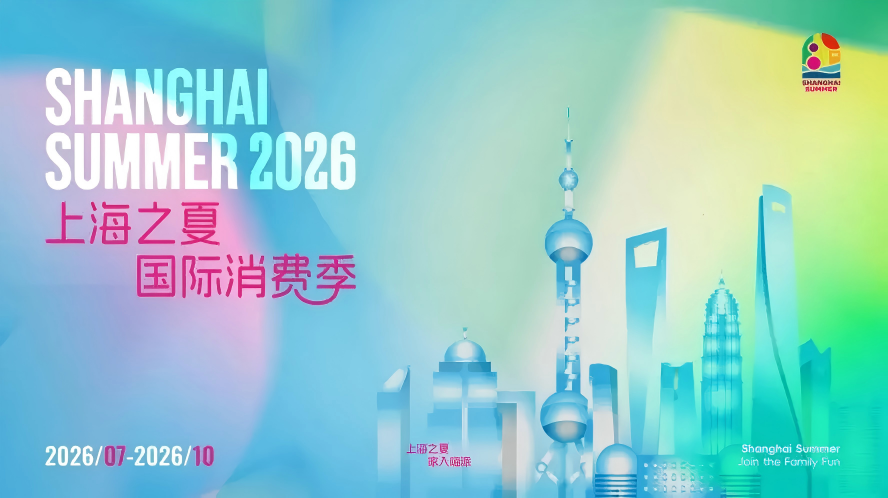
The “Shanghai Summer 2026” International Consumption Season will run from July through October. Under the theme “Shanghai Summer, Join the Family Fun”, this year’s event will be organized around the six letters of “S-U-M-M-E-R”, with six themed sections dedicated to sports, urban exploration, museums, music, entertainment, and relaxation. Together, these themed programs will showcase the vibrancy and appeal of Shanghai throughout the summer season.
Source: Shanghai Release
Corporate Activities
1. Atlas Copco Group Establishes Its First Localized Vacuum Business Entity in Waigaoqiao
[Keywords: Atlas Copco Group]
Recently, Atlas Copco Group established its first independent, localized market entity in China under its vacuum technique business segment. The new company, Shanghai Hongwei Vacuum Technology Co., Ltd., has completed registration in the Waigaoqiao Free Trade Zone.
The company has also announced plans to begin construction of a local manufacturing facility and research and development center in 2026, aiming to better meet the needs of China’s high-end manufacturing sectors, including semiconductor and new energy industries.
Source: Pudong Release
2. Chia Tai Tianqing Opens Global R&D Headquarters in Hongqiao Qianwan
[Keywords: Chia Tai Tianqing]
Recently, the global research and development headquarters of Chia Tai Tianqing Pharmaceutical Group, built with a total investment of RMB 1.8 billion, officially commenced operations in Hongqiao Qianwan. An international biopharmaceutical innovation and development forum themed “Innovation Without Boundaries, Advancing Biopharmaceutical Development” was held on the same day to mark the opening. According to the company, the global R&D headquarters will serve as a base for building an interdisciplinary and cross-industry innovation incubation park. Leveraging its location in the Yangtze River Delta region, the project aims to empower upstream and downstream sectors and help establish the region as a leading source of biopharmaceutical innovation.
Source: Minhang Today
Culture & Art
1. "Dawn of the First Empire: The Qin's Unification Archaeological Treasures" Opens
[Keywords: Qin culture]
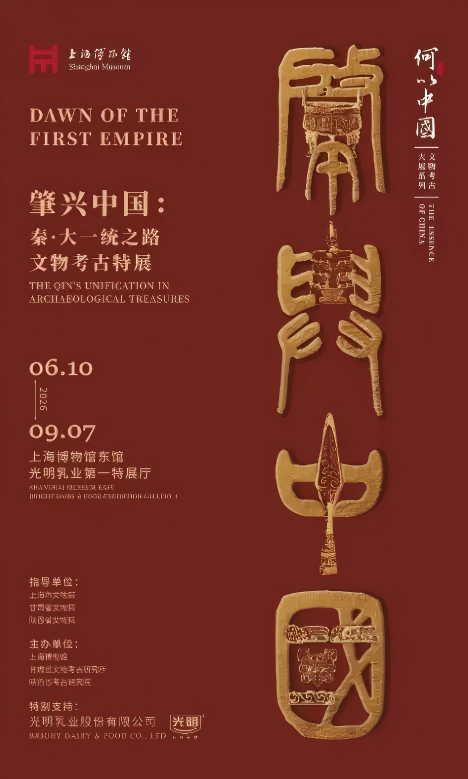
On June 9, the special archaeological exhibition “Dawn of the First Empire: The Qin’s Unification Archaeological Treasures” opened at the Shanghai Museum East. The exhibition brings together 328 sets and 510 cultural relics from 14 archaeological and museum institutions in Gansu, Shaanxi and Shanghai. Using archaeological discoveries as its foundation and the development of Chinese civilization as its central narrative, the exhibition presents a comprehensive account of the Qin people’s remarkable journey from a frontier tribe in eastern Gansu to the force that unified China.
Source: Shanghai Museum
2. The 16th International Exhibition of Traditional Fine Arts Opens
[Keywords: International Exhibition of Traditional Fine Arts]
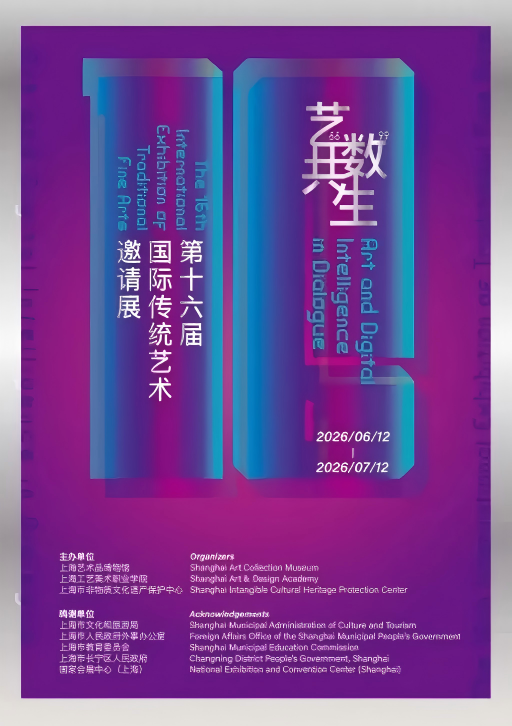
On June 12, the “Art and Digital Intelligence in Dialogue — 16th International Exhibition of Traditional Fine Arts” officially opened at the Shanghai Art Collection Museum. The exhibition features more than 180 outstanding works from 38 countries. Highlights include Chinese and European paintings that blend the language of classical oil painting with the spirit of contemporary life; Central Asian artworks that combine distinctive ethnic characteristics with modern aesthetic expression; North African crafts noted for their rich colors and decorative appeal; and digital creations by artists from countries including South Korea, France and Poland, integrating AI-generated technologies with diverse artistic media.
Source: Shanghai Changning Culture and Tourism
3. "On Top of the World Tree: Ancient Civilizations on the Americas" Exhibition Begins as Four Treasures of Ancient American Civilizations Make Their Debut
[Keywords: Ancient Civilizations on the Americas]
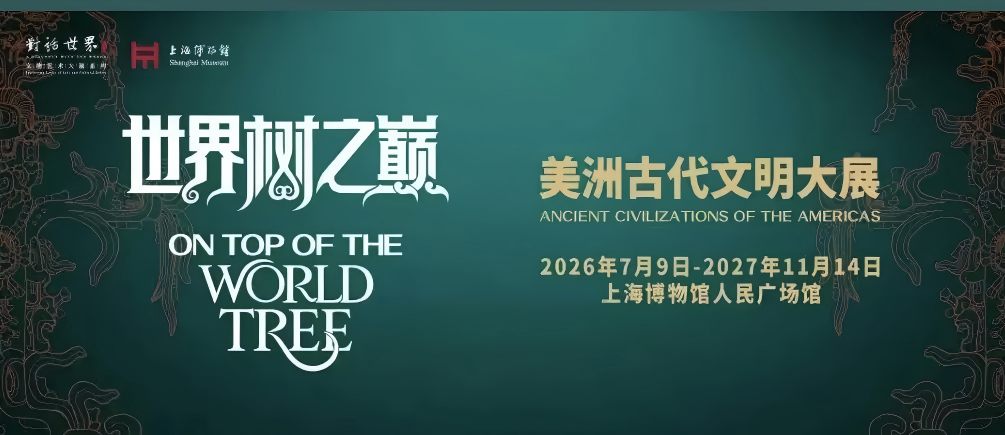
On June 11, four artifacts from the “On Top of the World Tree: Ancient Civilizations on the Americas” exhibition were unveiled during a special unboxing event at the Shanghai Museum on People’s Square, marking the beginning of the exhibition. The four key artifacts unveiled during the unboxing event were Monument 52 from San Lorenzo from the National Museum of Anthropology, Las Limas Monument 1 from the Museum of Anthropology of Xalapa, a ceramic vessel depicting Tlaloc, the Rain God, from the Templo Mayor Museum, and a gold headdress from the Larco Museum. All four are among the exhibition's centerpiece exhibits. They are representative relics of American civilizations such as the Olmec, Aztec and Chimú cultures, embodying the spiritual essence and artistic achievements of the ancient civilizations of the Americas.
Source: Shanghai Museum
4. "Imperial Colours — Qing Dynasty Court Costumes from the Palace Museum" to Open in Shanghai This July
[Keywords: Imperial costumes exhibition]
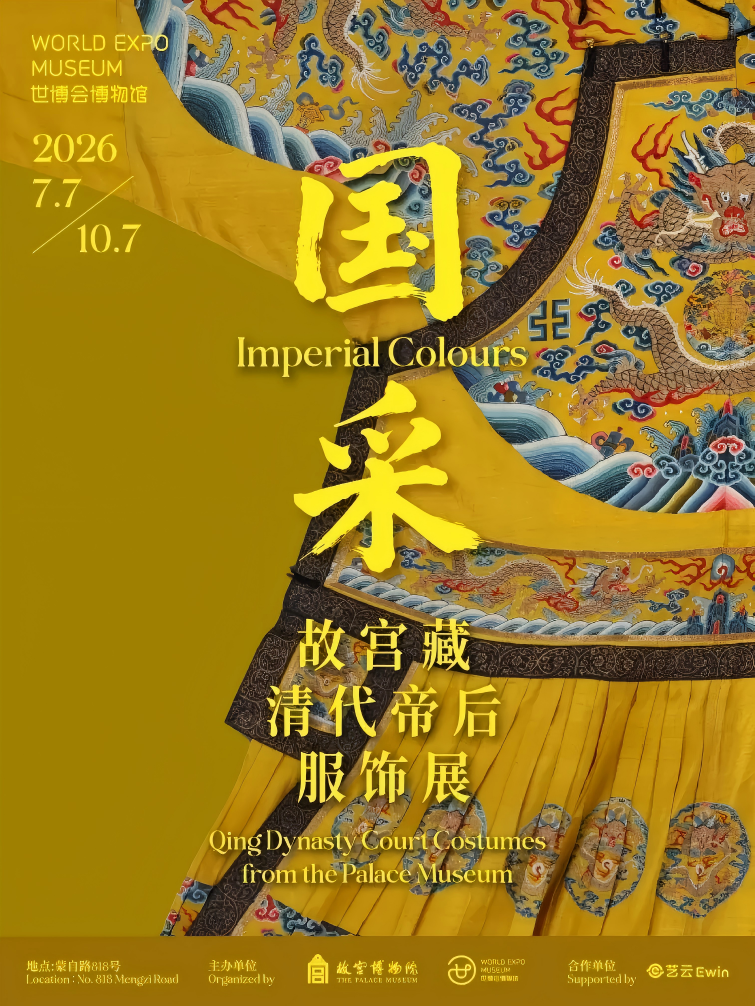
From July 7 to October 7, 101 textile and embroidered costume artifacts from the collection of the Palace Museum will be on display in Shanghai, offering visitors a glimpse into the finest traditions of Chinese aesthetics. The exhibition will also mark the first large-scale exhibition of imperial court costumes ever held in Shanghai.
Source: World Expo Museum