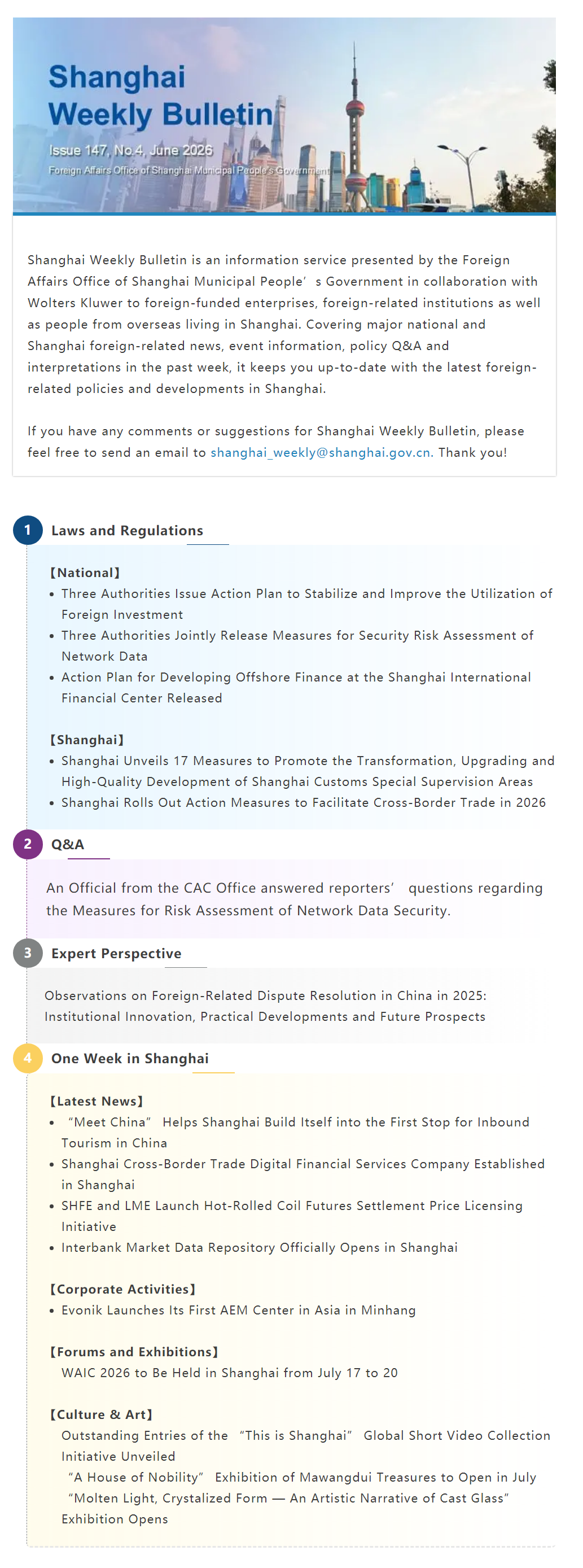
Shanghai rolls out action measures to facilitate cross-border trade in 2026 (Issue 147)
Laws and Regulations
National
1. Three Authorities Issue Action Plan to Stabilize and Improve the Utilization of Foreign Investment
[Keywords: Foreign investment]
The Ministry of Commerce, the National Development and Reform Commission, and the Ministry of Finance recently issued the Action Plan for Stabilizing and Improving the Utilization of Foreign Investment. The document sets out 15 measures in five key areas: expanding market access, enhancing the ease of foreign investment, boosting investment promotion, strengthening the service and support system for foreign-invested enterprises, and optimizing the management of foreign investment.
Source: Xinhua News Agency
2. Three Authorities Jointly Release Measures for Security Risk Assessment of Network Data
[Keywords: Network data, Security risk assessment]
On June 18, the Cyberspace Administration of China (CAC), together with two other authorities, jointly released the Measures for Security Risk Assessment of Network Data. The document clarifies the requirements, basis, and forms of security risk assessments, as well as provisions concerning the certification and development of assessment institutions and the notification of major risks. It also sets out requirements for the preparation, submission, and inspection of risk assessment reports. The document will take effect on August 20, 2026.
Source: CAC
3. Action Plan for Developing Offshore Finance at the Shanghai International Financial Center Released
[Keywords: Shanghai International Financial Center, Offshore finance]
Recently, the Peoples Bank of China (PBC), together with four other authorities and the Shanghai Municipal People’s Government, jointly issued the Action Plan for Developing Offshore Finance at the Shanghai International Financial Center. The document sets out key measures in areas including supporting pilot offshore financial initiatives in Pudong New Area, facilitating cross-border fund flows and account management, promoting digital applications, expanding offshore financial services, improving the legal framework for offshore finance, strengthening regulation and risk prevention, and enhancing overall implementation and coordination. The document is of great significance for accelerating the development of Shanghai as an international financial center and advancing high-standard financial opening-up on a broader scale and at a deeper level.
Source: PBC
Shanghai
1. Shanghai Unveils 17 Measures to Promote the Transformation, Upgrading and High-Quality Development of Shanghai Customs Special Supervision Areas
[Keywords: Customs special supervision areas]
Recently, the Shanghai Municipal Development & Reform Commission (SMDRC) issued the Several Measures on Promoting the Transformation, Upgrading and High-Quality Development of Shanghai Customs Special Supervision Areas. The document introduces 17 measures in four key areas: focusing on priority sectors, fostering the development of new business models and formats, optimizing regulatory mechanisms, and promoting intensive and efficient land use.
Source: SMDRC
2. Shanghai Rolls Out Action Measures to Facilitate Cross-Border Trade in 2026
[Keywords: Cross-border trade, Facilitation]
Recently, the Shanghai Municipal Commission of Commerce (SMCC), together with six other authorities, issued the Several Measures for the 2026 Special Action to Promote Cross-Border Trade Facilitation at Shanghai Ports. The document sets out 23 measures across four key areas: deepening innovation in customs clearance and regulatory models, optimizing regulatory services for new forms of foreign trade, improving the efficiency of cross-border logistics and transportation, and strengthening the development of smart ports and interconnectivity.
Source: SMCC
Q&A
An Official from the CAC Office answered reporters' questions regarding the Measures for Risk Assessment of Network Data Security.
Q1
How will unnecessary and overlapping inspections related to network data security be avoided?
A1
According to the document, under the guidance of the national coordination mechanism for data security, the CAC, together with relevant authorities under the State Council responsible for telecommunications, public security and other areas, will establish a dedicated mechanism for network data security risk assessments to guide and supervise risk assessment activities. In line with the principle of “whoever oversees the business, oversees the business data and data security”, competent authorities will organize risk assessments and related inspections within their respective industries and sectors. Annual risk assessment and inspection plans must be submitted to the CAC by the end of January each year. The CAC will share and coordinate these plans with relevant authorities responsible for telecommunications, public security and national security under the State Council to avoid unnecessary and overlapping inspections. In addition, the document expressly stipulates that, with respect to the same network data security incident or risk, network data processors shall not be repeatedly required to engage assessment institutions to conduct risk assessments.
Q2
How does the document strengthen ex-ante, ongoing and ex post supervision of risk assessments?
A2
To ensure full-chain and comprehensive supervision of risk assessment and risk mitigation activities before, during and after the event, the document sets out specific requirements:
First, competent authorities are required to organize regular risk assessments within their respective industries and sectors to promptly identify and prevent network data security risks.
Second, relevant authorities at or above the provincial level will examine and verify assessment reports submitted by important data processors. Where supervision, verification or other regulatory work reveals security risks in network data processing activities, network data processors may be required to undergo designated risk assessments.
Third, where important data processing activities identified during assessments are found to endanger national security or the public interest, relevant authorities shall promptly provide administrative guidance, including requiring rectification or suspending important data processing activities, in order to eliminate network data security risks.
Fourth, relevant authorities are required to strengthen the sharing of risk information and coordinate responses to identified risks.
Fifth, the document emphasizes the role of public oversight. Complaints and reports submitted by organizations or individuals must be handled in a timely manner by the relevant authorities.
Sixth, strict and impartial law enforcement will be carried out. Once the Measures takes effect, network data processors that fail to conduct risk assessments as required, or assessment institutions that conduct risk assessments in violation of the document, will be penalized in accordance with the law.
Source: CAC
Expert Perspective
Observations on Foreign-Related Dispute Resolution in China in 2025: Institutional Innovation, Practical Developments and Future Prospects
By Liu Guolin and Duan Jiaqi [Grandall Law Firm]
[Continued from the previous issue]
Article Summary
In 2025, a number of representative cases emerged in the field of international dispute resolution, highlighting significant advances in China’s judicial practice in foreign-related litigation, cross-border recognition and enforcement of judgments, and the overseas enforcement of arbitral awards. The mutual recognition and enforcement case involving a shareholder dispute in a Sino-foreign joint venture demonstrated that, with the deepening of the mechanism for reciprocal recognition and enforcement of civil and commercial judgments between the Chinese mainland and Hong Kong, the recognition and enforcement of Hong Kong court judgments in the Chinese mainland has become more stable and predictable, thereby strengthening confidence in cross-border commercial activities within the Guangdong-Hong Kong-Macao Greater Bay Area. Meanwhile, an arbitration case between a major Chinese state-owned infrastructure enterprise and the owner of an Indonesian power project marked the first successful recognition and enforcement of a CIETAC (China International Economic and Trade Arbitration Commission) arbitral award in Indonesia. The case has provided an important avenue for Chinese enterprises seeking to recover debts in Southeast Asia and has further enhanced the international influence of Chinese arbitral awards.
Article Details
II. Analysis of Typical Foreign-Related Dispute Resolution Cases in 2025
(II) Foreign-Related Litigation: Practical Breakthroughs in Jurisdiction, Injunctive Relief and Reciprocal Recognition of Judgments
Case on the Recognition and Enforcement of a Judgment in a Shareholder Dispute of a Sino-Foreign Joint Venture
In this case, a dispute arose between the shareholders of a Sino-foreign joint venture. Pursuant to the dispute resolution clause in the joint venture contract, the foreign shareholder initiated legal proceedings before a Hong Kong court and obtained a favorable judgment ordering the Chinese shareholder to transfer its equity interest. The foreign shareholder subsequently applied to an intermediate people’s court in Chinese mainland for recognition and enforcement of the Hong Kong judgment.
Upon review, the Chinese mainland court, in accordance with the Arrangement of the Supreme People’s Court on Reciprocal Recognition and Enforcement of Judgments in Civil and Commercial Matters by the Courts of the Chinese Mainland and of the Hong Kong Special Administrative Region, held that the Hong Kong court had properly exercised jurisdiction, the proceedings had been conducted in accordance with due process, and recognition and enforcement of the judgment would not contravene the public policy of the Chinese mainland. The court therefore ruled to recognize and enforce the Hong Kong judgment.
This case serves as a microcosm of the deepening judicial cooperation and mutual recognition framework within the Guangdong-Hong Kong-Macao Greater Bay Area. With the implementation of the Arrangement on Reciprocal Recognition and Enforcement of Judgments Between the Chinese Mainland and the Hong Kong Special Administrative Region, the recognition and enforcement of Hong Kong judgments in the Chinese mainland have become increasingly predictable. This has greatly facilitated the resolution of cross-border commercial disputes and strengthened business confidence in conducting commercial activities across the Greater Bay Area.
(III) Cross-Border Circulation: Recognition and Enforcement of Chinese Arbitral Awards and Chinese Court Judgments Abroad
1. Arbitration Case Between a Chinese State-Owned Infrastructure Enterprise and the Owner of an Indonesian Power Project
In this case, the claimant was a major Chinese state-owned infrastructure enterprise, while the respondent was the owner of a power project in Indonesia. A dispute arose between the parties in connection with the performance of the construction contract. Pursuant to the arbitration clause in the contract, the claimant initiated arbitration proceedings before the CIETAC and obtained an award in its favor. After the award became effective, the claimant sought recognition and enforcement of the CIETAC arbitral award before the Central Jakarta District Court (Pengadilan Negeri Jakarta Pusat), as the respondent possessed assets in Indonesia that were available for enforcement. This case marked the first application for the recognition and enforcement in Indonesia of an arbitral award rendered by a Chinese arbitration institution. Prior to this case, there had been no successful precedent involving the recognition and enforcement of a Chinese institutional arbitral award in Indonesia.
This case marked the first successful recognition and enforcement in Indonesia of an arbitral award rendered by the CIETAC, representing a landmark breakthrough. Although both China and Indonesia are contracting states to the Convention on the Recognition and Enforcement of Foreign Arbitral Awards (the New York Convention), Indonesian law imposes certain special procedural requirements for the recognition and enforcement of foreign arbitral awards, including the requirement that the award be registered by the arbitrator or an authorized representative acting on the arbitrator’s behalf. The successful enforcement of the award in this case has provided Chinese enterprises with a clear and practical pathway for recovering debts in Indonesia. It demonstrates that CIETAC arbitral awards can be recognized by Indonesian courts and ultimately enforced through local compulsory enforcement procedures. The case has therefore significantly enhanced the credibility, recognition and influence of CIETAC awards across Southeast Asia.
[To Be Continued]
One Week in Shanghai
Latest News
1. "Meet China" Helps Shanghai Build Itself into the First Stop for Inbound Tourism in China
[Keywords: Meet China]
On June 18, a Meet China cultural and tourism resource matchmaking event focusing on the upgrading of inbound tourism services was held in Shanghai. During the event, Meet China, a national-level demonstration platform for inbound tourism consumption independently developed by the China Digital Culture Group, made its debut. Designed as a user-friendly digital travel assistant for international visitors, Meet China features two core functions: “Instant Understanding” and “Instant Payment”. The “Instant Understanding” function provides real-time multilingual consultation services, consumption guidance and travel recommendations, while the “Instant Payment” function enables overseas visitors to complete bookings, payments, reservations and verification procedures seamlessly by using their preferred payment methods.
Source: Shanghai Tourism
2. Shanghai Cross-Border Trade Digital Financial Services Company Established in Shanghai
[Keywords: Shanghai cross-border digital finance company]
Recently, Shanghai Cross-Border Trade Digital Financial Services Co., Ltd. was established in Shanghai. Leveraging the role of the international operation center of the digital yuan, or e-CNY, as a national financial infrastructure platform, the company will focus on China’s import and export trade scenarios and promote the application of the digital renminbi in cross-border payment and settlement, trade financing, and other business areas. The company aims to help build an efficient, intelligent, compliant and interconnected cross-border trade service system powered by the digital renminbi, further supporting the development of cross-border trade and financial innovation.
Source: Shanghai Securities News
3. SHFE and LME Launch Hot-Rolled Coil Futures Settlement Price Licensing Initiative
[Keywords: Hot-rolled coil futures]
Recently, the Shanghai Futures Exchange (SHFE) and the London Metal Exchange (LME) held a signing ceremony for the licensing of the SHFE Hot-Rolled Coil (HRC) Futures Settlement Price. Under this collaboration, SHFE will license its HRC futures settlement price to the LME, supporting the launch of a futures contract referenced to the SHFE benchmark. The collaboration marks the first time a Chinese futures exchange has partnered with a leading international exchange on metals futures, introducing Shanghai benchmark price to a mature and well-regulated futures market.
Source: Shanghai Futures Exchange
4. Interbank Market Data Repository Officially Opens in Shanghai
[Keywords: Interbank market data repository]
Recently, Interbank Market Data Repository (Shanghai) Co., Ltd. officially commenced operations in Shanghai. Jointly established by seven institutions, the data repository will aggregate high-frequency transaction data from interbank financial sub-markets, including bonds, money markets, derivatives, gold and bills, and conduct systematic analysis of such data to serve financial institutions, macroeconomic regulation and financial market supervision.
Source: PBC
Corporate Activities
Evonik Launches Its First AEM Center in Asia in Minhang
[Keywords: Evonik]
Recently, Evonik Industries inaugurated its first Anion Exchange Membrane (AEM) application technology center in Asia at the Xinzhuang Industrial Park in Shanghai’s Minhang District. As a key innovation platform in Evonik’s Asian network, the center will focus on critical segments of the water electrolysis hydrogen production value chain, accelerating technological innovation and the commercialization of green hydrogen solutions. The new facility is expected to inject fresh momentum into the development of Minhang's green and low-carbon industries.
Source: Minhang Today
Forums and Exhibitions
WAIC 2026 to Be Held in Shanghai from July 17 to 20
[Keywords: WAIC]

The 2026 World Artificial Intelligence Conference (WAIC) and High-Level Meeting on Global AI Governance will be held in Shanghai from July 17 to 20. The event will be hosted across three major venues: the Expo Area (Shanghai World Expo Center and Shanghai World Expo Exhibition & Convention Center), the Zhangjiang Area (Zhangjiang Science Hall), and the West Bund Area (West Bund International Convention and Exhibition Center). Under the theme “AI Partnership For A Bright Future”, the conference will feature six main components: Conference and Forum, Display and Exhibition, Contest and Award, Application and Experience, Innovation and Incubation, Talent and Recruitment.
Source: International Services Shanghai
Culture & Art
1. Outstanding Entries of the "This is Shanghai" Global Short Video Collection Initiative Unveiled
[Keywords: This is Shanghai]

Since its launch in June 2025, the “This is Shanghai” Global Short Video Collection Initiative has received nearly 600 submissions from around the world. The entries explore five themes that capture the charm, taste, people, objects, and scenes of the city. Through its WeChat account DocuChina, selected shortlisted films are being featured in a dedicated series, sharing the stories behind their creation, the visual language of their storytelling, the creative journeys of their filmmakers, and the resonance they evoke across the city, offering vivid portrayals of Shanghai through the lens of the camera.
Source: Shanghai Release
2. "A House of Nobility" Exhibition of Mawangdui Treasures to Open in July
[Keywords: Mawangdui, Han Dynasty]

From July 3 to October 7, A House of Nobility — Aesthetics and Cultivation of Life in the Mawangdui Han Tombs, a major exhibition of national treasures, will be held at the China Art Museum (Shanghai Art Museum). The exhibition will feature 195 sets of artifacts, comprising a total of 472 exhibits. Through a systematic exploration of the lifestyles of Han Dynasty aristocrats, including Lady Xin Zhui of the Mawangdui Han Tombs, the exhibition offers an in-depth look at the evolution of their aesthetic pursuits and spiritual cultivation.
Source: International Services Shanghai
3. "Molten Light, Crystalized Form — An Artistic Narrative of Cast Glass" Exhibition Opens
[Keywords: Glass art exhibition]

Recently, the annual special exhibition “Molten Light, Crystalized Form — An Artistic Narrative of Cast Glass” opened at the second-floor gallery of the Liuli China Museum. The exhibition brings together 28 modern and contemporary cast glass artworks spanning more than a century. Featuring works from different regions and periods, it presents an artistic narrative shaped by heat, materiality and light, offering visitors a unique perspective on the evolution and expressive possibilities of cast glass art.
Source: Huangpu Culture and Museums