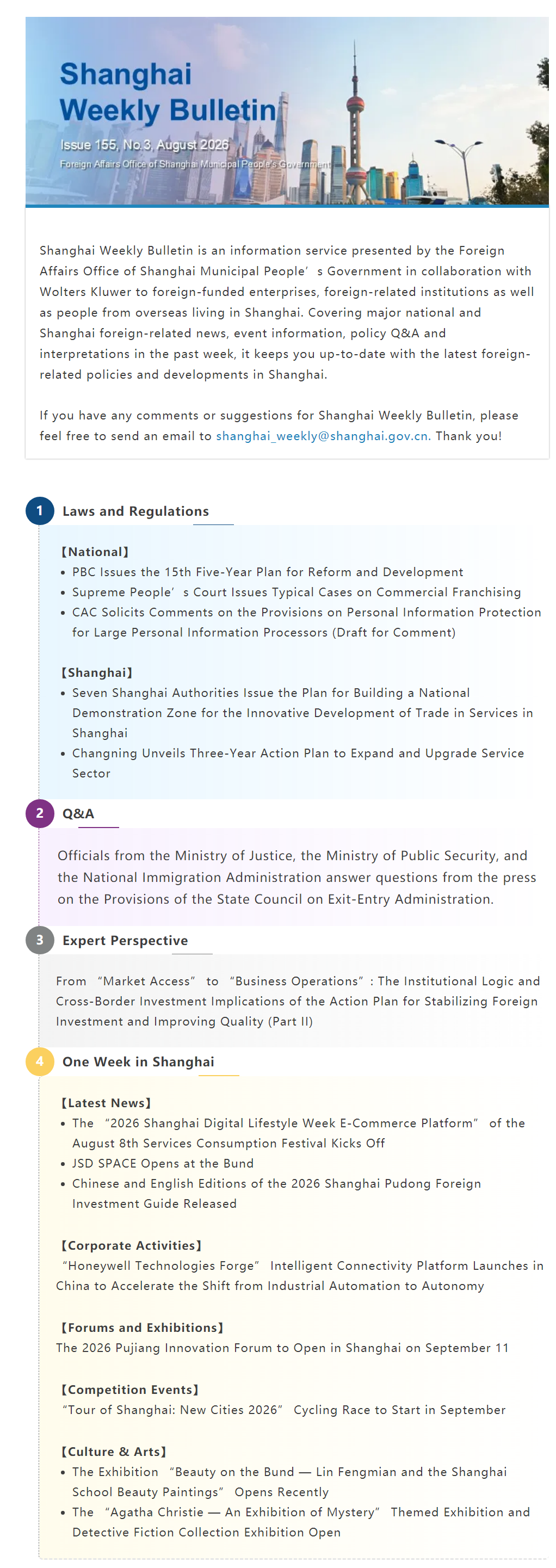
Changning unveils three-year action plan to expand and upgrade service sector (Issue 155)
Laws and Regulations
National
1. PBC Issues the 15th Five-Year Plan for Reform and Development
[Keywords: Central Bank, 15th Five-Year Plan]
Recently, the People’s Bank of China (PBC) issued the 15th Five-Year Plan for Reform and Development of the People’s Bank of China and formulated and issued nine supporting action plans for related subfields. The document covers areas including building a scientific and sound monetary policy system and a comprehensive macroprudential management system, continuously improving the quality and effectiveness of financial services for the real economy, and continuously developing an open, inclusive, dynamic, and resilient modern financial market.
Source: PBC
2. Supreme People's Court Issues Typical Cases on Commercial Franchising
[Keywords: Commercial, Franchising]
Recently, the Supreme People’s Court selected and issued seven typical cases on commercial franchising. The selected cases feature four aspects: accurately determining legal relationships in franchising, protecting the lawful rights and interests of franchisees in accordance with the law, urging franchisors to fully perform their statutory obligations, and severely cracking down on illegal and criminal activities in the franchising sector.
Source: Supreme People’s Court
3. CAC Solicits Comments on the Provisions on Personal Information Protection for Large Personal Information Processors (Draft for Comment)
[Keywords: Large personal information processors, Personal information]
Recently, the Cyberspace Administration of China (CAC) publicly solicited comments on the Provisions on Personal Information Protection for Large Personal Information Processors (Draft for Comment). The document sets out three criteria for determining whether a personal information processor qualifies as a large personal information processor, and requires such processors, when processing personal information based on individual consent, to adopt the approach that has the least impact on individuals’ rights and interests. The deadline for submitting comments is September 7, 2026.
Source: CAC
Shanghai
1. Seven Shanghai Authorities Issue the Plan for Building a National Demonstration Zone for the Innovative Development of Trade in Services in Shanghai
[Keywords: Trade in Services]
Recently, the Shanghai Municipal Commission of Commerce and six other authorities issued the Plan for Building a National Demonstration Zone for the Innovative Development of Trade in Services in Shanghai. The document sets out 27 key tasks in six areas, with the goal that by 2030, the city’s trade in services will exceed US$300 billion and Shanghai will strive to become a globally influential hub for trade in services.
Source: International Services Shanghai
2. Changning Unveils Three-Year Action Plan to Expand and Upgrade Service Sector
[Keywords: Service sector]
Shanghai’s Changning District recently issued the Three-Year Action Plan for Expanding and Upgrading the Service Sector in Changning District (2026–2028). Covering 18 tasks in five categories, the document builds on the district’s strengths in industries such as the industrial internet and lifestyle internet. It aims to develop flagship service-sector brands such as “Fashionable Changning” and “Shanghai Silicon Alley”, facilitate Changning’s integration into Shanghai’s service-sector development layout of “One Core, Two Wings, Three Belts, and Multiple Clusters”, and promote the expansion, upgrading, and high-quality development of Changning’s service sector.
Source: Shanghai Municipal People’s Government
Q&A
Officials from the Ministry of Justice, the Ministry of Public Security, and the National Immigration Administration answer questions from the press on the Provisions of the State Council on Exit-Entry Administration.
Q1
Please briefly introduce the main considerations behind establishing a record-filing management system for exit-entry intermediary service agencies under the Provisions.
A1
In recent years, the number of agencies providing exit-entry intermediary services in China has grown rapidly. While facilitating services for persons entering or leaving the country, problems have also emerged, including inadequate information on the number and status of agencies, illegal or non-compliant business practices by some agencies, and infringement of the lawful rights and interests of persons entering or leaving the country. These issues have undermined the sound and healthy development of the industry and compromised national exit-entry administration, making it urgently necessary to improve the relevant systems and standards. Adhering to a problem-oriented approach, the Provisions introduces targeted improvements to the management system for intermediary service agencies, specifically in the following aspects:
First, a record-filing management system is established. Agencies and personnel entrusted by persons entering or leaving the country to provide intermediary services such as exit-entry policy consultation, document processing on behalf of clients, and procedure handling shall be subject to record-filing management. Intermediary service agencies must file with the local immigration administration authority within 15 days of their establishment, while personnel engaged in exit-entry intermediary services shall complete the filing procedures through their employing agencies. Agencies already providing intermediary services before the Provisions took effect shall complete the filing procedures within 90 days from the effective date of the Provisions. Policy consultation, inquiries, and other activities conducted for non-profit purposes do not constitute exit-entry intermediary services as referred to in these Provisions.
Second, the conditions that intermediary service agencies must meet are specified. To ensure the quality of intermediary services and improve service standards, agencies engaged in such services are required to have personnel with relevant professional expertise, premises and financial resources commensurate with the scale of intermediary activities, and other necessary conditions. The Provisions also specifies that overseas enterprises and agencies are not permitted to provide exit-entry intermediary services within China. Enterprises and agencies with foreign, Hong Kong, Macao, or Taiwan investment that are lawfully established within China may engage in exit-entry intermediary services in accordance with the law.
Third, intermediary service activities are regulated. To effectively protect the lawful rights and interests of persons entering or leaving the country and promote the sound and healthy development of the industry, the Provisions prohibits agencies engaged in exit-entry intermediary services from publishing false information or soliciting clients through exaggerated or misleading publicity, providing or assisting in providing false materials, or assisting others in illegally obtaining visas, stay or residence permits, and passports, or in completing related procedures.
Q2
What measures does the Provisions set out to strengthen the protection of the lawful rights and interests of persons entering or leaving the country?
A2
To better protect the lawful rights and interests of persons entering or leaving the country, the Provisions, on the basis of protecting the personal safety of persons leaving the country, strengthens protection in two ways: on the one hand, it enhances the protection of personal privacy and personal information. It is emphasized that the competent authorities and their personnel shall keep confidential, in accordance with the law, any trade secrets, personal privacy, and personal information learned in the course of performing their duties. It is also stipulated that exit-entry intermediary service agencies shall not disclose, sell, or illegally provide trade secrets, personal privacy, or personal information. On the other hand, the Provisions specifies that the authority making a decision to deny exit shall notify the person concerned in writing, in accordance with the law, of the facts, reasons, legal basis, and available remedies for the denial. When enforcing such a decision, the immigration administration authority shall notify the person concerned in accordance with the notification of the decision-making authority, thereby effectively strengthening protection of the person’s lawful rights and interests in leaving the country.
Source: National Immigration Administration
Expert Perspective
From "Market Access" to "Business Operations": The Institutional Logic and Cross-Border Investment Implications of the Action Plan for Stabilizing Foreign Investment and Improving Quality (Part II)
By LAN Jie, XU He, GUO Huarong, and ZHAO Wenjia [Haiwen & Partners]
[Continued from last issue]
[Article Overview]
Focusing on the arrangements in the Action Plan for Stabilizing, Consolidating, and Improving Foreign Investment (hereinafter referred to as the “Action Plan”) concerning the improvement of the management system for foreign-related mergers and acquisitions, this article analyzes the potential institutional opportunities for cross-border share swaps and strategic investment by foreign capital. It notes that the current Provisions on Mergers and Acquisitions of Domestic Enterprises by Foreign Investors (Decree [2006] No. 10, issued by the Ministry of Commerce (MOFCOM) and five other authorities; hereinafter referred to as “Decree [2006] No. 10”) need to be better coordinated with the Foreign Investment Law, the new Measures for the Administration of Strategic Investment, and other regulatory regimes, particularly in areas including approval mechanisms, transaction consideration, payment methods, and cross-border share-swap rules, and is urgently in need of revision and improvement. At the same time, the Action Plan permits qualified foreign equity investment institutions to participate as strategic investors in securities offerings by listed companies in non-related industries, helping broaden channels for foreign capital to enter China’s A-share capital market and providing clearer policy expectations for long-term capital participation in the Chinese market.
[Article Details]
II. Improving the Management System for Foreign-Related Mergers and Acquisitions: New Opportunities for Cross-Border Share Swaps and Strategic Investment
Article 4 of the Action Plan proposes two inherently related measures: first, “accelerating the revision and issuance of provisions on foreign investors’ mergers and acquisitions of domestic enterprises and optimizing the M&A management process and requirements for payment of consideration”; and second, “allowing qualified foreign equity investment institutions to participate as strategic investors in securities offerings by listed companies in non-related industries”. Together, the two measures pursue a common goal: to create a more flexible and streamlined institutional channel for foreign capital to participate in China’s domestic capital market.
(1) Expected Revision of Decree [2006] No. 10 and Modernization of the M&A Management System
Decree [2006] No. 10, promulgated in 2006 and revised in 2009, has been in effect for nearly 20 years. Although, following implementation of the Foreign Investment Law in 2020, the approval provisions in Decree [2006] No. 10 that conflict with higher-level law, including approval of related-party M&A transactions, are no longer implemented, its provisions on the basis for determining transaction consideration, payment deadlines, payment forms, valuation models, and other matters remain effective and constitute the most important departmental regulation in the field of foreign-related mergers and acquisitions.
The urgency of revising Decree [2006] No. 10 is reflected at three levels.
First, after foreign investment became fully subject to the system of pre-establishment national treatment plus a negative list, the commerce authorities completely withdrew from prior approval. Accordingly, the provisions of Decree [2006] No. 10 concerning MOFCOM’s approval of foreign-related mergers and acquisitions need to be expressly repealed. Once approval is abolished, if the original provisions on the basis for determining transaction consideration, payment deadlines, payment forms, valuation models, and other matters are to be retained, it will be necessary to clarify how their implementation can be ensured without regulatory approval. Following the China Securities Regulatory Commission (CSRC)’s issuance of new rules on the record-filing of overseas listings in 2023, red-chip structures and H-share listings were brought under the same regulatory framework, and both became subject to prior record-filing. The advantages of red-chip structures have diminished, and their use has declined significantly. Nevertheless, red-chip structures remain advantageous for attracting overseas investors and pursuing listings in jurisdictions other than the Hong Kong SAR. The Provisions of the State Council on Outbound Investment, released on June 1, proposes to formulate specific administrative measures for overseas investment by domestic residents. How individuals may establish financing platforms overseas in the future, and how the related-party M&A provisions of Decree [2006] No. 10 will be revised, will reflect the state’s policy stance toward red-chip structures, and thus directly affect the future development and financing paths of Chinese enterprises.
Second, the provisions on cross-border share swaps in the current rules have become outdated. Article 28 of Decree [2006] No. 10 provides that equity used as a means of payment must be “equity of an overseas listed company”, excluding equity of an overseas unlisted company (except a special purpose company) as possible consideration. The revised Measures for the Administration of Strategic Investment by Foreign Investors in Listed Companies, which took effect in December 2024 (hereinafter referred to as the “new Measures for the Administration of Strategic Investment”), expressly permit cross-border share swaps using equity of an overseas unlisted company, except where the strategic investment is implemented through an agreement-based transfer. The two provisions conflict, and institutional coordination is urgently needed through revision.
Third, coordination between Decree [2006] No. 10 and other foreign investment management systems needs to be strengthened. For example, the provisions of Decree [2006] No. 10 on cross-border share swaps partially overlap with the scope of application of the new Measures for the Administration of Strategic Investment, while the information reporting system under the Foreign Investment Law framework and the procedural requirements of Decree [2006] No. 10 also need to be further streamlined. The new policy’s proposal to “optimize the M&A management process and requirements for payment of consideration and strengthen regulatory coordination among government departments” is precisely a response to these issues.
(2) “Cross-Industry” Strategic Investment
The Action Plan permits qualified foreign equity investment institutions to participate as strategic investors in securities offerings by listed companies in “non-related industries”. The significance of this breakthrough provision merits in-depth analysis.
Under the Administrative Measures for the Registration of Securities Offerings by Listed Companies and supporting rules, when a foreign investor participates in a targeted offering by an A-share listed company as an offering recipient determined in advance by the board of directors, commonly known as a “fixed-price offering”, it must be a “strategic investor” in an A-share listed company under CSRC rules. Strategic investors are divided into industrial investors and capital investors, and an industrial investor must “possess important strategic resources in the same or a related industry as the listed company”. However, the definition of a capital investor does not expressly include “foreign equity investment institutions”, creating some uncertainty as to whether foreign equity investment institutions may serve as capital investors.
The Action Plan expressly permits foreign equity investment institutions to participate in securities offerings by listed companies in “non-related industries”, meaning that foreign equity investment institutions may serve as capital investors and thus will not be subject to the requirement of industrial synergy. This breakthrough not only opens a channel for additional foreign capital to enter the A-share market but also reserves policy space for long-term capital such as foreign sovereign wealth funds.
[To be continued]
One Week in Shanghai
Latest News
1. The "2026 Shanghai Digital Lifestyle Week E-Commerce Platform" of the August 8th Services Consumption Festival Kicks Off
[Keywords: Shanghai Digital Lifestyle Week E-Commerce Platform, August 8th Services Consumption Festival]
The “2026 Shanghai Digital Lifestyle Week E-Commerce Platform”, an initiative associated with the August 8th Services Consumption Festival, recently kicked off. Under the theme of “digital intelligence empowerment, diverse integration, scenario innovation, and quality services for the public”, the event focuses on tourism and leisure, dining, housekeeping and cleaning, transportation, automobile maintenance, cultural performances, medical aesthetics, and health and wellness. More than 30 service consumption initiatives integrating online and offline activities will be launched during the event.
Source: Shanghai Commerce
2. JSD SPACE Opens at the Bund
[Keywords: JSD SPACE, Jewelry]
JSD SPACE, a core industry space of the Shanghai International Jewelry Fashion Functional Zone, recently opened to the public, alongside the launch of the “100 DAYS of Global Treasures: International Jewelry Artists Joint Exhibition”. Leveraging the prime location of the Bund Finance Center, JSD SPACE integrates seven core functions to create a one-stop service complex for the jewelry industry.
Source: Shanghai Huangpu
3. Chinese and English Editions of the 2026 Shanghai Pudong Foreign Investment Guide Released
[Keywords: Pudong, foreign investment guide]
The Chinese and English editions of the 2026 Shanghai Pudong Foreign Investment Guide were recently launched to further advance high-standard opening-up and provide global investors with a comprehensive overview of Pudong’s investment opportunities, industrial layout, and business environment. Grounded in the realities of Pudong’s development as a leading area, the guide systematically presents an overview of Pudong, investment sectors, key areas, and investment services, providing authoritative and practical information for domestic and overseas enterprises seeking to learn about and invest in Pudong.
Source: China (Shanghai) Pilot Free Trade Zone
Corporate Activities
"Honeywell Technologies Forge" Intelligent Connectivity Platform Launches in China to Accelerate the Shift from Industrial Automation to Autonomy
[Keyword: Honeywell]
Recently, Honeywell Technologies officially launched the “Honeywell Technologies Forge” platform in Pudong, which integrates AI and deep industrial expertise. The company has established a dedicated operating environment for the platform in China and is working closely with local cloud service providers to support localized data storage and processing, with the aim of accelerating the digital transformation of local enterprises and better meeting the needs of the Chinese market.
Source: Shanghai Foreign Investment Association
Forums and Exhibitions
The 2026 Pujiang Innovation Forum to Open in Shanghai on September 11
[Keywords: Pujiang Innovation Forum]

From September 11 to 14, the 19th Pujiang Innovation Forum will be held in Shanghai. With the theme “Sharing Innovation and Shaping the Future: The Mission of the Global Sci-Tech Community Amid a New Round of Sci-Tech Revolution”, this year’s forum will invite the Republic of South Africa as the guest country of honor and Hunan Province as the guest province of honor. It will focus on organizing “1+1+24+N” events, including one opening ceremony, one main forum, 24 thematic forums, and N supporting activities such as youth innovation seminars and achievement release events.
Source: Shanghai Science and Technology
Competition Events
"Tour of Shanghai: New Cities 2026" Cycling Race to Start in September
[Keywords: “Tour of Shanghai: New Cities 2026” Cycling Race]

The Tour of Shanghai: New Cities 2026 will take place from September 4 to 6. The race will once again link the five new towns of Jiading, Songjiang, Qingpu, Fengxian, and Nanhui. Twenty-one top professional cycling teams from 12 countries, including China, Italy, Spain, and Malaysia, will gather in Shanghai for a high-level showdown.
Source: “Tour of Shanghai: New Cities 2026” Cycling Race
Culture & Arts
1.The Exhibition "Beauty on the Bund — Lin Fengmian and the Shanghai School Beauty Paintings" Opens Recently
[Keywords: Shanghai School Beauty Paintings]

The exhibition titled “Beauty on the Bund — Lin Fengmian and the Shanghai School Beauty Paintings” recently opened at the Shanghai Chinese Painting Academy Art Museum, bringing together selected portrayals of women in the Shanghai School tradition dating from the late Qing dynasty through the modern and contemporary periods. The exhibition features works by renowned artists including Qian Huian, Ren Yi, Wu Youru, Zheng Mantuo, Feng Chaoran, Zhang Daqian, and Lin Fengmian, as well as rare works by lesser-known artists. The exhibition runs through November 15.
Source: Shanghai Tourism
2.The "Agatha Christie — An Exhibition of Mystery" Themed Exhibition and Detective Fiction Collection Exhibition Open
[Keywords: Agatha Christie]

The “Agatha Christie — An Exhibition of Mystery” themed exhibition, together with an exhibition of detective fiction collections, opened recently. Featuring approximately 140 rare items from China and abroad, the exhibition traces the century-long development of detective literature, from its emergence and golden age to its introduction to Shanghai. Manuscripts, rare out-of-print editions, and archival materials from film, television, and stage productions connect British mysteries with Shanghai’s literary heritage, unfolding a century-long panorama of detective fiction.
Source: Xuhui Shanghai