Comprehensive guide for the China Scholastic Competency Assessment
The China Scholastic Competency Assessment (CSCA) is a standardized exam launched by the China Scholarship Council to assess students' language proficiency and academic readiness, helping you prepare more effectively for undergraduate studies in China. It is required for undergraduate program applications at universities that offer the Chinese Government Scholarship.
Your CSCA transcript, along with your high school academic records and other supporting materials, will serve as a key reference for university admissions and scholarship decisions.
This practical guide to the CSCA is designed to help you start your academic journey with clarity and confidence, answering questions such as:
- What is the CSCA?
- How to prepare for the CSCA?
- How to take the CSCA online test?
I. What is the CSCA?
(I) Do I have to take the CSCA exam?
Yes, it is mandatory for most applicants. Starting from the 2026 and 2027 academic years, all international students applying to undergraduate programs at universities participating in the Chinese Government Scholarship must take the CSCA exam and include their scores in the required materials.
(II) What subjects are covered?
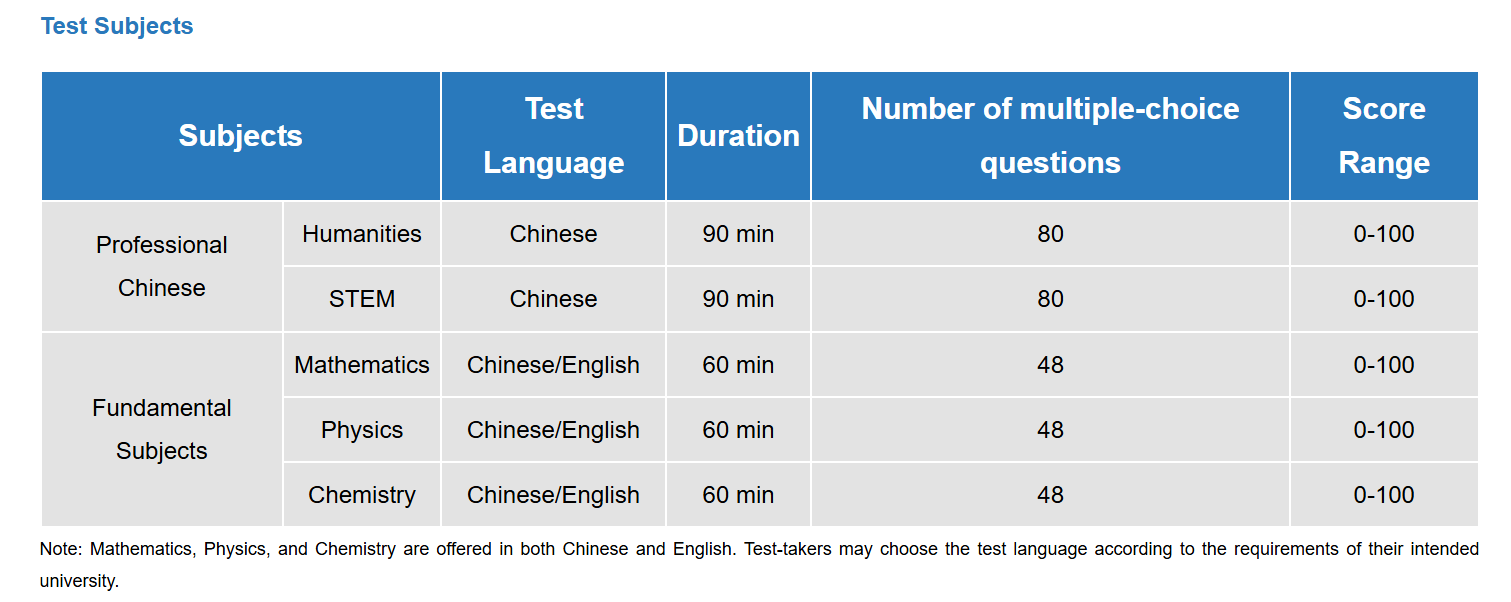
The exam includes four subjects: Professional Chinese, Mathematics, Physics, and Chemistry. The latter three are classified as Fundamental Subjects.
Different majors have different subject requirements. Be sure to review the official enrollment guidelines from your target universities in advance.
1. Professional Chinese
Professional Chinese is offered in two categories: Humanities and STEM (Science, Technology, Engineering and Mathematics).
- Applicants to Chinese-taught undergraduate programs should take the Professional Chinese test that corresponds to their intended major category.
- Applicants to fully English-taught undergraduate programs are exempt from the test.
- Applicants to Chinese Language undergraduate programs may be exempt from the test if they provide a valid HSK Level 4 score.
2. Fundamental Subjects
(1) Mathematics (Mandatory): Mathematics tests foundational academic skills and logical reasoning. It is required for all programs.
(2) Physics and Chemistry (Optional): Requirements vary by university and program. Applicants to programs in science, engineering, agriculture, or medicine must take at least one of these subjects.
3. Test language
Mathematics, Physics, and Chemistry tests are available in both Chinese and English. Applicants can choose the test language based on their university's requirements.
4. Test duration
Professional Chinese: 90 minutes
Fundamental Subjects: 60 minutes per subject
5. Question types
All CSCA subjects consist of multiple-choice questions.
Professional Chinese: 80 questions
Fundamental Subjects: 48 questions per subject
6. Test structure and format
The CSCA primarily consists of multiple-choice questions. All subjects are scored on a 100-point scale.
Below are the test details:
7. Contact:
CSCA official contact: cscasupport@cscdf.org
(III) Can I take the exam if I'm not applying for a Chinese Government Scholarship program?
Yes. CSCA is open to all students planning to study in China. A strong score can enhance your application to any Chinese university by demonstrating your academic abilities.
Click here to view the list of Shanghai universities participating in the Chinese Government Scholarship.
(IV) When can I register, and what are the fees?
1. Registration period
Please visit the official CSCA website (https://csca.cn/home) for exact dates.
2. Registration fees
- Single subject: 450 yuan (approximately $64)
- Two or more subjects: 700 yuan
3. Required materials
Materials include an ID photo, valid identification, and a credit card. Check the official CSCA website for the full list of requirements.
(V) When is the exam held, and how many times per year?
Starting in 2026, the CSCA exam will be held five times a year: January, March, April, June, and December.
Exam schedule (Beijing Time)
- Professional Chinese: 1 pm to 2:30 pm
- Mathematics: 3:30 pm to 4:30 pm
- Physics: 5:30 pm to 6:30 pm
- Chemistry: 7:30 pm to 8:30 pm
Time zone differences are considered to accommodate global candidates.
In December, April, and June, sessions will take place during daytime hours in the Asia-Pacific region, while sessions in January and March are tailored for Europe, Africa, and the Americas.
Please take note of the breaks between subjects and plan accordingly.

(VI) What are the test formats?
The CSCA employs a hybrid testing approach, allowing you to select the format that best fits your needs.
1. Computer-based testing
Taken at an authorized test center under standardized conditions.
2. Paper-based testing
Taken in a traditional test format at an authorized testing center.
3. Home-based online testing
Taken at home under real-time online proctoring.
Starting in December 2025, the first batch of on-site testing centers opened in Vietnam and Thailand, with more locations planned.
For details on test formats and centers, please visit the official CSCA website.
Click here for key points on taking the CSCA online.
China Scholastic Competency Assessment online test guide
(VII) How can I check my scores?
After the exam, you can log in to the CSCA official website to view your scores.
Score release times vary by exam format:
- For home-based online testing and computer-based testing, scores are available within seven business days.
- For paper-based testing, scores are released within 14 business days.
(VIII) Preparation tips
You can visit the official CSCA website for updates, and download and review preparation resources such as exam outlines, practice materials, and sample tests directly from the platform.
II. How to prepare for the CSCA?
(I) Utilize official resources for effective preparation
1. Your preparation "command center"
(1) Information hub: The official CSCA website is the authoritative platform for all exam-related information. Bookmark it to access key materials, including the latest exam syllabus, registration notices, policy updates, and official answers to frequently asked questions.
(2) Application portal: The "Study in China" website (https://campuschina.org/) serves as the primary platform for the Chinese Government Scholarship and for accessing official information about universities in China. Visit the site in advance to learn about the application process.
2. Your preparation "core map"
Download the exam syllabus for your required subjects from the CSCA website. The syllabus forms the foundation of your entire review plan. Study it in depth to ensure your preparation aligns with the official requirements.
(II) Plan your review in advance
1. Make a preparation calendar
Based on the exam date, divide your remaining review time into three phases, each with clear objectives:
- Foundation stage: Systematically cover all knowledge points outlined in the exam syllabus. Ensure you understand the core concepts and principles to build a solid foundation.
- Intensification stage: Focus on practicing questions and targeting weak areas. At this stage, begin timed practice sessions to improve accuracy and speed.
- Sprint stage: Take full-length mock exams aligned with the official test schedule. This will help you manage pacing and question sequence. After each mock exam, review your performance against the syllabus and error log to identify and address any remaining gaps.
Pro tip: Record your phased preparation tasks in a planner or digital calendar. For example, mark "begin timed practice" three weeks before the exam and "full-length mock exam" one week before the test to keep your plan clear and easy to track.
2. Expand your learning channels
- Teaching others: Explaining concepts to others is one of the best ways to learn. Join a study group to find CSCA partners and schedule weekly sessions to discuss challenging problems and explain key concepts to each other. Teaching others helps reinforce and clarify your own knowledge.
- Leverage online resources: If a particular concept is challenging during self-study, try to make use of high-quality online courses. Search for teaching videos on high school-level Chinese Mathematics, Physics, Chemistry, or Chinese on online educational platforms or video websites. Different teachers' explanations may offer new perspectives and help solidify your understanding.
3. Establish a cycle of "Understanding – Practice – Reflection"
- Build a strong foundation: The CSCA assesses core academic knowledge and skills. Prioritize the understanding of core concepts, formulas, and theorems rather than rote memorization.
- Learn from your mistakes: Keeping an error log is one of the most effective ways to improve your performance. Review your mistakes regularly to identify their root causes, whether they stem from gaps in understanding, careless errors, or ineffective problem-solving strategies. Reflecting on these patterns will help you avoid making the same mistakes on the exam.
We hope this guide helps you prepare confidently and perform your best on the CSCA.
Source: Official WeChat account of China Scholarship Council (ID: "gh_afaa09c3e5f3")
Updated Aug 5, 2026