Shanghai's ocean economy rides new quality productive forces
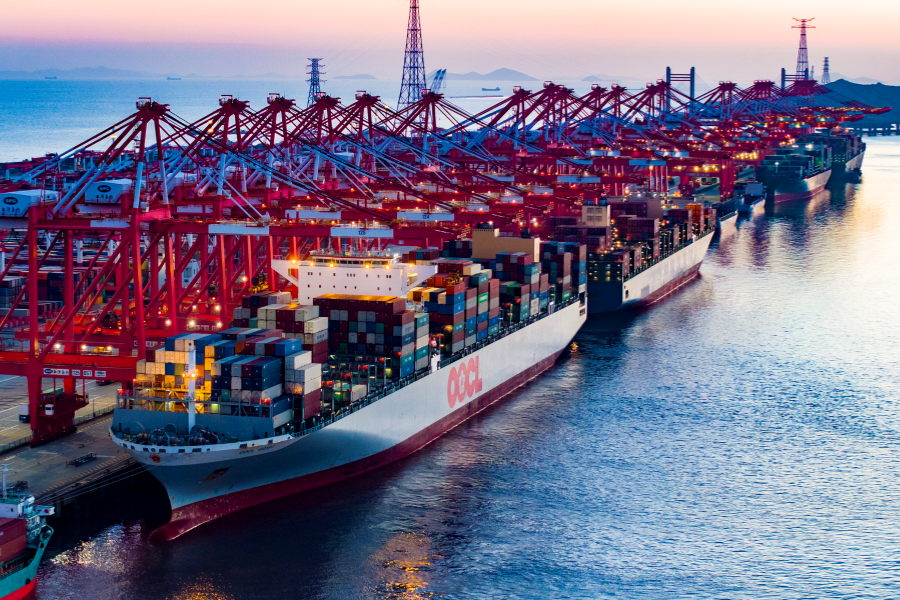
Shanghai's blue economy, also known as the ocean economy — the term broadly used to describe the sustainable economic activities associated with the oceans and seas — is flourishing through new quality productive forces, according to a new comprehensive report issued recently.
Details of the city's extensive achievements were outlined in the Shanghai Modern Marine City Development Blue Book 2024 Assessment Report — officially released by the Shanghai Municipal Oceanic Bureau on June 6.
The report documents Shanghai's modern marine city construction level ranked third globally and first domestically last year.
In 2024, Shanghai's ocean output value amounted to 1.14 trillion yuan ($158.69 billion), hitting a historic high with a nominal year-on-year growth of 11.2 percent.
This accounted for 21.1 percent of the city's GDP and 10.8 percent of China's total ocean output value — positioning Shanghai as the leader in ocean output value per unit of marine area nationwide.
The structure of the city's ocean industry was further optimized — a modern ocean industry system led by services and upgraded by manufacturing was formed.
The tertiary industry represented by shipping services and marine tourism accounted for 71.9 percent of its ocean economy. The secondary industry saw a nearly 3-percentage-point increase from the previous year, reaching 28 percent.
The advanced marine manufacturing industry was expanded and strengthened. Throughout 2024, the shipbuilding and marine engineering industry maintained high growth, with the total output value of major enterprises topping 120 billion yuan — a rise of 20 percent year-on-year.
Last year, China State Shipbuilding Corporation Limited's three major shipyards in Shanghai — Jiangnan Shipyard (Group) Co Ltd, Hudong-Zhonghua Shipbuilding (Group) Co Ltd and Shanghai Waigaoqiao Shipbuilding Co Ltd — delivered 69 vessels in total and received 128 new orders, representing respective increases of 19 percent and 70 percent year-on-year.
What's more, the Shanghai shipbuilding and marine engineering equipment cluster was selected as a national advanced manufacturing industry cluster in 2024.
The city enhanced the quality and efficiency of its modern marine services. The China Ocean Economy Stock Price Index — the first domestic comprehensive index covering the Shanghai, Shenzhen, Beijing and Hong Kong markets in the ocean sector — was launched.
The total trade volume of the shipping index futures exceeded 3.98 trillion yuan, with a daily average turnover topping 12 billion yuan.
In 2024, the container throughput of Shanghai Port exceeded 50 million twenty-foot equivalent units or TEUs — the standard container size — ranking first in the world for 15 consecutive years.
The implementation of visa-free entry for foreign tourist groups arriving on cruise ships saw over 50 percent of international cruise ships arriving in China berth in Shanghai, with the Adora Magic City cruise liner alone welcoming more than 600,000 passengers last year.
Overall, Shanghai has expedited the development of emerging ocean industries. Initiatives to advance deep-sea offshore wind power pilot projects were underway last year, with the successful commencement of the first phase of the Jinshan offshore wind power project.
The city launched China's first smart forecast system for tuna fishing conditions and first intelligent soft-bodied bionic fish called Wen Yao.
Moreover, the world's first-ever full-process onboard carbon capture and storage or OCCS system was developed in Shanghai.
Zero carbon emissions were achieved during the operations process of the first phase of the container terminal in the Luojing Port area.
Source: Shanghai Municipal Oceanic Bureau