AI shifts from flashy demos to practical applications at 8th CIIE
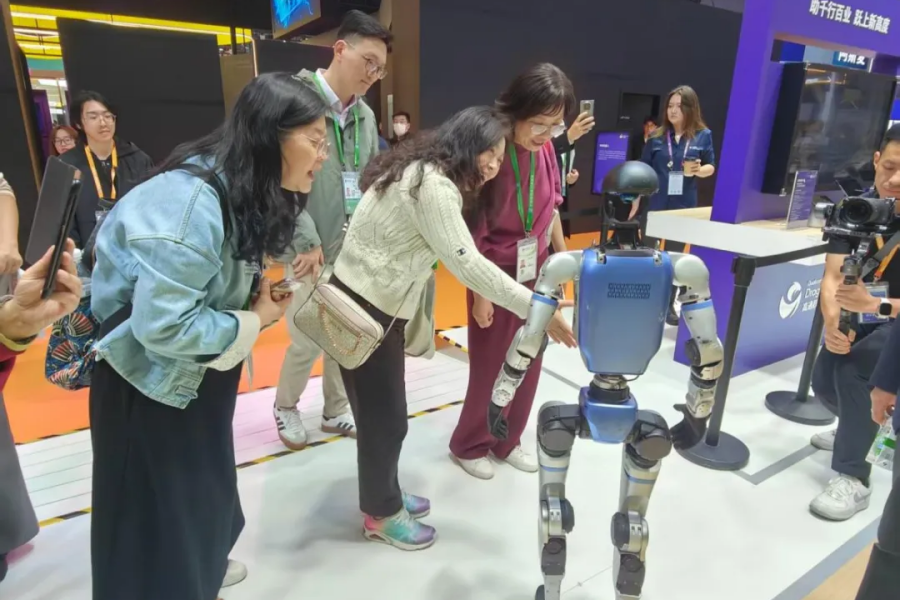
At the 8th China International Import Expo this year, artificial intelligence moved from flashy demos to practical deployment. China now holds about 60 percent of global AI patents, drawing heightened multinational interest in innovation.
Qualcomm's booth featured a blue Unitree G1 humanoid robot adorned with Qualcomm branding. Unitree Robotics, a prominent Chinese robotics company, was highlighted as an example of direct collaboration between robot manufacturers and chip suppliers at the CIIE.
The robot demonstrated its integration with the Qualcomm Dragonwing™ IQ9 Series platform, an industrial-grade, on-device AI computing solution built for demanding workloads and low-latency edge inference, such as real-time vision, control, and large language model inference.
Qualcomm China technical marketing director Li Yonggang said the IQ9 Series enables multimodal large-model deployment, enhancing environment perception, natural-language interaction and precise motion control — capabilities essential for real-world industrial robotics.
Besides humanoid robots, visitors experienced AI smartphones, AI PCs and AI glasses using on-device intelligent agents. Running models on devices reduces latency, boosts responsiveness and can limit personal data sent to cloud servers.
At Siemens' booth, a live Tower of Hanoi AI challenge attracted crowds. Siemens used MioVerse, a three-dimensional collaboration and validation platform that combines AI with digital-twin simulation to verify instructions virtually before execution.
Siemens executives said China remains one of its most important markets, with extensive local R&D and manufacturing facilities, and that industrial AI, strengthened IP frameworks, and deeper local partnerships will accelerate practical application in manufacturing.
Source: Shanghai Intellectual Property Administration