New valuation system urged for tech listings
Support from China's capital market for emerging technologies has strengthened amid ongoing nationwide reforms, yet experts say a new valuation framework and patient, long-term capital are considered critical to sustaining the growth of new quality productive forces over the long term.
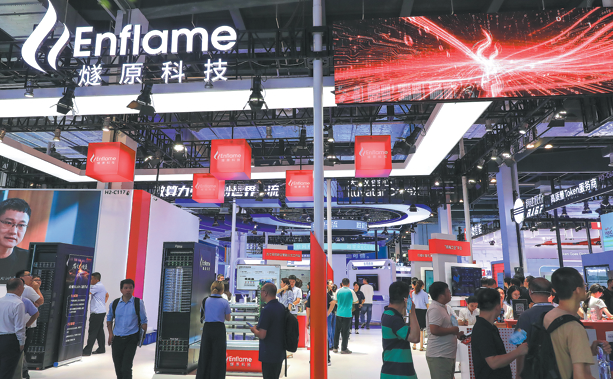
The comments followed Enflame Technology’s highly anticipated initial public offering. The Shanghai-based artificial intelligence chipmaker released the results of its STAR Market IPO subscription on Sept 3. Priced at 142.18 yuan ($21.18) per share, the offering is set to raise more than 6 billion yuan, which will fund the development and commercialization of its fifth- and sixth-generation AI chips.
Enflame's upcoming float will make all four of China's major GPU players publicly traded. The other three — Moore Threads, MetaX, and Biren Technology — saw their prices surge more than fourfold on their first day of trading.
Moore Threads and MetaX are both listed on the STAR Market in Shanghai, while Biren Technology is listed in Hong Kong.
Over the past eight months, 17 companies raised more than 97.5 billion yuan through STAR Market listings. Their combined IPO proceeds accounted for nearly 51.3 percent of the total A-share IPO value during the same period, which spiked 190 percent year-on-year to more than 190 billion yuan.
To date, 64 pre-profit companies have listed on the STAR Market, including Enflame Technology.
Dong Zhongyun, chief economist at AVIC Securities, said the STAR Market's listing criteria align well with frontier sectors such as AI, commercial aviation, biomedicine, and quantum information, which typically involve long investment cycles, substantial investments, and losses in the early stages of development.
In general, a more inclusive, adaptive, and globally aligned multilayered capital market is taking shape in China at an accelerated pace. It has become a pillar for developing new quality productive forces, facilitating the shift from old to new economic drivers, said Zhang Jun, chief economist of China Galaxy Securities.
But the logic for valuing technology assets is being reconstructed. The true tech leaders will command both a security premium and a growth premium. Those that are just riding the hype will see their valuations shrink and liquidity dry up, Zhang said.
Yang Chuan, a distinguished senior research fellow at the Shanghai Institution for Finance and Development, said the greatest difficulty in valuing tech companies today is the lack of a unified benchmark. Different investors measure the same company by their own standards. This may result in significant price deviations from the company's fundamentals and drastic price fluctuations, he said.
Zhu Ning, professor at the Shanghai Advanced Institute of Finance at Shanghai Jiao Tong University, warned that some investors are starting to take it for granted that hard-tech stocks will only go up, which is a risky signal from a behavioral economics standpoint. When the rally becomes too rapid and excessive, it is usually followed by a sharp correction, he said.
Leading robotics player Unitree has seen its price slashed by nearly 36 percent from its first-day closing high of 845 yuan on Aug 19.
The STAR 50 Index, which tracks large-cap stocks, has shed 9 percent since Aug 17, mainly due to a decline in the semiconductor sector.
Yang Delong, chief economist of First Seafront Fund, said the recent fluctuations are simply market corrections. Semiconductor, chipmaking and computing companies, which benefit from China's economic restructuring, are showing considerable investment value after the latest adjustments.
Fang Yi, chief strategist of Guotai Haitong Securities, said increasing allocation to companies with higher and stable dividends may be a good choice in the fourth quarter to balance risks. But the market's interest in emerging technologies will remain unchanged.
Source: China Daily