Demo day connects Latin American startups with Chinese investors
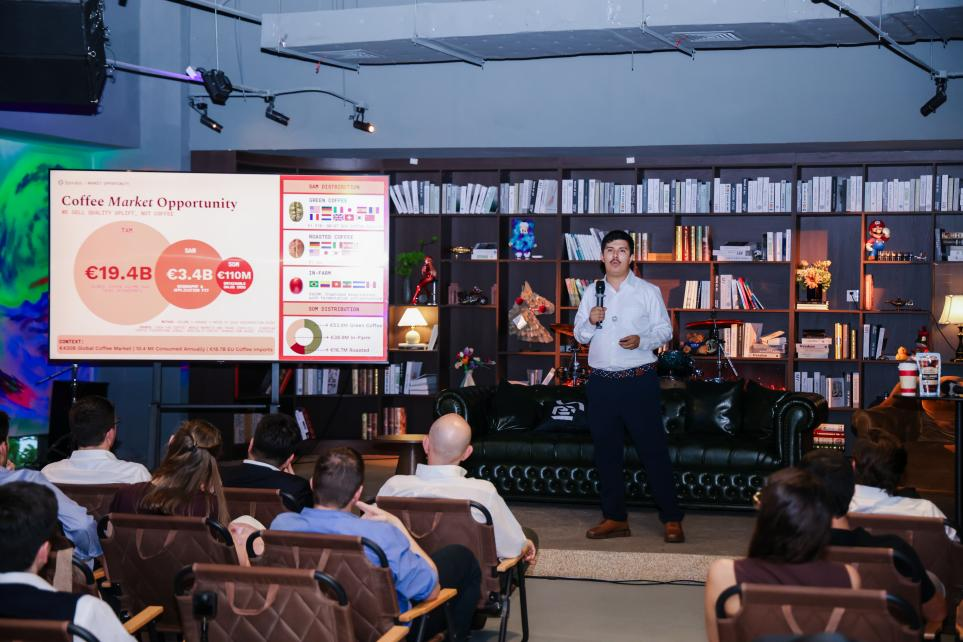
About 50 startup and venture capital representatives from Argentina, Uruguay, Chile, Colombia, and Paraguay presented projects and explored collaboration with Chinese investors at a demo day in Shanghai on Sept 8.
The demo day was part of the Second Sino-Latin American Entrepreneurs and Startups Summit and was held under the theme "Weaving the Bio Silk Road".
The startups presented projects in three sessions covering nature-based technology and bioindustry, health and deep biotechnology, and agriculture and food technology. The program also included a robot demonstration and networking activities.
Cristian J. Inderkumer, director of research at the Civil Association for Argentinian-Chinese Cooperation, one of the event's organizers, said the event aimed to connect Latin American startups and venture capital funds with their Chinese counterparts.
The delegation had visited technology companies, incubators, and investment institutions in Shanghai, Hangzhou, and Suzhou before the demo day, he said.
Inderkumer said the organizers saw particular potential for cooperation in food technology, life sciences, and health care. Their longer-term goal is to develop the summit into a platform through which investors from either region could support startups in the other.
The summit has already helped facilitate an investment. Agustin Bramanti, growth lead at SF500, an Argentine venture capital fund, said one of the startups that joined last year's delegation developed a relationship with a major Chinese chemical company, which later invested in it.
Guido D'Angelo, head of capital markets and strategic sectors at the Rosario Board of Trade, and Lara Svendsen, an innovation specialist at the institution, provided an institutional perspective. The Argentine organization is active in the agricultural and capital markets.
D'Angelo and Svendsen said Chinese robotics and artificial intelligence technologies could be applied to agricultural production and market data analysis in Argentina. At the same time, Argentina's strengths in agriculture and biotechnology could provide technologies and projects for the Chinese market.
Among the startups seeking such opportunities was Sporalys. Juan Rubiano, its co-founder and CEO, said the company uses solid-state fermentation to adjust coffee flavors for different markets.
Rubiano said that Shanghai has more coffee shops than any other city in the world and represents a major opportunity for the company. During his visit, he explored different parts of China's coffee value chain, including cafes such as Manner Coffee and Luckin Coffee, as well as equipment manufacturers.
He also planned to travel to Yunnan province, one of China's coffee-growing regions, to taste locally grown coffee and learn about its production. Rubiano said China's coffee sector is growing in both production and consumption. He added that China has a more complete coffee value chain than Colombia does.
He also wanted to better understand the legal requirements for establishing a company in China and identify potential partners for entering the market.
From the perspective of Chinese investors, Fu Luqian, an investor with a major renminbi-denominated private equity fund, said the presentations had given him a clearer understanding of South American startups, particularly their technological expertise and experience in health care.
Shanghai could provide these companies with a large consumer market, access to both renminbi- and dollar-denominated funds, industry partners, and technology and medical professionals, Fu said. He added that some startups could consider forming joint ventures in Shanghai to conduct localized research and development before entering the broader Chinese market.
Most delegation members were visiting Shanghai for the first time. Bramanti said he was impressed by the city's infrastructure and the balance between its architecture and riverfront.
Their experiences also extended beyond the business itinerary. Rubiano said his business partner even had a new pair of glasses made in Shanghai during their stay.