Guidelines for foreign-related civil litigation (II) — Filing and entrustment of agents
Commencement and Case Filing
1. Conditions for Bringing an Action
An action may be brought only if the following conditions are satisfied: (1) the plaintiff is a citizen, legal person, or other organization that has a direct interest in the case; (2) there exists a definite defendant; (3) there are specific claims for relief, supporting facts and grounds; and (4) the action falls within the scope of civil cases accepted by the People's Courts and within the jurisdiction of the People's Court with which it is filed.
A defendant shall be deemed definite where the plaintiff provides sufficiently specific information, such as the defendant's name and domicile, to distinguish the defendant from other persons.
Where the information concerning the defendant stated in the statement of claim is insufficient to identify a clearly identifiable defendant, the People's Court may notify the plaintiff to make corrections or provide supplementary information. If the defendant still cannot be identified after such correction or supplementation, the People's Court shall rule not to accept the action.
2. Manner of Bringing an Action
To bring an action, a statement of claim shall be submitted to the People's Court together with copies corresponding to the number of defendants. Where a party has genuine difficulty preparing a written statement of claim, the action may be brought orally. The People's Court shall record the oral statement and notify the opposing party.
3. Contents of the Statement of Claim
A statement of claim shall contain the following particulars: (1) the plaintiff's name, gender, age, ethnicity, occupation, employer, domicile, and contact information; or, where the plaintiff is a legal person or other organization, its name and domicile, together with the name, position, and contact information of its legal representative or principal person in charge; (2) the defendant's name, gender, employer, domicile, and other relevant information; or, where the defendant is a legal person or other organization, its name, domicile, and other relevant information; (3) the claims for relief and the facts and grounds on which they are based; and (4) the evidence and its sources, as well as the names and domiciles of witnesses.
4. Verification of the Identity of Parties Bringing an Action
(1) A foreign individual shall submit a passport or other identity document.A foreign enterprise or organization shall submit documents establishing its identity and documents proving that the individual appearing in the proceedings on its behalf shall be authorized to act as its representative.Such documents shall be notarized by a notarial authority in the country where they are issued and authenticated by an embassy or consulate of the People's Republic of China in that country.If that country has no diplomatic relations with the People's Republic of China, the documents shall first be notarized in that country, then authenticated by the embassy or consulate in that country of a third country having diplomatic relations with the People's Republic of China, and finally authenticated by the embassy or consulate of the People's Republic of China in that third country.
(2) A resident of the Hong Kong or Macao Special Administrative Region shall submit a Hong Kong or Macao identity document, a Residence Permit for Hong Kong and Macao Residents, a Mainland Travel Permit for Hong Kong and Macao Residents, or another identity document. An enterprise or organization shall submit documents establishing its identity and documents proving that the person appearing in the proceedings on its behalf is authorized to act as its representative. The documents shall be notarized by a notary or China-Appointed Attesting Officer recognized by the Mainland and shall be examined, sealed, and forwarded by China Legal Service (Hong Kong) Limited or China Legal Service (Macao) Limited.
(3) A resident of the Taiwan Region shall submit a Taiwan identity document, a Residence Permit for Taiwan Residents, a Mainland Travel Permit for Taiwan Residents, or another document establishing identity. An enterprise or organization shall submit documents establishing its identity and documents proving that the person appearing in the proceedings on its behalf is authorized to act as its representative.Such documents shall be processed through the cross-Strait channel for the use and verification of notarial certificates.
5. Preparation of Materials
Where written materials submitted to a People's Court are in a foreign language, a Chinese translation shall be submitted concurrently. If the parties dispute the Chinese translation, they shall jointly appoint a qualified translation agency to provide a translated text. If they cannot agree on the translation agency, the People's Court shall designate one.
6. Online Commencement and Case Filing
The People's Courts shall provide online case-filing services to parties to cross-border litigation through the China Mobile Micro Court.
Where a party to cross-border litigation applies for online case filing for the first time, the People's Court with which the action is filed shall first verify the party's identity. Identity verification shall be conducted primarily online through platforms such as the Exit-Entry Document Identity Verification Platform of the National Immigration Administration. Where online verification is unavailable, the Court shall conduct manual online verification of the party's identity documents and other supporting materials, including materials relating to notarization, authentication, transmission, and verification by mail.
All other materials and requirements shall be the same as those applicable to filing an action offline, as described above.
Appointment of Agents ad Litem
1. Qualifications and Permitted Scope of Agents ad Litem
Where foreign nationals, stateless persons, foreign enterprises, or foreign organizations bringing or defending an action before a People's Court need to appoint a lawyer as an agent ad litem, they shall appoint a lawyer of the People's Republic of China.
A foreign party to foreign-related civil proceedings may appoint a national of the same country as an agent ad litem, and may also appoint a lawyer from that country to act as an agent ad litem in a non-lawyer capacity. An official of a foreign embassy or consulate in China may, when authorized by a citizen of that country, act as an agent ad litem in a personal capacity, but shall not enjoy diplomatic or consular privileges and immunities in the proceedings.
2. Contents of a Power of Attorney
A party appointing another person to act in litigation shall submit to the People's Court a power of attorney signed or sealed by the principal. The power of attorney shall specify the matters entrusted and the scope of authority granted. An agent ad litem shall obtain special authorization from the principal to admit, waive, or modify claims, enter into a settlement, or file a counterclaim or an appeal.
3. Powers of Attorney Submitted by Foreign Parties
A power of attorney signed outside the territory of the People's Republic of China by a foreign individual or the authorized representative of a foreign enterprise or organization shall be notarized by a notarial authority in the country where it is signed and authenticated by an embassy or consulate of the People's Republic of China in that country. If that country has no diplomatic relations with the People's Republic of China, the power of attorney shall first be notarized in that country, authenticated by the embassy or consulate in that country of a third country having diplomatic relations with the People's Republic of China, and then authenticated by the embassy or consulate of the People's Republic of China in that third country. A power of attorney signed within the territory of the People's Republic of China shall be signed before a judge or notarized by a notarial institution on the Mainland.Where an international treaty or convention concluded, acceded to, or otherwise joined by the People's Republic of China and the country in which the foreign individual, enterprise, or organization is located provides specific certification formalities, those provisions shall apply, except for provisions to which the People's Republic of China has declared a reservation.
4. Powers of Attorney Submitted by Parties from Hong Kong or Macao
A power of attorney signed outside the Mainland by a resident of the Hong Kong or Macao Special Administrative Region, or by the representative of an enterprise or organization from either Region, shall be notarized by a notary or China-Appointed Attesting Officer, followed by examination, sealing and transmission by China Legal Service (Hong Kong) Limited or China Legal Service (Macao) Limited.A power of attorney signed on the Mainland shall be signed before a judge or notarized by a notarial institution on the Mainland.
5. Powers of Attorney Submitted by Parties from Taiwan
A power of attorney signed outside the Mainland by a resident of the Taiwan Region shall be processed through the cross-Strait channel for the use and verification of notarial certificates. A power of attorney signed on the Mainland shall be signed before a judge or notarized by a mainland notarial institution on the Mainland.
Where a party from the Taiwan Region holding a Residence Permit for Taiwan Residents appoints a Mainland lawyer or another individual as an agent ad litem, the power of attorney transmitted to the People's Court by the agent is not required to be notarized, authenticated, or subjected to any other certification formalities.
6. Powers of Attorney Submitted by Mainland Chinese Citizens Habitually Resident Abroad
A power of attorney mailed or otherwise forwarded from abroad by a Mainland Chinese citizen habitually resident abroad shall be certified by an embassy or consulate of the People's Republic of China in that country. In the absence of such an embassy or consulate, the power of attorney shall first be certified by the embassy or consulate in that country of a third country maintaining diplomatic relations with the People's Republic of China, and then certified by the embassy or consulate of the People's Republic of China accredited to that third country; alternatively, it may be certified by a local patriotic overseas Chinese organization.
7. Online Appointment through Video Witnessing
A party to cross-border litigation whose identity has been verified and who appoints a Mainland lawyer as an agent ad litem may apply to the People's Court where the action is filed for online video witnessing. The video-witnessing session shall be initiated remotely by a judge, with the judge, the cross-border party and the appointed lawyer participating simultaneously by video. The cross-border party shall communicate in Mandarin Chinese or be assisted by an interpreter. The judge shall verify the identity of the appointed lawyer and the lawyer's law firm and confirm that the appointment reflects the cross-border party's true intention. When the cross-border party and the appointed lawyer sign the relevant appointment documents under the judge's video witnessing, no additional notarization, authentication, transmission, or other similar formalities shall be required. Following the video-witnessing session, the appointed lawyer may complete online case filing, online payment, and other matters on behalf of the party.
8. Special Rules on Identity Documents, Powers of Attorney, and Other Supporting Documents
On 8 March 2023, the People's Republic of China acceded to the Convention Abolishing the Requirement of Legalisation for Foreign Public Documents (hereinafter referred to as the “Convention”). The Convention entered into force for China on 7 November 2023.
Pursuant to the Convention, where a public document issued in one Contracting Party falls within the scope of the Convention and is intended to be presented within the territory of the People's Republic of China, consular legalisation shall no longer be required. Instead, the document need only bear an Apostille issued by the competent authority of the State in which the document originates.
Public documents commonly covered by the Convention include documents emanating from courts or tribunals, administrative documents, notarial acts, and official certificates placed affixed to documents signed by persons in their private capacity. The Convention is intended to simplify and expedite the cross-border circulation of public documents by replacing consular legalisation with an Apostille issued by the competent authority of the State of origin, thereby reducing the burden on parties and enhancing judicial efficiency.
For public documents executed in the territory of a Contracting Party that has not objected to China's accession to the Convention—including notarial acts pertaining to powers of attorney, judgments and other judicial documents, and other public documents—a party shall only submit an Apostille compliant with the Convention if the document was issued on or after 7 November 2023. Accordingly, for a power of attorney signed by a party having no domicile within the territory of the People's Republic of China, the required formality shall change from “notarization plus consular authentication” to “notarization plus Apostille”.
Annex: Model Apostille. The Apostille shall be in the form of a square with sides at least 9 centimetres long.
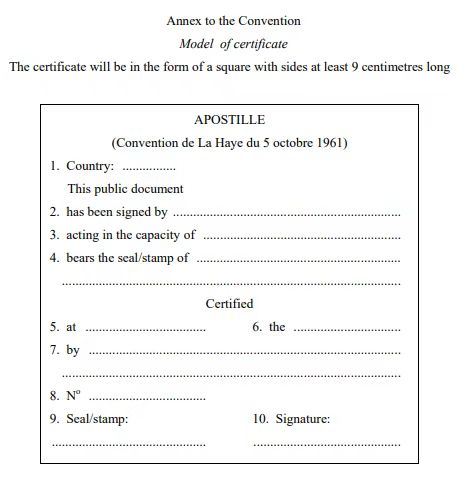
Source: Changning District People's Court