Nation's shipbuilders chart exciting waters
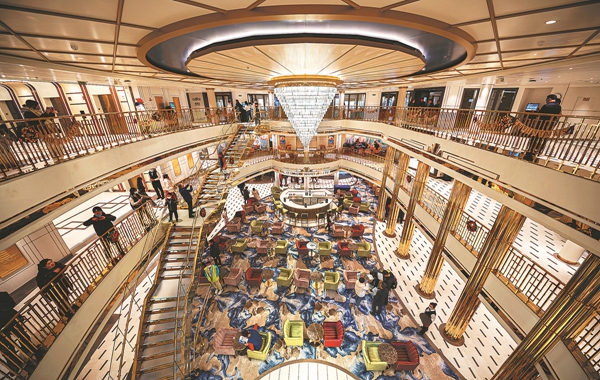
Visitors to the vessel get to know each other in the lounge area. TAO RAN/FOR CHINA DAILY
Deliveries from Chinese constructors account for half the global total
China's first domestically built large cruise ship, Adora Magic City, embarked on its maiden voyage on Jan 1, when it left Shanghai for destinations in Northeast Asia.
The successful delivery and operation of the vessel saw China join countries such as Italy, France, Germany and Finland in designing and building their own cruise ships.
It also signified that China is the only country to have mastered the technology for building an aircraft carrier, a large liquefied natural gas carrier and a large cruise ship.
The nation's shipbuilding industry is now well positioned to develop its cruise industry chain to a level and scale to match such achievements, with experts predicting that China's cruise economy will grow to 500 billion yuan ($71 billion) by 2035.
Xing Yue, general manager at Clarksons Research in China, wrote in a report: "Just five shipyards across the world have the experience of building large cruise ships. China State Shipbuilding Corp, or CSSC, and Shanghai Waigaoqiao Shipbuilding Co's development of Adora Magic City ended the dominance of three European shipyards in building large cruise vessels."
Chen Gang, general manager of Shanghai Waigaoqiao Shipbuilding Co, a unit of CSSC, said constructing a cruise ship is regarded as the "crown jewel" of the shipbuilding industry. Such a gigantic engineering project directly reflects a nation's comprehensive scientific and technological levels and manufacturing strengths, Chen added.
Since China's cruise ship project began in October 2013, some 2.3 million man-hours were devoted to design and 18 million man-hours to construction before Adora Magic City became operational.
The 323.6-meter-long, 37.2-meter-wide vessel houses 55,000 sets of equipment, 25 million components and parts, 4,750 kilometers of cables, 365 km of pipelines and 120 km of air pipes.
The ship, which has a gross tonnage of 135,500 tons, can accommodate a maximum of 5,246 travelers in its 2,125 guest cabins. Equipped with a 40,000-square-meter public living and entertainment area, the vessel is known as a "modern city on the sea".
Chen, who is also chief designer of the shipyard's large cruise ship project, said, "One of our designers, who has worked on air-conditioning systems for ships for most of his life, said that all such systems he has designed comprise less than half of a single cruise ship."
Niklas Peterstam, captain of Adora Magic City, has high expectations for the vessel. He and his crew of about 1,300 from 28 countries will welcome passengers aboard trips that offer a unique maritime experience.
"I think that after many years of growth and development, people in China will love this special kind of vacation. Families will admire this ship because it has so much to offer, especially for women and children," he said.
Boasting a trendy state-of-the-art shopping center that occupies about 2,000 square meters, Adora Magic City boasts the largest duty-free retail space in Chinese waters by partnering with China Duty Free Group.
Since joining the vessel on July 7, Peterstam said he had taken part in two sea trials in July and September, along with two trial voyages with passengers last month, before the vessel's maiden voyage.
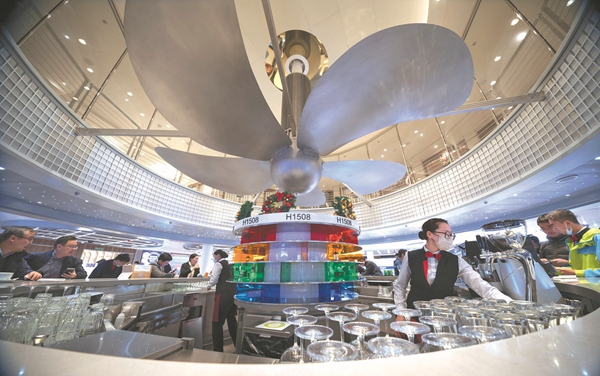
Visitors to the vessel get to know each other in the lounge area. TAO RAN/FOR CHINA DAILY
Deliveries from Chinese constructors account for half the global total
China's first domestically built large cruise ship, Adora Magic City, embarked on its maiden voyage on Monday, when it left Shanghai for destinations in Northeast Asia.
The successful delivery and operation of the vessel saw China join countries such as Italy, France, Germany and Finland in designing and building their own cruise ships.
It also signified that China is the only country to have mastered the technology for building an aircraft carrier, a large liquefied natural gas carrier and a large cruise ship.
The nation's shipbuilding industry is now well positioned to develop its cruise industry chain to a level and scale to match such achievements, with experts predicting that China's cruise economy will grow to 500 billion yuan ($71 billion) by 2035.
Xing Yue, general manager at Clarksons Research in China, wrote in a report: "Just five shipyards across the world have the experience of building large cruise ships. China State Shipbuilding Corp, or CSSC, and Shanghai Waigaoqiao Shipbuilding Co's development of Adora Magic City ended the dominance of three European shipyards in building large cruise vessels."
Chen Gang, general manager of Shanghai Waigaoqiao Shipbuilding Co, a unit of CSSC, said constructing a cruise ship is regarded as the "crown jewel" of the shipbuilding industry. Such a gigantic engineering project directly reflects a nation's comprehensive scientific and technological levels and manufacturing strengths, Chen added.
Since China's cruise ship project began in October 2013, some 2.3 million man-hours were devoted to design and 18 million man-hours to construction before Adora Magic City became operational.
The 323.6-meter-long, 37.2-meter-wide vessel houses 55,000 sets of equipment, 25 million components and parts, 4,750 kilometers of cables, 365 km of pipelines and 120 km of air pipes.
The ship, which has a gross tonnage of 135,500 tons, can accommodate a maximum of 5,246 travelers in its 2,125 guest cabins. Equipped with a 40,000-square-meter public living and entertainment area, the vessel is known as a "modern city on the sea".
Chen, who is also chief designer of the shipyard's large cruise ship project, said, "One of our designers, who has worked on air-conditioning systems for ships for most of his life, said that all such systems he has designed comprise less than half of a single cruise ship."
Niklas Peterstam, captain of Adora Magic City, has high expectations for the vessel. He and his crew of about 1,300 from 28 countries will welcome passengers aboard trips that offer a unique maritime experience.
"I think that after many years of growth and development, people in China will love this special kind of vacation. Families will admire this ship because it has so much to offer, especially for women and children," he said.
Boasting a trendy state-of-the-art shopping center that occupies about 2,000 square meters, Adora Magic City boasts the largest duty-free retail space in Chinese waters by partnering with China Duty Free Group.
Since joining the vessel on July 7, Peterstam said he had taken part in two sea trials in July and September, along with two trial voyages with passengers last month, before the vessel's maiden voyage.
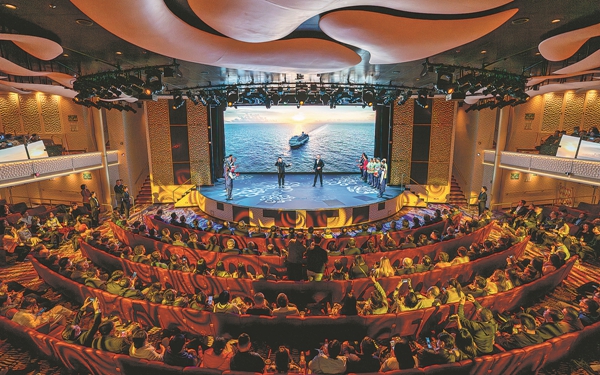
A theater on Adora Magic City provides entertainment. WAN QUAN/FOR CHINA DAILY
Significant results
Xing Wenhua, chairman of the Shanghai Society of Naval Architects and Marine Engineers, said, "The Chinese shipbuilding industry maintained its strong development momentum by outperforming in the three major shipbuilding indicators — contracting, orders, and deliveries — seeing growth across the board and a leading market share."
In recent years, the industry has achieved significant results in its accelerated structural adjustment, transformation and upgrading, Xing said.
The nation's new shipbuilding breakthroughs cover large cruise ships, vessels powered by LNG, methanol and ammonia, high-end marine engineering equipment, ultra-large container ships, pure car and truck carriers, high-end marine fishery equipment, and marine research vessels, Xing added.
Lin Guolong, director of Shanghai Maritime University's Logistics Research Center, said, "These achievements in high-end ships have been made not only in terms of technologies and craftsmanship, but also in winning market recognition." Lin was referring to major Chinese shipbuilders' accomplishments regarding vessels universally recognized as the most difficult to build due to the advanced techniques that are required.
Since delivering Dapeng Sun, the nation's first home-built LNG carrier in April 2008, Hudong-Zhonghua Shipbuilding (Group) Co, a CSSC subsidiary, has developed five generations of LNG carriers.
Securing 37 new orders in 2022, the company, which is based in Shanghai, said at the start of last year that it aimed to double its LNG vessel construction capacity and accelerate research and development throughout the year.
In September, it announced that its self-designed-and-developed LNG carrier, which occupies 271,000 cubic meters and is the world's largest, had received approval in principle certificates from four major classification bodies.
Construction of the vessel showed that Chinese shipbuilders' research and development, design, and manufacturing capabilities were entering a new phase, the company said.
Last year, Jiangnan Shipyard (Group) Co, also a unit of CSSC, completed work on upgrading and technique innovation, as well as accelerating management and production processes.
The company, headquartered in Shanghai, met its manufacturing target for the year more than one month ahead of schedule.
Among the medium- to high-end vessels it delivered, the company's dual fuel VLGC, or very large gas carrier, which can transport up to 93,000 cu m of liquefied gas, is the world's largest of its kind with a competitive edge. The vessel has met the latest emissions regulations and requirements.
Hu Keyi, the company's corporate technology chief, said the delivery of VLGCs has further consolidated its leading position in global VLGC research, development and construction.
"In the past, domestic shipbuilders always seemed to accept the superiority of foreign engineering, manufacturing and managerial prowess, but Jiangnan refused to do so," Hu said.
Lin said, "The benefits of cost efficiency, a complete industrial and supply chain, and constant breakthroughs in key techniques and technologies have seen China come very close to becoming a shipbuilding power."
Data from Clarksons show that in the first 10 months of last year, 1,547 new ship orders amounting to 89.12 million deadweight tonnes were placed globally, with nearly 58 percent of them going to Chinese shipyards.
A total of 4,359 ships comprising 122.58 million CGT are currently on global order books, with Chinese shipyards securing orders for 2,539 vessels comprising 59.34 million CGT.
Lin said China is still at the initial stage of becoming a recognized worldwide shipbuilding power.
To weather the challenges ahead, the nation's shipyards need to be more competitive in their research and development, designs and techniques. They should also pay special attention to nurturing talent, enhancing management and efficiency, and adapting flexibly to market needs in terms of design, production and technique, Lin said.