Foreign shipping firms embrace coastal piggyback services at Shanghai ports
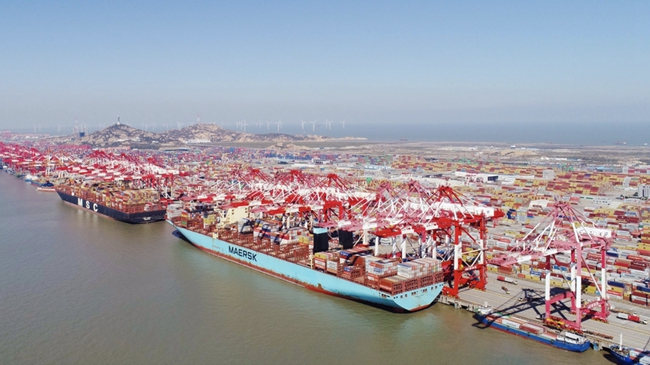
In July, a Maersk container ship docks at the Yangshan port terminal. [Photo by Jiang Jianjun]
Foreign shipping companies are exploring new business ventures at Shanghai's thriving ports, embracing the innovative concept of coastal piggyback services. This innovative service, which was first trialed at Yangshan Port in May 2022, enables international container liner companies from foreign nations and domestic regions, including Hong Kong Special Administrative Region (SAR) and Macau SAR, to efficiently transport domestic trade goods between various Chinese ports using their self-owned or majority-owned vessels.
During the first half of this year, Yangshan Customs processed an impressive total of 7,784 coastal piggyback shipments, totaling to 49,000 TEUs (Twenty-foot Equivalent Units), which represents significant year-on-year growth. This innovative system for global shipping firms not only streamlines trade operations but also reduces logistics costs for both exporters and importers. Additionally, it optimizes the utilization rate of container ships.
Notably, on July 7, a shipment of 20 containers carrying timber was successfully transported from Yangshan Port to Qingdao using this coastal piggyback service. This shipment was transported by the vessel "Yongcheng", which is operated by Pacific International Lines (PIL).
This marked PIL as the third foreign shipping entity authorized to conduct coastal piggyback operations in China, after industry heavyweights Maersk and CMA CGM.
Simultaneously, Shanghai's Waigaoqiao port has emerged as China's premier vehicle import-export hub, according to recent statistics. In the first half of this year, Waigaoqiao Customs oversaw the export of a staggering 613,000 domestically manufactured cars, a 27.7 percent increase compared to the previous year.
With an average of two to three roll-on/roll-off vessels departing daily, the port efficiently dispatches over 3,000 vehicles to more than 100 countries and regions worldwide, firmly establishing itself as China's largest hub for complete vehicle imports and exports.
Source: Shanghai Observer