Shanghai launches advanced container transport service platform
On the morning of Sept 10, Zhang Zhiwen – import department manager of the international freight division of the Shanghai Port Logistics Group – completed an online cargo release document on his computer for a client in just 3-4 minutes.
Many details were automatically generated by the system, eliminating the need for manual input.
"Previously, clients had to fill in detailed information with a pen, send the physical documents to us by express delivery and then we would dispatch personnel to deliver them to the window unit, a process that took at least one to two days," Zhang said.
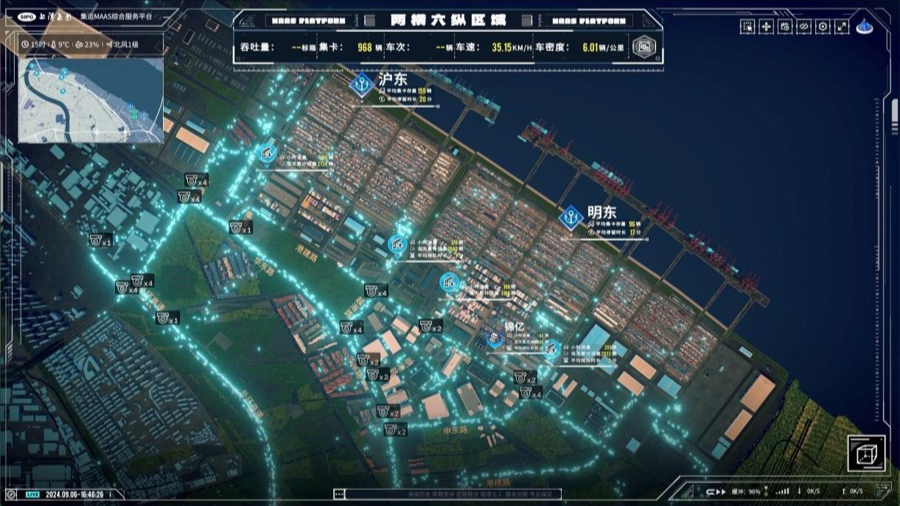
This extraordinary transformation was made possible by the International Container Transport Service Platform – developed by the Shanghai Municipal Transportation Commission and the Shanghai Port Group – which was launched on the same day.
The platform integrates advanced technologies – such as maritime trade blockchain and distributed storage computing – to create a service system that provides for one-stop inquiries, integrated functionality and single-document operations.
"It serves as a comprehensive data integration hub for the transportation system, covering the entire chain of container transport," said Zou Ying, general manager of the technology information department at Shanghai Port Group.
"It is a fully integrated business processing portal, providing digital supply chain services to various business entities," Zhou added.
In addition to saving time through one-stop online services and promoting environmental sustainability, the platform allows stakeholders – including cargo owners, shipping companies, port operators, logistics enterprises and government regulatory agencies – to access real-time information on cargo locations and their status globally.
By logging onto the platform's webpage or downloading the official app, users can track information on cargo movements in various transport modes and stages.
Zou highlighted the fact that the platform's ability to address long-standing industry challenges related to cross-business entity, cross-department and cross-regional data sharing – emphasizing the use of blockchain technology to ensure information security.
"What outsiders see on the system is just a string of code, without revealing specific cargo details," Zou said.
Tian Haiyang, a researcher at the science and technology information department of the Shanghai Municipal Transportation Commission, said that just as Shanghai had one-stop government services in the administrative field, it was now accelerating the development of the metropolis as an international shipping center – necessitating a similar portal platform for its port logistics services.
Tian emphasized that the platform – as a unified public service platform centered on port services – marked a new chapter in the construction of a smart service-oriented port in Shanghai.
The initiative not only advanced data interconnections in the field of container transport, but also contributed to the creation of a more optimized and transparent port-logistics ecosystem – promoting the digital development of the maritime economy and enhancing the capabilities of the shipping center, Tian added.
As the platform continues to evolve, a 2.0 version of the platform is understood to be in the pipeline, with ongoing upgrades aimed at enhancing services and user experiences.
Source: Shanghai Observer