Shanghai surgeon performs landmark robotic kidney surgery in Italy
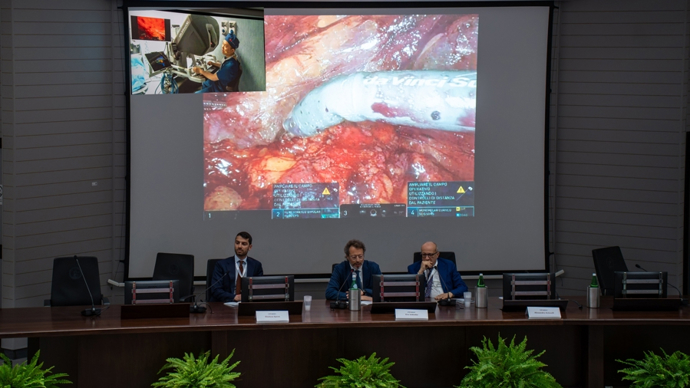
In a live broadcast to international medical experts, a urological surgeon from Shanghai's Changhai Hospital successfully performed a kidney cancer surgery on a 78-year-old patient in Italy using robotic assistance.
The surgery took place on May 16 at the University of Naples Federico Second Hospital and was livestreamed as a demonstration for global experts attending the 2025 Multidisciplinary Diagnosis and Treatment Collaboration Group Conference of the European Association of Urology .
The patient had a tumor located at the renal hilum, a critical zone densely packed with blood vessels, making traditional kidney-sparing surgery highly risky due to the potential for vascular injury.
Earlier this year, Wu successfully performed a similar surgery on an Italian patient during an international conference on urology surgical innovation, receiving wide acclaim from his international peers.
Impressed by his expertise, the Italian medical team invited him back for this recent surgery.
Wu’s team adopted a retroperitoneal robotic approach guided by 3D imaging and AI-powered preoperative simulation, part of Changhai Hospital’s signature protocol that integrates precision surgery with enhanced recovery practices.
Shanghai's Changhai Hospital is renowned for its advanced kidney-preserving techniques in the treatment of kidney cancer.
During the one-hour operation, the team led by Wu successfully removed the tumor while limiting blood flow interruption to just 18 minutes, thereby minimizing damage to the kidney.
The procedure was broadcast live, with Wu providing real-time commentary on key techniques. Experts from various countries engaged in an active discussion on the procedure’s technical details.
Thanks to the minimally invasive approach, the patient was able to eat and walk within hours, and was discharged the next morning.
Source: Shanghai Observer