Shanghai to present innovative eco-restoration solution on global stage
Shanghai is set to showcase its innovative approach to ecological restoration in megacities at the World Conservation Congress in Abu Dhabi in October.
The initiative, centered on the Huangpu River basin, will represent China and highlight Shanghai's unique "nature-based solutions" (NbS) model.
The move follows the establishment of the world's first NbS City Center in Shanghai, located on Fuxing Island, through a partnership between the International Union for Conservation of Nature (IUCN) and the Ministry of Natural Resources of China.
This center will serve as a hub for research, localized practices, and international collaboration on NbS.
Shanghai's NbS project stands out for its comprehensive, city-wide scope, a departure from previous NbS projects that typically focused on an isolated site such as a rainforest or a lake.
Stewart Maginnis, deputy director general of the IUCN, noted that Shanghai has pioneered an integrated approach to ecological restoration within the Huangpu River basin, positioning the city as a global leader in comprehensive ecological governance.
Historically, Shanghai has encountered several ecological challenges, including urban resilience issues, limited high-quality ecological spaces, and the degradation of its unique Jiangnan (region south of the Yangtze River) water town landscape.
To address these issues, Shanghai is taking a holistic approach that focuses on preserving the city's natural assets while implementing targeted restoration measures.
Wu Yan, director of Land Use Implementation at the Shanghai Municipal Bureau of Planning and Natural Resources, explained that Shanghai's ecosystem is shaped by the interaction of four major natural forces: the Yangtze River, Taihu Lake, Hangzhou Bay, and the East China Sea.
The Huangpu River network, vital to Shanghai, forms a large-scale ecological protection and restoration pattern that integrates rivers, lakes, coastal areas, bays, islands, and urban parks.
Current efforts are tailored to the specific needs of different regions within the Huangpu River basin.
In the upstream suburban areas, the focus is on ecological conservation, including identifying and protecting Shanghai's distinctive village landscapes, developing suburban parks, and restoring farmland and greenery on inefficient construction land.
These measures aim to revitalize the water system, protect the traditional Jiangnan polder system, and restore a diverse agricultural-forestry-wetland ecosystem.
The midstream urban areas are undergoing a "re-naturalization" process. Initiatives include the connection of the 42-kilometer waterfront along the Suzhou Creek and the construction of a 45-kilometer continuous ecological corridor along the Huangpu River.
These efforts aim to restore the ecological shoreline and enhance the connectivity of urban ecological corridors.
Additionally, the creation of waterfront wetland buffer zones, such as at the Houtan Wetland Park in the Shanghai Expo Culture Park, and the development of urban habitat gardens in residential areas, schools, and commercial zones promote biodiversity and ecological coexistence.
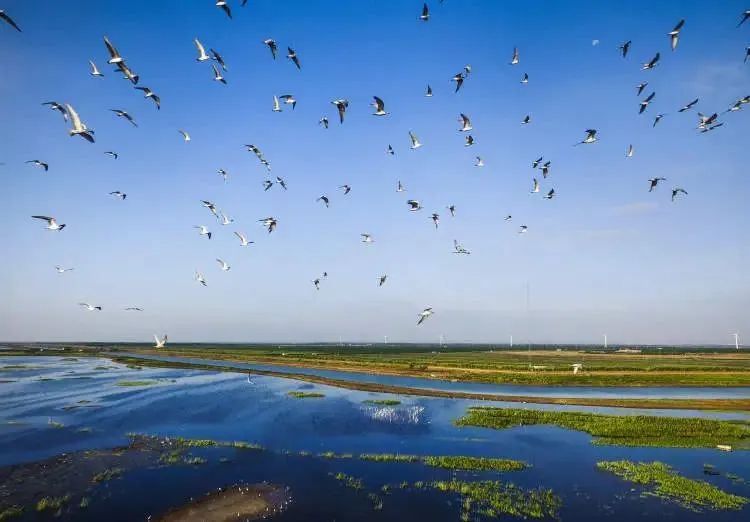
Downstream, along the coast, Shanghai is constructing "resilient ecological dikes" to protect and restore coastal wetlands, enhancing the overall ecological function of the river estuary.
Fuxing Island, situated in the Huangpu River, exemplifies Shanghai's commitment to NbS with plans to establish a 30,000-square-meter wetland purification area and a 10,000-square-meter offshore ecological zone.
Luo Ming, executive deputy director of the NbS Asian Hub, highlighted that Shanghai’s efforts demonstrate the potential for "natural remedies" to address ecological challenges even in densely populated megacities.
The solutions provided by Shanghai are comprehensive and can deal with the complex and intertwined challenges faced by cities, he added.
Source: Jiefang Daily