Advanced deep-sea cable-laying vessel enters service in Shanghai
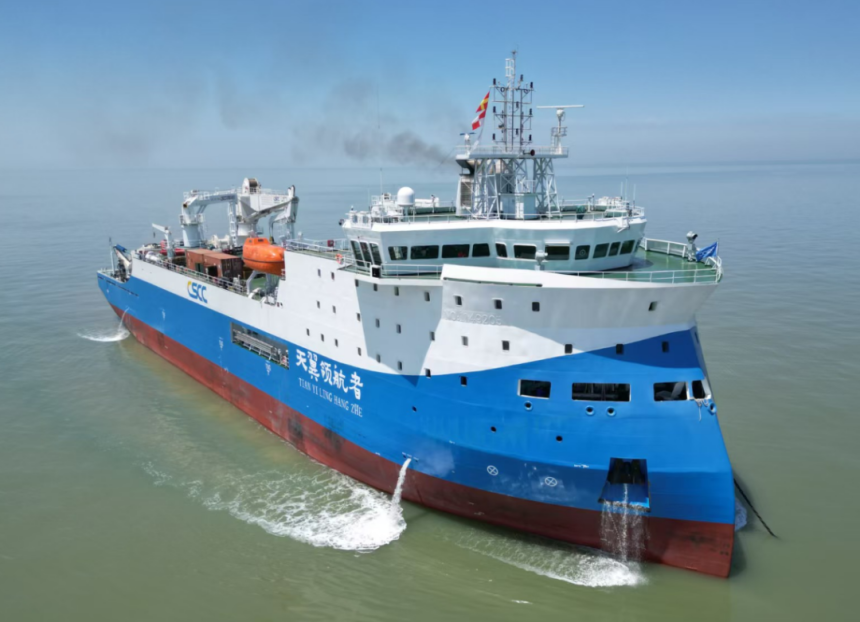
The Tian Yi Ling Hang Zhe, an advanced subsea fiber-optic cable-laying vessel designed for deep-sea operations, has entered service in Shanghai's Chongming district.
Operated by China Submarine Cable Construction, the vessel is designed for unrestricted navigation. It is 115.8 meters in length and 24 meters in width, with a molded depth of 12 meters, a full-load displacement of 18,000 metric tons, and a deadweight capacity of 10,000 tons.
The vessel features an integrated electric propulsion system with a total power supply capacity of 1.3 megawatts. Its dynamic positioning Class 2 system enables high-precision cable burial operations in Sea State 5 conditions.
It is equipped with an advanced cable-laying system, including a linear cable engine with 20 pairs of traction wheels, a 4-meter-diameter drum cable engine, and a deep-water burial plow system. These systems work, with the support of the independently developed control software, to ensure the deep-sea cable installation.
The vessel also carries a company-developed burial plow capable of operating at depths of up to 1,000 meters and burying cables up to 5.5 meters below the seabed, as well as an underwater vehicle rated for operations at depths of up to 5,000 meters.
It features full 5G and wireless network coverage, with quantum encryption and satellite transmission technologies providing secure communications.
An 80-ton active heave-compensated crane at the stern can deploy and recover ocean observation equipment at depths of up to 1,500 meters. The vessel is capable of carrying out the installation, construction, repair, and maintenance of offshore engineering systems worldwide.
Now in service, the vessel will support marine communications network development, subsea engineering projects, and network security, while contributing to the construction of subsea cable systems in international waters.
As a key platform for building transoceanic and deep-sea high-speed data links, it is also expected to support the computing infrastructure required for the growth of the AI industry.
Source: Chongming district data bureau


FAQs
- Do I need a physical marriage certificate when applying for a residence permit for private affairs?
- Do I need to declare my ADHD medication to customs during an airside transit at Shanghai Pudong Airport?
- Is Wusongkou International Cruise Terminal an eligible port under the 240-hr visa-free transit policy?
- What are the customs and quarantine requirements for pets entering or leaving China via Shanghai Pudong airport?