Program helps organize better lives for all
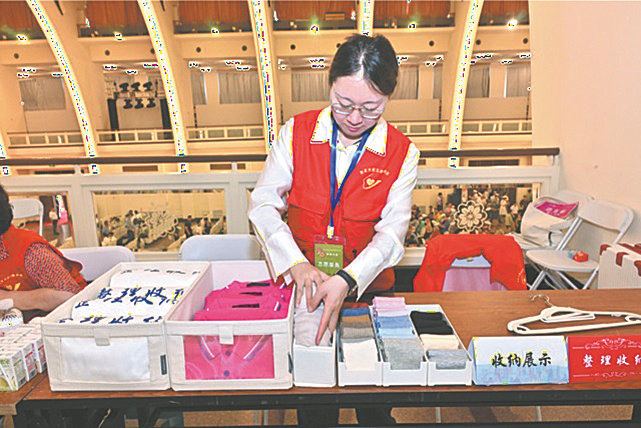
After eight years as a home organizer, An Xiaojiao finally feels her profession is receiving the recognition it deserves.
A graduate of the inaugural Shanghai house stewards program, An took first place in home storage and organization at the 2026 Shanghai women's domestic service vocational skills competition this year. Her salary has risen 10 percent since completing the program.
"Before, I only addressed surface-level behavioral problems with elderly clients. Now I dig into the psychological needs behind those behaviors and match them with targeted professional skills," says An, who works at a local community service development center.
When organizing a home, she no longer simply arranges items but guides clients through decluttering and builds a storage system around their daily habits. "Clients witness how a cluttered home transforms into sustainable order, and they can directly perceive the value of professional service."
The second term of the program launched at the Zhongyuan campus of Shanghai Open University on Aug 8, when over 50 selected workers began a five-month systematic curriculum.
Guided by the Shanghai Municipal Commission of Commerce and led by the university, the initiative aims to elevate Shanghai's domestic service industry to a high-quality level.
Strong outcomes
Last summer, 67 students graduated from the inaugural program. The results were impressive: 85 percent received client commendations and salary increases, 56 percent achieved significant career advancement, and several won municipal vocational awards, according to the university.
Behind these outcomes lies a profound transformation in Shanghai's domestic service sector.
In October 2025, six municipal departments led by the Shanghai Municipal Commission of Commerce issued a three-year action plan to develop employee-based domestic service enterprises. Official data show that the first 16 pilot firms have helped 2,741 people find domestic service jobs, with 97.8 percent holding vocational certificates. Their revenue grew 32 percent year-on-year in the first half of 2026.
Policy support has expanded across multiple dimensions.
Domestic service workers and infant development guides have been added to the city's urgently needed skilled talent list, with skill-upgrading subsidies raised by 30 percent. By this April, 11,774 people obtained domestic service vocational certificates. The government has also built dedicated housing for workers and provides free commercial insurance.
"Domestic work is no longer low-end labor many assume it to be," says Yu Haiqun, president of the Shanghai Home Service Industry Association. Since entering the industry in 2019, he has witnessed three major shifts: increased industry recognition, clearer regulatory responsibilities, and a younger workforce.
"In the future, home care for the elderly and children will implement an occupational access licensing system. Domestic service is a high-end livelihood sector," he says, revealing that Shanghai plans to lead the formulation of unified national standards for the industry.
A well-planned initiative
The second term of the program builds on 13 core modules with new courses in smart home management, medical accompaniment, pet care, and family psychological counseling, aligning with emerging market demands.
"Domestic workers should evolve from being mere helpers to becoming professional family life service specialists," states Jia Wei, dean of Shanghai Open University. He emphasizes that high-end talent must not only possess diverse professional skills but also understand family culture and living habits to help families improve their lives.
"Our first lesson is to 'see the family' — to look beyond housework and recognize the emotional needs and relationship dynamics within a household, allowing them to apply their skills where they are most needed," Jia explains. Trainees learn to identify and bridge emotional gaps in families, transforming from ordinary domestic workers into professional service providers.
The trainee profile has improved significantly.
The average age of the students is 39.8 — 1.2 years younger than the first term — with 42.3 percent holding a bachelor's degree or higher, up 14 percent. Nearly a quarter have over 10 years of experience, and all were chosen through resume screening, psychological testing, written exams, and interviews.
Zhong Wenfeng, a new trainee and former children's art teacher with a degree in fine arts, now works as a child companion.
"Many people don't understand my choice. They think a college graduate is wasting her education in domestic work," Zhong says. "But domestic service is far from just cleaning. I apply my art expertise — teaching children painting and crafts, designing learning spaces, and guiding their cognitive development through art."
All training hours are recorded in the university's credit bank and can be converted into credits for domestic service degree programs. Shanghai Open University is the city's only institution accredited to offer undergraduate degrees in domestic service studies.
Upon graduation, trainees will have access to academic credit pathways and priority hiring at employee-based enterprises. Eligible graduates will be prioritized for the Shanghai high-skilled domestic service talent pool.
"The domestic service industry is a sunrise industry, and more importantly, a heartwarming livelihood cause," says Zhang Jingjing, director of the livelihood service industry development division at the Shanghai Municipal Commission of Commerce.
For An, the professional organizer, the program has meant more than skill upgrading. She now trains new practitioners, researches market demands, and develops standardized service protocols. Her former classmates remain in close contact — some have transitioned into high-end private chefs, while others promote professional services through new media.
"There are no shortcuts in this profession. Short-term experience can only get you through the moment. Continuous learning is what carries us forward," An says. "We have chosen a career related to family happiness. Stand on professionalism, deliver service with warmth, and we will earn society's respect for the domestic service industry."


FAQs
- Do I need a physical marriage certificate when applying for a residence permit for private affairs?
- Do I need to declare my ADHD medication to customs during an airside transit at Shanghai Pudong Airport?
- Is Wusongkou International Cruise Terminal an eligible port under the 240-hr visa-free transit policy?
- What are the customs and quarantine requirements for pets entering or leaving China via Shanghai Pudong airport?