Track-laying begins on Shanghai-Nanjing high-speed railway
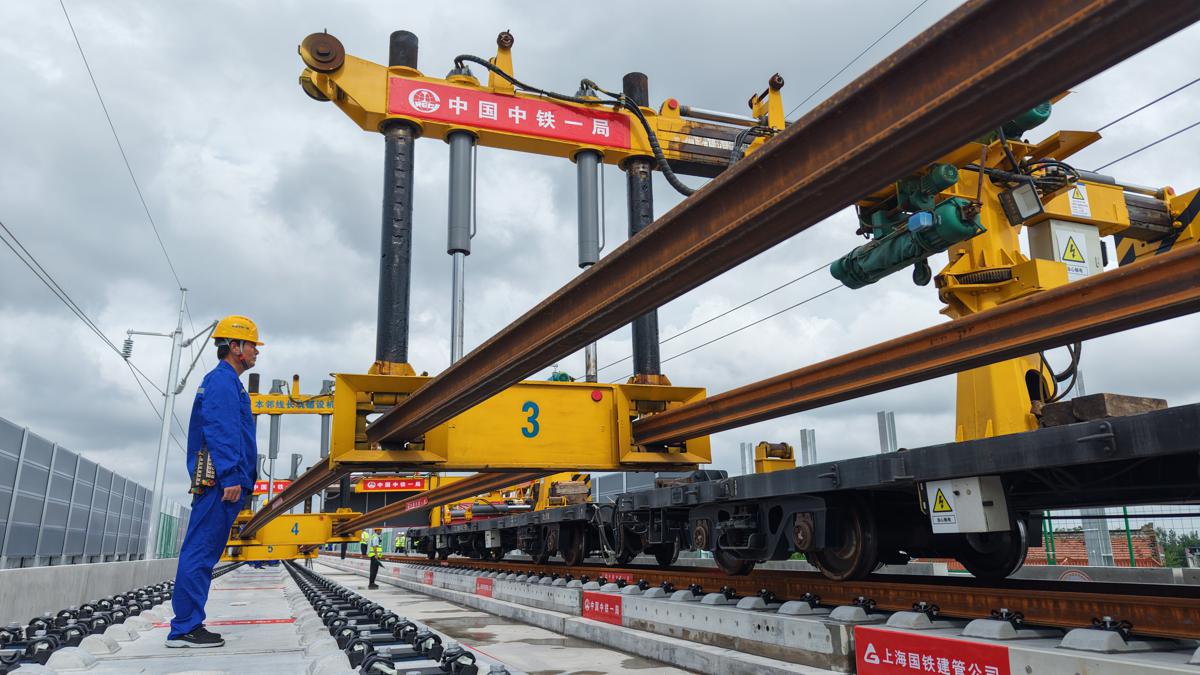
The first rails for the Shanghai-Nanjing section of the Shanghai-Chongqing-Chengdu high-speed railway were laid on Sept 3, marking a milestone for a project designed to further integrate eastern China's economic powerhouse region.
At the Tongtaiyang bridge construction site in Nantong, Jiangsu province, automated rail-laying machines pulled out and positioned the first pair of 500-meter steel rails, marking the start of full-line track installation.
"The commencement of track-laying operations lays a solid foundation for completing installation along the entire corridor," said Song Ming, track-laying manager of the project from China Railway First Group Co.
Spanning 422.9 kilometers with a designed speed of 350 kilometers per hour, the line will serve as a vital link along the Yangtze River corridor within China's "eight vertical and eight horizontal" high-speed rail network.
Starting at the newly built Shanghai Baoshan Railway Station, the line will pass through Suzhou, Nantong, Taizhou, and Yangzhou in Jiangsu province before terminating at Nanjing North Railway Station. It will have 12 stations in total.
To enhance efficiency, an intelligent, multifunctional dual-line rail-laying system has been deployed, allowing two tracks to be laid simultaneously without requiring equipment to return or switch lines.
"Previously, using traditional single-line track-laying equipment, a single crew could lay around 4 kilometers per day," Song said.
"Now, with the dual-line system, a single crew can complete 9 kilometers per day, while significantly reducing the number of process steps and labor intensity."
To coordinate complex, concurrent operations, teams are using cloud-based tracking and transit management systems. These platforms monitor equipment around the clock, providing real-time dispatching and early warnings to maintain safety and keep the project on schedule.
Construction crews are also leveraging green and smart technologies, including high-power electric rail vehicles, energy-storage mobile welding units, robotic bolt fasteners, and eco-friendly rail cutters.
Once operational, the high-speed line will ease heavy passenger traffic along the Yangtze River corridor and divert some Shanghai-bound traffic from existing coastal and Beijing-Shanghai routes.
Source: China Daily


FAQs
- Do I need a physical marriage certificate when applying for a residence permit for private affairs?
- Do I need to declare my ADHD medication to customs during an airside transit at Shanghai Pudong Airport?
- Is Wusongkou International Cruise Terminal an eligible port under the 240-hr visa-free transit policy?
- What are the customs and quarantine requirements for pets entering or leaving China via Shanghai Pudong airport?