Integrated shipping model streamlines cargo flows through Shanghai ports
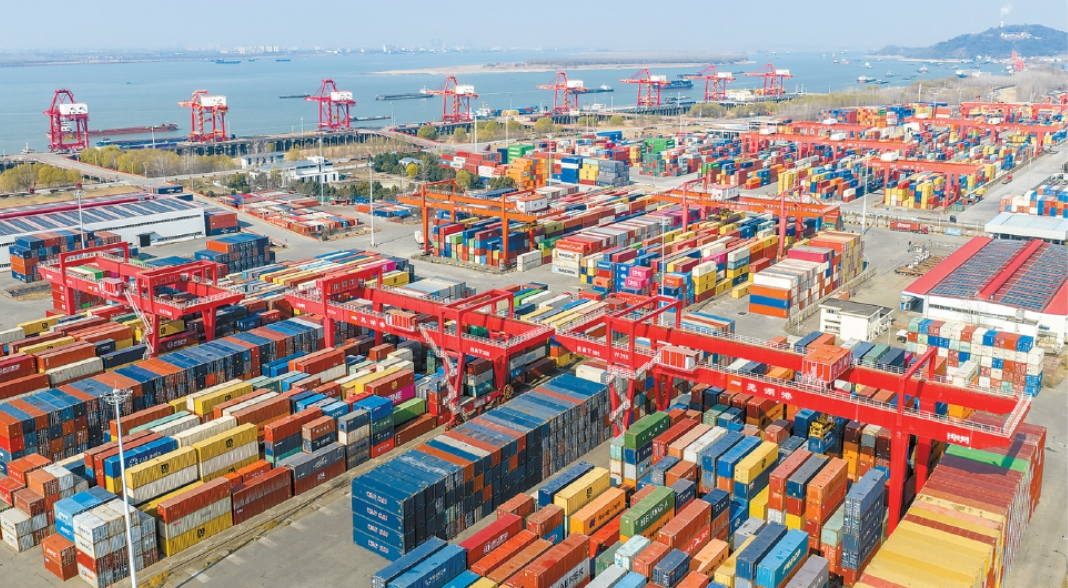
The vessel Jianghaitong 188 recently departed Zhujiaqiao Terminal at Wuhu Port in Anhui province, carrying containers bound for overseas markets. Two days later, the cargo arrived at Shanghai's Yangshan Port, where it was directly transferred to an ocean-going vessel for Europe without undergoing additional customs transit declarations.
The shipment marked Anhui's first water-to-water multimodal export shipment under the new system.
Previously, cargo exported from Wuhu via Yangshan Port had to complete customs declarations both at the departure port and again at the exit port in Shanghai. Under the new process, companies complete the entire set of procedures at the point of origin or entry, enabling a single declaration, a single document throughout the journey, and seamless transport.
The new models, known as the "single document" and "single container" systems, are gradually being introduced at more ports across the Yangtze River Delta region. The initiative represents both an innovation in shipping management and an important step toward deeper regional integration and a more unified national market.
Data connectivity
The new system relies on cross-regional data connectivity among customs, maritime, and other authorities. Once digital platforms are linked, departments in different regions can share information, allowing identical data to be transmitted automatically and eliminating repeated submissions by companies.
Before cargo departs Wuhu, businesses complete declarations for multimodal transport in advance, essentially obtaining a "through ticket" for the shipment. The document contains full logistics information.
Companies submit the information through the China International Trade Single Window, where the system automatically fills in the required forms, reducing manual procedures. When the cargo reaches Shanghai, companies only need to complete vessel transfer procedures before the containers continue their journey overseas.
The model has already been applied to exports of lithium batteries, photovoltaic products, and electric vehicles. In July 2024, the first "single container" intermodal shipment involving these goods was completed.
Electric vehicles are classified as Class 9 dangerous goods in maritime transport, which previously required multiple hazardous cargo declarations at different ports during cross-regional shipments.
Through data connectivity and mutual regulatory recognition between maritime authorities in Shanghai and Jiangsu province, approval information submitted in one region can now be shared with another, eliminating repeated declarations.
As a result, the time required to move electric vehicles from inland cities to ports has been reduced from five or six days to two or three days, while logistics costs have dropped by about 15 percent.
In 2025, the "single document" and "single container" model for water-to-water transport of dangerous cargo between Nanjing Port and Shanghai Port expanded beyond the "new trio" product categories to cover additional categories of dangerous cargo, including Classes 3, 6.1, 8, and 9.
At the same time, the "single document" and "single container" model has begun expanding from the YRD region to ports along the Yangtze River.
Integrated port supervision
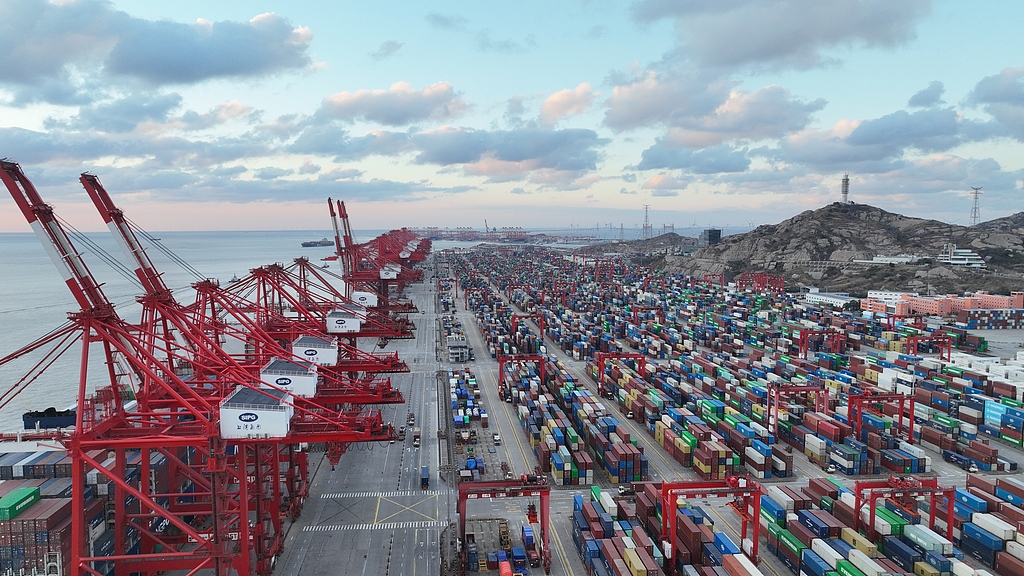
The YRD region has introduced a joint unloading system, a coordinated supervision mechanism that allows inland ports and seaports to operate under an integrated customs clearance system.
The model was first launched between Yangshan Port in Shanghai and Taicang Port in Jiangsu province in 2020, and has since expanded across the region.
In July 2025, the first shipment under this model between Haining Port in Jiaxing, Zhejiang province, and Yangshan Port was completed, marking a further expansion of the model to 15 ports in the region.
Under traditional water-to-water transshipment procedures, cargo had to undergo separate declarations, release procedures, and transit formalities at both ports. Under the new system, Haining Port is treated as an extension of Yangshan Port, allowing the two ports to operate under integrated supervision.
Imported cargo can complete customs clearance at Yangshan Port and be transported by barge to Haining Port for direct pickup. Export cargo can complete customs declaration at the local port and be transferred to Yangshan Port by barge for direct loading onto international vessels.
With the model, cargo now undergoes one declaration, one inspection, and one release. Each imported container can save about 200 yuan ($29) in transport costs, while export containers can save about 400 yuan, and transport time is roughly half that of road transport.
Source: Jiefang Daily