Largest exhibition of ancient American artifacts opens in Shanghai
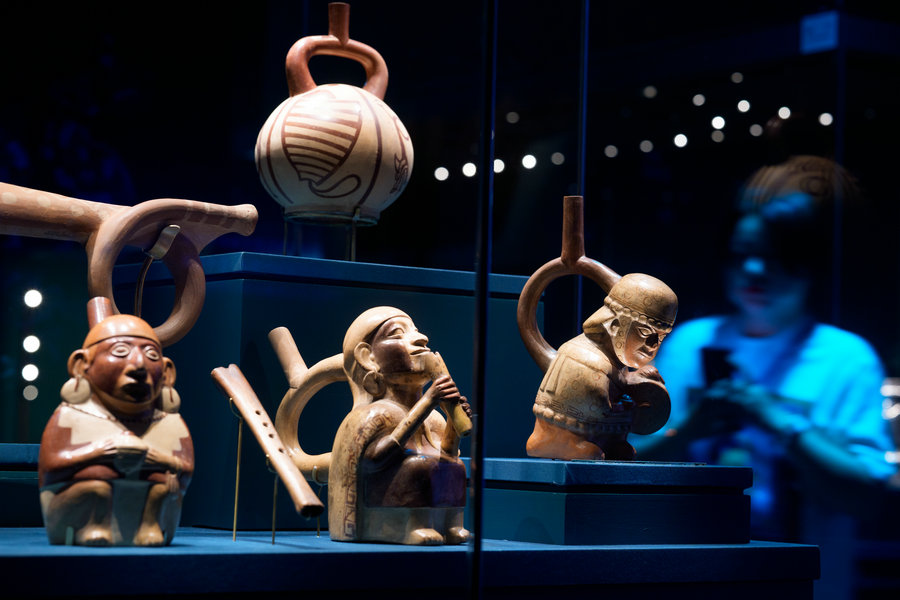
Shanghai Museum celebrated the opening of its highly anticipated exhibition, On Top of the World Tree: Ancient Civilizations of the Americas, on July 8. Hailed as the world's largest and most comprehensive presentation of ancient American civilizations, the exhibition runs from July 9 to Nov 14, 2027, and showcases nearly 3,000 artifacts from Mexico and Peru.
Antonio Saborit Garcia Pena, the director of Mexico's National Museum of Anthropology, previewed the exhibition before its public opening. He commended the curatorial choice to include Chinese artifacts among the displays, calling it a "fantastic idea," and pointed out the notable formal similarities between Chinese and Mesoamerican cultures.
Juan Manuel Garibay Lopez, the national coordinator of museums and exhibitions at Mexico's National Institute of Anthropology and History, described the project as a monumental effort by the Shanghai Museum to deepen public understanding of Mesoamerican civilizations.
"I hope Chinese audiences will situate Mesoamerica in time and draw comparisons with their own cultural history," he said. "To understand another culture is to understand ourselves — which is very important today."
For Shanghai Museum Director Chu Xiaobo, the exhibition marks an unprecedented effort to interpret Mesoamerican civilizations through a distinctly Chinese lens. It is the sixth installment in the museum's A Dialogue with the World series, which prioritizes partnerships with countries where civilizations originated.
"Many leading Western museums hold extraordinary collections of American artifacts," Chu noted. "Rather than borrowing from them, we chose to work directly with the source nations. As heirs to an ancient civilization, we believe this approach better honors the dignity and ownership of the original cultures."
Ge Yun, a member of the curatorial team, highlighted the growing role of Chinese scholarship in Mesoamerican studies. Although European and Japanese institutions entered the field earlier, Chinese archaeologists have been catching up since 2015, when researchers from the Chinese Academy of Social Sciences participated in excavations in Honduras.
Participating in fieldwork in Mesoamerica indicates a change, as Ge noted. "China is transitioning from merely receiving knowledge to actively creating global archaeological stories — stories that are influenced not just by research but also by how we present, organize, and communicate them to the public."
Source: China Daily


FAQs
- Can a service dog transit through Shanghai Pudong Airport without quarantine?
- Is there a mandatory retirement age for a foreign employee in Shanghai?
- Where to ask about applying for a student visa to Japan in Shanghai?
- How do I apply for a new residence permit when transferring to a university in Shanghai?