China Scholastic Competency Assessment preparation guide

Dear students,
The application season for the 2026 Chinese Government Scholarship undergraduate programs is approaching, and the first global sitting of the China Scholastic Competency Assessment (CSCA) began on Dec 21, 2025.
As the second round of the exam, scheduled for Jan 25, draws near, it is natural to feel nervous or under pressure. To support you during this important time, we have prepared a concise preparation guide with practical advice to help you approach the CSCA with confidence and clarity.
Know what you will be tested on
1. Exam subject combination
Different majors have different subject requirements. Be sure to review the official enrollment guidelines issued by your target universities in advance.
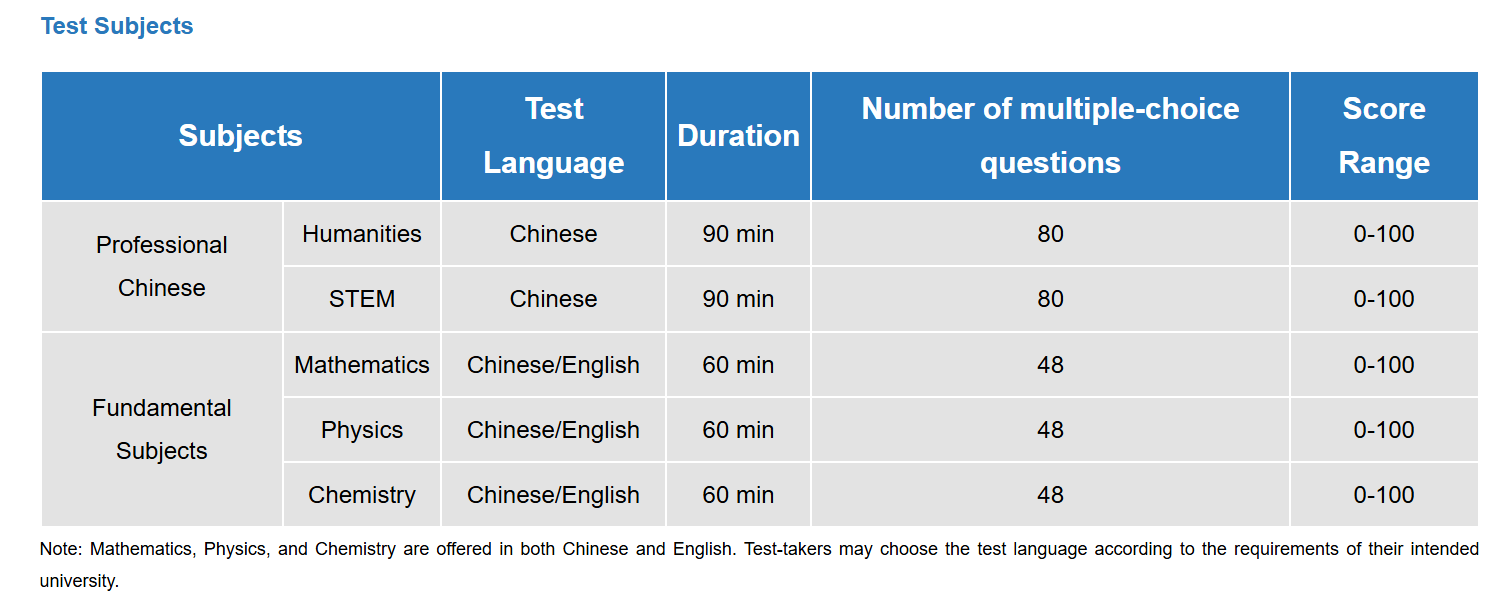
- Mathematics (Mandatory): A compulsory subject for all applicants to undergraduate programs.
- Professional Chinese: Required for students planning to pursue undergraduate programs taught in Chinese. Candidates may choose between Humanities Chinese or STEM Chinese according to their intended major.
- Physics or Chemistry (Optional): Applicants to science-related majors, including engineering, computer science, agriculture, and medicine, must choose at least one of these two subjects.
2. Test structure and format
The CSCA mainly consists of multiple-choice objective questions.
Below are the test details:
Utilize official resources for effective preparation
1. Your "preparation command center"
(1)Information hub: The official CSCA website is the authoritative platform for all exam-related information. Bookmark it to access key materials, including the latest exam syllabus, registration notices, policy updates, and official answers to frequently asked questions.
(2)Application portal: The Study in China website serves as the core service platform for the Chinese Government Scholarship and accessing official information about universities in China. Familiarize yourself with the site in advance to learn about the application process.
2. Your preparation "core map"
Download the exam syllabus for your required subjects from the CSCA website. The syllabus forms the foundation of your entire review plan. Study it in depth to ensure your preparation aligns with the official requirements.
Plan your review in advance
1. Make a preparation calendar
Based on the exam date, divide your remaining review time into three phases, with clear objectives for each phase:
- Foundation stage: Systematically cover all knowledge points outlined in the exam syllabus. Ensure you understand the core concepts and principles to build a solid foundation.
- Intensification stage: Focus on practicing questions and target weak areas. At this stage, begin timed practice sessions to improve accuracy and speed.
- Sprint stage: Take full-length mock exams according to the official test schedule. These will help you manage pacing and question sequence. After each mock exam, review your performance against the syllabus and error log to identify and address any remaining gaps.
Pro tip: Record your phased preparation tasks in a planner or digital calendar. For example, mark "begin timed practice" three weeks before the exam and "full-length mock exam" one week before the test, making your plan clear and easy to track.
2. Expand your learning channels
- Teaching others: Explaining concepts to others is one of the best ways to learn. Join a study group to find CSCA partners and schedule regular weekly sessions to discuss challenging problems and explain knowledge points to each other. Teaching others helps reinforce and clarify your own knowledge.
- Leverage online resources: If a particular concept is challenging through self-study, try to make use of high-quality online courses. Search for teaching videos related to high school-level Chinese Mathematics, Physics, Chemistry, or Chinese on online education platforms or video websites. Different teachers' explanations may offer new insights and help solidify your understanding.
3. Establish a cycle of "Understanding – Practice – Reflection"
- Master fundamentals: The CSCA focuses on assessing foundational academic abilities. Prioritize understanding core concepts, formulas, and theorems over rote memorization.
- Use an error log: Your error log is a powerful tool for improving scores. Regularly analyze your mistakes to identify the root cause — was it a lack of conceptual understanding, carelessness, or an incorrect approach? Through reflection, you can avoid making the same mistakes on the actual exam.
We hope this guide helps you prepare effectively for the CSCA. Wishing you success on the test and in securing an admission offer from your desired university!
Sources: Official WeChat account of China Scholarship Council (ID: "gh_afaa09c3e5f3"), official website of CSCA