AI opens new pathways in eldercare
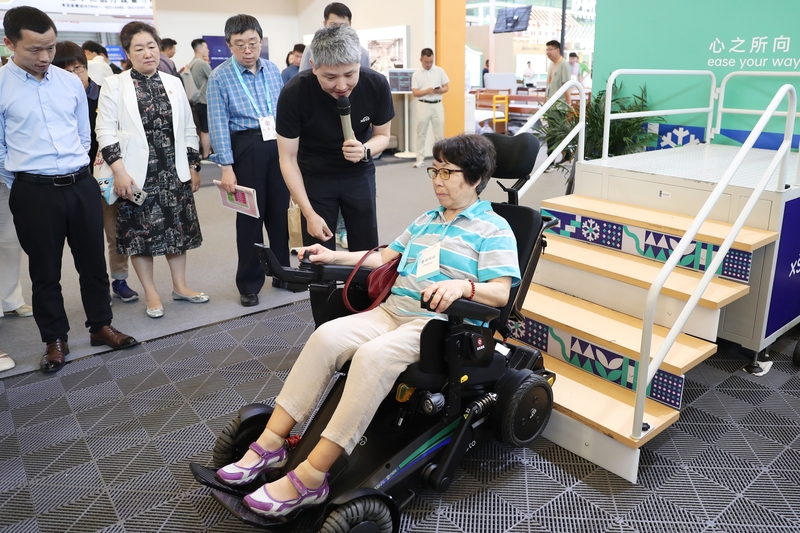
China's silver consumption is rapidly shifting from basic subsistence spending to quality-oriented enjoyment consumption, a prominent industrial trend fully demonstrated at the International Exhibition of Senior Care, Rehabilitation Medicine and Healthcare Shanghai 2026 (AID 2026).
With 323 million people aged 60 and above nationwide — 23 percent of the total population, and with 37.6 percent of Shanghai's registered population over 60, demand for smarter, safer senior care products is surging. AI-powered domestic devices are leading the industry's comprehensive upgrade, driven by technological advances and robust supply chains.
The expo — held from June 4 to 6 — showcased unprecedented AI penetration in senior care products. A host of newly launched intelligent mobility devices have become exhibition highlights.
Sweetrich's newly launched M6 radar intelligent mobility wheelchair, equipped with dual LiDAR sensors and reverse imaging systems, can automatically brake and steer to avoid barriers, adapting to narrow household spaces and crowded supermarket scenarios.
Ageronx's new omnidirectional wheelchair features 12-inch large omnidirectional wheels and an automatic locking system that activates when users stand up, preventing accidental injuries. Priced at around 10,000 yuan ($1,475), the model will be upgraded with self-developed AI obstacle-avoidance radar, according to Zhu Peng, the group's project manager.
AI exoskeletons and all-terrain robots are addressing critical mobility challenges in elevator-less older residential communities.
RoboCT operations manager Li Chongxuan said its late-2025 AI walking exoskeleton delivers adaptive uphill assistance and downhill buffering via embedded terrain-recognition chips. Built with lightweight, breathable materials, it has been in high demand since its launch.
The Xsto X13 embodied mobile robot, another star exhibit, switches to track mode to navigate 35 cm narrow passages, climb stairs and traverse rough terrain. Xsto Deputy General Manager Huang Zhou said the first batch sold out instantly after its April launch.
Beyond mobility devices, premium rehabilitation equipment is fueling quality senior consumption growth.
For the first time, the expo launched a dedicated silver economy finance zone, where major financial institutions including ICBC, CCB and Shanghai Trust showcased elderly-oriented services such as eldercare trusts and voluntary guardianship programs, enhancing senior wealth management and rights protection.
As China's most aged megacity, Shanghai is building a full-cycle care system via talent training, policy incentives and scenario optimization. In May 2026, Shanghai included community nursing stations in hospice care training for the first time, a key shift from institutional to home-based care, said Zhu Jingwei, Shanghai Open University non-degree education director.
Shanghai aims to train 800 hospice care professionals in 2026 and has cultivated over 30,000 senior care workers since 2024, while developing industry standards. The city offers a 100,000-yuan one-time subsidy for elderly tech scenarios, with 122 smart senior care homes already operational.
The city's first physical silver products store, operational for more than five months, fills the gap of offline elderly consumption scenarios, with a single-day sales peak of 80,000 yuan.
At the concurrent 2026 AID Silver Industry Innovation and Development Conference, renowned economic observer Qin Shuo noted that the shift of silver consumption from subsistence-oriented to enjoyment-oriented has become the core growth driver of China's booming silver economy.


FAQs
- Do I need a physical marriage certificate when applying for a residence permit for private affairs?
- Do I need to declare my ADHD medication to customs during an airside transit at Shanghai Pudong Airport?
- Is Wusongkou International Cruise Terminal an eligible port under the 240-hr visa-free transit policy?
- What are the customs and quarantine requirements for pets entering or leaving China via Shanghai Pudong airport?