Leave policies for employees in Shanghai
If you're an employee in Shanghai, you might have questions regarding leave policies, such as:
- Which holidays are employees entitled to, and how are their salaries calculated?
- Are new hires entitled to annual leave during their first year of employment?
- Are weekends included in annual leave?
- Are employees on irregular work hours entitled to annual leave?
- What if specific holidays for specific groups fall on a weekend?
Here are the answers from the Shanghai Municipal Human Resources and Social Security Bureau to these frequently asked questions.
1. Which holidays are employees entitled to, and how are their salaries calculated?
Case:
David, a recent graduate, began his job at a chemical company in November 2025. Recently, he found an article detailing the 2026 overtime pay calendar for statutory holidays, including the holidays and rules for overtime pay. Enthusiastic about the nine-day Spring Festival break in 2026, he considered which holidays employees in Shanghai would observe.
Answer:
(1) Public holidays for all employees:
- New Year's Day:
Three days off: Jan 1 (Thursday) to Jan 3 (Saturday)
Workday: Jan 4 (Sunday)
- Spring Festival:
Nine days off: Feb 15 (Sunday) to Feb 23 (7th day of Chinese New Year, Monday)
Workdays: Feb 14 (Saturday), Feb 28 (Saturday)
- Qingming Festival:
Three days off: April 4 (Saturday) to April 6 (Monday)
- China's Labor Day:
Five days off: May 1 (Friday) to May 5 (Tuesday)
Workday: May 9 (Saturday)
- Dragon Boat Festival:
Three days off: June 19 (Friday) to June 21 (Sunday)
- Mid-Autumn Festival:
Three days off: Sept 25 (Friday) to Sept 27 (Sunday)
- National Day:
Seven days off: Oct 1 (Thursday) to Oct 7 (Wednesday)
Workdays: Sept 20 (Sunday), Oct 10 (Saturday)
(2) Annual leave system:
Employees who have worked for more than one year are entitled to paid annual leave. Employees with a cumulative tenure of more than one year but less than 10 years are entitled to 5 days of annual leave.
Those who have worked for more than 10 years but less than 20 are entitled to 10 days of annual leave.
Those who have worked for more than 20 years are entitled to 15 days of annual leave. National statutory holidays and weekends are not included in the annual leave entitlement.
(3) Other statutory leaves:
These types of leave are granted when specific eligibility criteria are met.
- Sick leave and medical treatment period
The medical treatment period is calculated and accumulated from the first day of sick leave. It is generally based on the average monthly working days calculated under national rules: an employee taking 20.67 consecutive or cumulative days of sick leave is considered to have used one month of the medical treatment period. This does not include China's statutory holidays and weekends.
Click here to learn more about sick leave and the medical treatment period.
Employees in Shanghai who are on sick leave due to illness or non-work-related injuries are entitled to wages based on the number of continuous years they have worked at the company.
Click here to learn how to calculate sick pay.
- Marriage leave
When a couple gets married, they are granted 1 to 3 days of leave.
Click here to learn more about the rules for salary during marriage leave.
- Maternity leave, childbirth leave, and breastfeeding leave for female employees
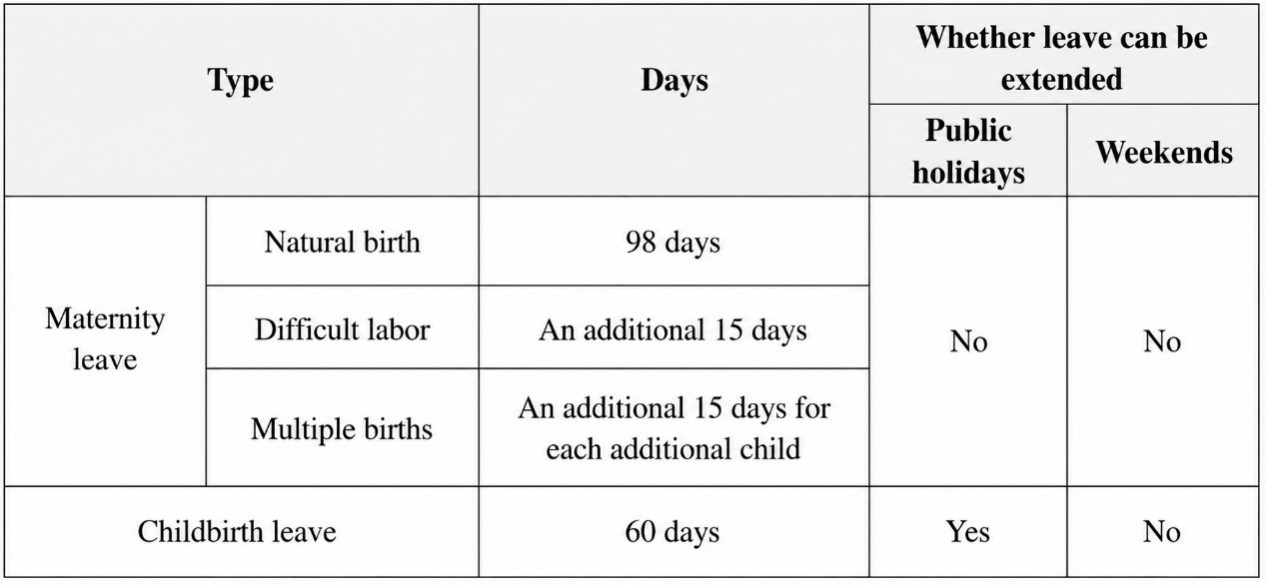
Under Shanghai's family planning regulations, for couples who give birth in accordance with China's laws and regulations, the mother, in addition to the national maternity leave of 98 days, may take an additional 60 days of childbirth leave, for a total of 158 days.
If the birth involves dystocia (difficult labor), an additional 15 days are granted. For multiple births, an additional 15 days are granted for each additional child.
After maternity leave ends, if a female employee faces difficulties and work arrangements permit, she may apply for 6.5 months of breastfeeding leave, subject to her employer's approval.
Employers are required to pay female employees on breastfeeding leave at least 80 percent of their wage income before the leave. Employees on breastfeeding leave are not required to work.
Q: How to apply for maternity leave social insurance subsidies?
- Prenatal leave
Prenatal leave is a statutory benefit for female employees in China. In general, a female employee who is more than seven months pregnant and meets any of the following conditions is entitled to two and a half months of prenatal leave:
- The employee applies for the leave, and the employer approves it based on work arrangements.
- A medical institution at or above the secondary level certifies that the employee has conditions that may affect normal childbirth, such as a history of habitual miscarriage, severe pregnancy syndromes, or pregnancy complications. The employee then applies for leave.
- Paternity leave for male employees
In Shanghai, for a couple who gives birth in accordance with laws and regulations, the father is entitled to 10 days of paternity leave, regardless of whether it is their first or second child.
Paternity leave must be taken continuously during the mother's maternity leave. The leave includes weekends but excludes public holidays. If a public holiday falls during paternity leave, the leave will be extended accordingly.
During paternity leave, the employee is entitled to receive his full salary.
Q: Are maternity leave, paternity leave, and marriage leave extended when overlapping with public holidays?
- Caregiver leave
The caregiver leave system has been recently revised in accordance with Shanghai's regulations on protecting the rights and interests of older adults, which came into effect on November 1, 2025.
Shanghai's regulations stipulate that when an older adult is hospitalized for medical treatment, their caregivers are eligible for up to five working days of leave per year.
Under relevant laws and the Civil Code of the People's Republic of China, a caregiver is the elderly's children and others legally obligated to provide support.
The applicant must have a legal duty of care for the elderly. The elderly must be 60 or older and formally admitted to a medical institution for continuous inpatient treatment. Outpatient observation, emergency observation, and other non-hospitalized conditions do not qualify for caregiver leave.
- Compassionate leave
When the employee's immediate family members (parents, spouse, and children) pass away, the employer may, at its discretion and depending on the specific situation, grant one to three days of compassionate leave.
- Work stoppage leave
If you're injured at work or diagnosed with an occupational disease, you may qualify for work stoppage leave, a paid leave to focus on medical treatment and recovery.
This leave generally lasts up to 12 months. In severe or exceptional cases, it can be extended by another 12 months, provided a municipal-level labor assessment committee approves the extension.
The leave typically begins on the date of the work-related injury. Your healthcare provider's recommendations determine the exact duration and must be confirmed by the labor authority.
- Additionally, travel leave may be granted based on the distance of the journey.
2. Are new hires entitled to annual leave in their first year of employment?
Case:
Nancy, a recent university graduate, started working at a cosmetics company in September. As the year ended, she planned to take two days of annual leave to visit her family during the New Year holiday. However, the company informed her that employees who have not completed 12 consecutive months of employment are not eligible for paid annual leave, and any leave taken would be unpaid personal leave. Is Nancy entitled to paid annual leave during her first year of employment?
Answer:
No, an employee must complete at least one year of continuous employment to qualify for paid annual leave. Since Nancy has not met this criterion, she will be eligible only after her second year with the company.
Annual leave entitlement is calculated as follows (fractions of less than one full day are not counted):
(Remaining calendar days in the year at the company ÷ 365 days) × Total annual leave days entitled for the year
For example, if Nancy starts work on Sept 1, 2025, and completes one year of service on Aug 31, 2026, her 2026 entitlement will be prorated. After Aug 31, 2026, there will be 122 calendar days remaining in the year, and Nancy is entitled to five annual leave days for the year. Based on the calculation:
(122 ÷ 365) × 5 = 1.67 days, which should be rounded down to one day of annual leave for 2026.
3. Are weekends included in annual leave?
Case:
Mike, a recent university graduate, joined a catering company. In the company's policies, he noticed a clause that read: "Annual leave includes weekends." This confused him because weekends are already rest days. Are weekends included in annual leave?
Answer:
No. Regular weekends are not included in annual leave. According to the Regulations on Paid Annual Leave for Employees:
- Employees with one to 10 years of service are entitled to five days of annual leave.
- Employees with 10 to 20 years of service are entitled to 10 days of annual leave.
- Employees with more than 20 years of service are entitled to 15 days of annual leave.
Statutory holidays and rest days, including weekends, are not counted toward annual leave. Therefore, the company's practice lacks legal basis.
Other leaves not counted as annual leave:
Under the Regulations on Paid Annual Leave for Employees, statutory leaves, including family visit leave, marriage leave, bereavement leave, maternity leave, and work-related injury leave, do not count toward annual leave.
4. Are employees on irregular working hours entitled to annual leave?
Case:
Edward recently joined a clothing company as a salesperson. During onboarding, the company informed him that his role operates under an irregular working hours system, and, according to the company's policy, employees in such roles are not entitled to annual leave. Is the company's statement correct?
Answer:
Incorrect. According to the Regulations on Paid Annual Leave for Employees, employees are not entitled to annual leave in the current year under any of the following circumstances:
- Employees who are entitled to statutory winter or summer vacation, and whose vacation duration exceeds the annual leave entitlement.
- Employees who have taken personal leave for a cumulative total of 20 days or more, and the employer has not deducted their wages in accordance with regulations.
- Employees with cumulative work experience of one to 10 years who have taken sick leave for a cumulative total of more than two months.
- Employees with 10 to 20 years of cumulative work experience who have taken sick leave for a cumulative total of more than three months.
- Employees with cumulative work experience of more than 20 years who have taken sick leave for a cumulative total of more than four months.
Additionally, Chinese labor laws require employers to provide adequate rest and leave rights to employees with irregular or long working hours. This might involve scheduled work and rest periods, shift changes, or flexible hours adapted to employees’ health and needs.
In summary, employees working irregular hours should not be denied annual leave. If they meet the eligibility criteria, they have the right to take it. Therefore, Edward continues to be entitled to annual leave.
5. What if specific holidays for specific groups fall on a weekend?
Case:
Jane worked at an information technology company. She noticed that Women's Day falls on a Sunday and that China's Youth Day, which falls on May 4, coincides with China's Labor Day holiday. Are there make-up days for these holidays if they fall on weekends?
Answer:
No. According to the latest national holiday arrangements, holidays for specific groups of employees include:
- Women's Day (March 8): Half-day leave for women
- China's Youth Day (May 4): Half-day leave for youth aged between 14 and 28
If these holidays fall on a weekend, no make-up leave days are provided.
We hope this guide answers your questions and helps you make the most of your career in Shanghai.
Disclaimer: This article is for general reference only and does not constitute legal advice. For specific cases, please consult the competent authorities or a qualified legal professional.
Sources: Shanghai Municipal Human Resources and Social Security Bureau; Shanghai Observer; sgst.cn/foreign; gov.cn; rsj.sh.gov.cn
Updated July 29, 2026